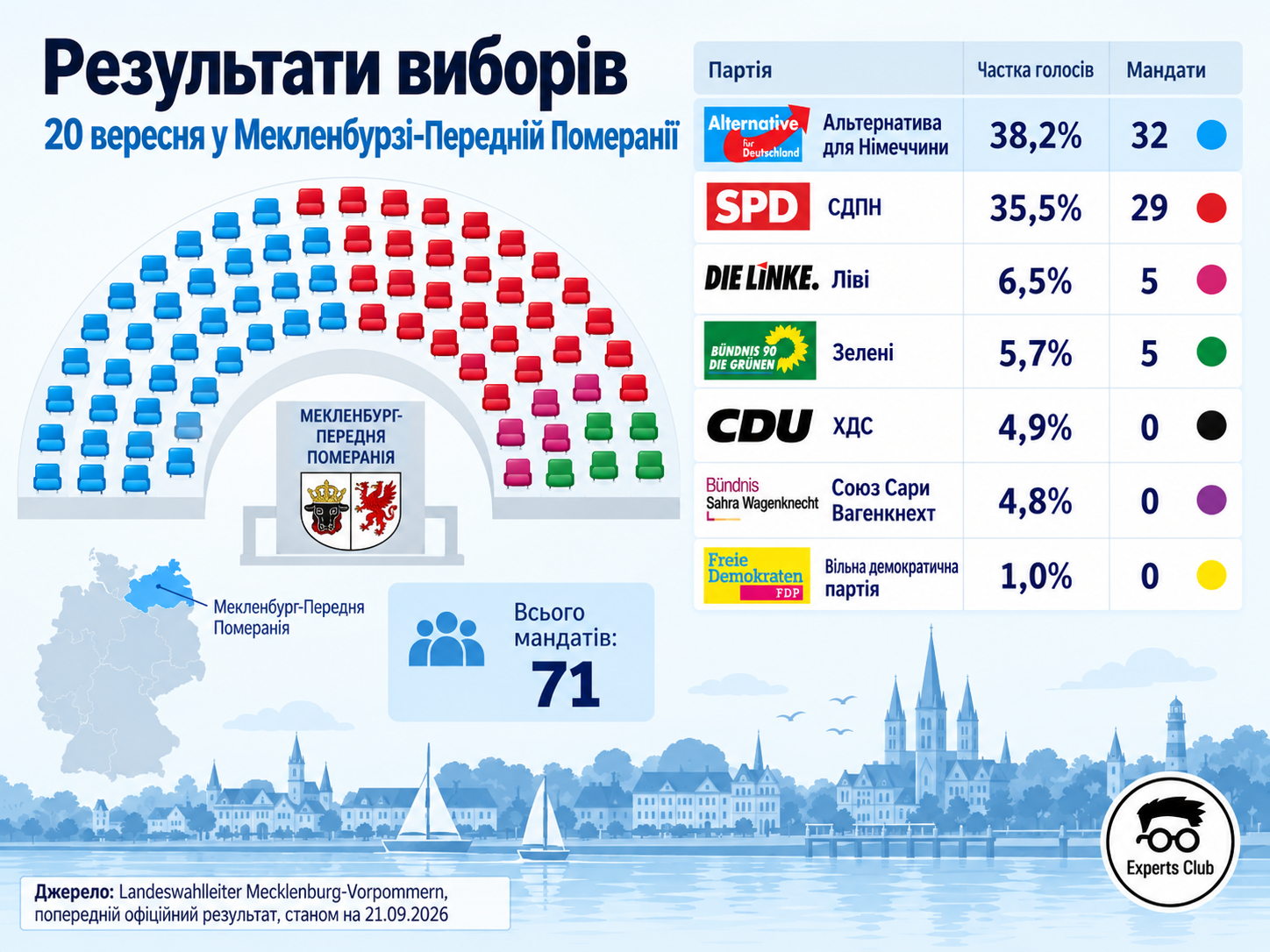
In the new Landtag, AdN gets 32 seats, SPD - 29, Left and "Greens" - five Since the other parliamentary parties exclude the coalition with AdN, the SPD, the Left and the Greens have a mathematical majority - together 39 out of 71 mandates. Thus, AdN's first place in the elections in itself does not mean the transfer of executive power to this party.
For the CDU, the result is historic. In the previous elections, the party received 13.3%, that is, it lost more than eight percentage points in five years. It is also the CDU's worst result in any state election in Germany since 1949.
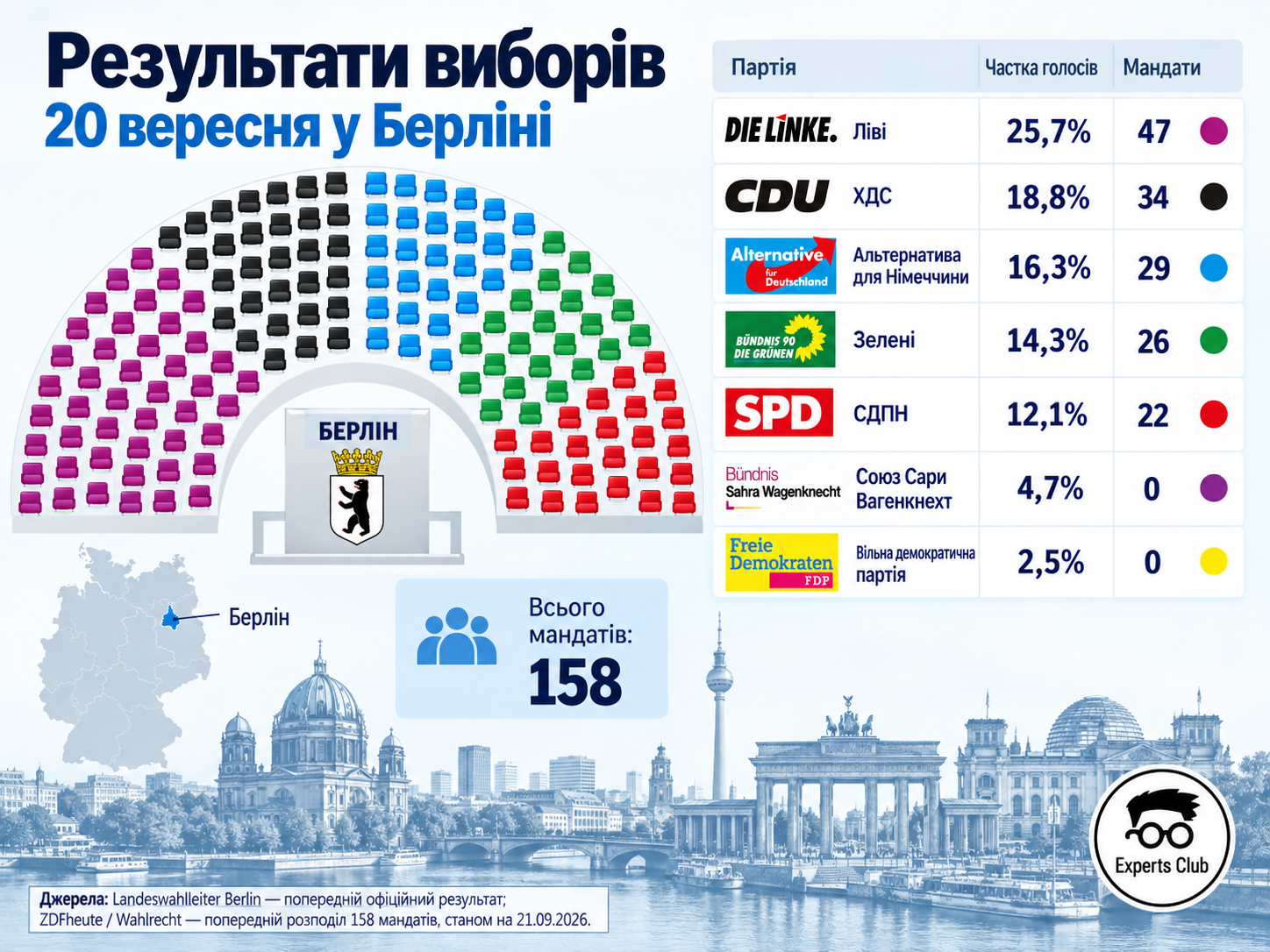
At the same time, there was a political shift at the opposite end of the spectrum in Berlin. According to the preliminary official results of the Land Election Administration, the Left received 25.7% of the vote, more than doubling the result of 2023 — 12.2%.
The CDU took second place with 18.8% against 28.2% in the previous election. AdN received 16.3%, "Greens" - 14.3%, SPD - 12.1%. For the Social Democrats, this is the worst result in the entire history of the elections to the Berlin parliament. BSW gained 4.7%, VDP - 2.5%. The turnout was 74.2%.
The current Berlin coalition of CDU and SPD lost its majority. Among the possible parliamentary configurations, the German mass media mentions the alliance of the Left, the Greens, and the SPD, as well as the option of a coalition of the CDU, the Greens, and the Social Democrats. The negotiations are just beginning, so it is still premature to talk about the composition of the future Berlin government.
The Experts Club draws attention to the fact that the results of September 20 are not an isolated episode. Just two weeks earlier, on September 6, the AdN won the election in Saxony-Anhalt with a record 43.8%, while the CDU won 17.2%. In 2021, the situation was practically the opposite: CDU had 37.1%, AdN - 20.8%.
Thus, the three September campaigns show a noticeable redistribution of votes. In two East German states, AdN took first place, while in the country's largest metropolis, the Left won. At the same time, the parties of the traditional center — primarily the CDU and SPD — lost support in most cases.
The Infratest dimap analysis allows us to partially explain the mechanism of this change.
In Mecklenburg-Western Pomerania, AdN attracted, according to a preliminary estimate, about 66,000 voters who had not voted before, about 48,000 former voters of SPD and about 32,000. former supporters of the CDU. The party has increased support in almost all age and professional groups.
At the same time, the SPD managed to avoid a more serious fall thanks to the personal rating of Manuela Schwezig. Almost half of those who voted for the Social Democrats told researchers that they would not have voted for the SPD without it. This shows that the regional factor and the popularity of a specific candidate can partially compensate for the negative attitude towards the party at the federal level.
The loss of a traditionally strong position in economic policy is a particularly worrying indicator for the CDU. Only 13% of the surveyed voters of Mecklenburg-Vorpommern considered the CDU to be the party most capable of solving economic problems. According to the ARD/Infratest dimap, this is the lowest indicator of the CDU's economic competence recorded in a regional election in Germany.
Furthermore, 89% of respondents said that the CDU promised a lot before the federal election, but delivered little. Among voters who did not vote for the CDU, 28% said they would consider voting for the party if Friedrich Merz had not been chancellor. Such data cannot be directly transferred to the whole of Germany, since the survey was conducted among voters of one federal state, but they show the scale of the problem in the northeast of the country.
Berlin demonstrated a different pattern of discontent. The main factor in the success of the Left was the housing policy. The party built the campaign around the cost of rent, the shortage of affordable housing and the idea of tightening control over large property owners. According to German and international media, rents in Berlin have almost doubled since 2014, and the city itself will need around 211,000 additional apartments by 2040.
This explains an important difference between Berlin and the eastern countryside. In Berlin, AdN also significantly improved the result — from 9.1% to 16.3%, but did not become the dominant party. Infratest dimap studies show that here her strongest topics remain migration and crime, while the housing issue helped to mobilize young urban voters around the Left.
According to the Experts Club, it would therefore be simplistic to interpret the September results solely as "Germany's turn to the right". Another conclusion seems more accurate - the space of the traditional party center is shrinking, and dissatisfied voters in various social and regional environments are moving to various alternative political forces.
In the eastern federal states, the AdN became the main beneficiary of this process, while Berlin shows the possibility of a similar protest mobilization in favor of the Left.
This conclusion coincides with the assessments of the German ARD, which after the elections noted the strengthening of parties on the fringes. of the political spectrum with the simultaneous loss of support from the parties of the center. According to Infratest dimap, the AdN in Mecklenburg-Vorpommern and the Left in Berlin were able to mobilize a significant number of those who had not voted before, as well as attract voters from traditional parties.
The results of the regional elections correspond to the overall federal dynamics. In the September ARD-DeutschlandTrend, conducted by Infratest dimap from August 31 to September 2, AdN was supported by 27% of those polled, the CDU/CSU union - 21%, the Greens - 15%, the SPD - 13%, the Left - 12%. The survey covered 1,319 German voters and has the usual statistical margin of error for such studies.
The economic background also remains difficult, although the situation is not unequivocally a crisis. Ifo raised its 2026 German GDP growth forecast to 1.4% in September, but expects inflation at 2.8%, unemployment around 6.3% and a further slowdown to 1.2% in 2027 and 0.8% in 2028. The Institute notes the pressure of high energy prices and the continued weakness of private consumption.
On September 21, the Bundesbank also reported that the growth of the German economy slowed down in the summer, and inflation reached 2.9% in August. Fuel and energy prices have become a particularly sensitive political factor. The average cost of fuel reached record levels earlier in September, which forced the government to discuss additional measures to support the population.
Thus, electoral discontent develops against the background of a combination of several factors: the cost of living, energy, migration, housing, the assessment of the work of the federal government and specific regional problems. It would be incorrect to explain the results with one factor or to automatically transfer the results of the eastern states to the whole of Germany.
For Chancellor Friedrich Mertz, the results of the vote became a serious political challenge. Mertz himself called the result of the CDU in Mecklenburg-Vorpommern a "disaster", but stated that he intends to keep the positions of chancellor and party chairman and continue the program of economic reforms.
On September 21, the presidium and the federal board of the CDU began discussing the election results. The deputy head of the party, Karin Prin, said that the CDU needs to better listen to the problems of citizens and show more empathy, but advocated the continuation of the main political course. Other representatives of the management have also publicly spoken against an immediate personal discussion about Mertz's replacement.
At the same time, the discussion of potential successors is indeed present in the German media. The prime minister of North Rhine-Westphalia, Hendrik Wüst, the prime minister of Hesse, Boris Rhein, the leader of the CSU and the head of Bavaria, Markus Zeder, and the federal minister of the interior, Alexander Dobrindt, are among the possible figures. However, none of them officially announced their intention to demand Mertz's resignation.
Moreover, on September 16, all eight CDU state prime ministers, including Wüst and Rhine, made a joint statement in support of the chancellor and against the premature personnel discussion. Therefore, at this stage, it is more correct to talk about the growth of internal party pressure on Mertz, and not about the procedure for his replacement, which has already begun.
For Ukraine, the results of the German regional elections are important primarily as an indicator of changes in the internal political space of the largest EU economy. The state elections themselves do not directly change the composition of the federal government or Berlin's foreign policy decisions. However, the growth of parties that are critical of certain areas of current German policy increases the importance of the internal debate on issues of budget spending, energy, migration and foreign policy.
According to the Experts Club assessment, the main result of the September elections is not so much the success of one specific party, but rather the acceleration of the fragmentation of the German party system. The formation of regional governments increasingly requires three-party coalitions, as the electoral support of forces with which other parliamentary parties refuse to form coalitions is simultaneously increasing.
This increases the role of personal ratings of regional politicians, specific socio-economic topics and the ability of parties to mobilize previously passive voters. Mecklenburg-Vorpommern showed how strong the effect of federal discontent can be in regional elections, while Berlin demonstrated that the same discontent can lead to completely different political choices depending on the structure of local issues.
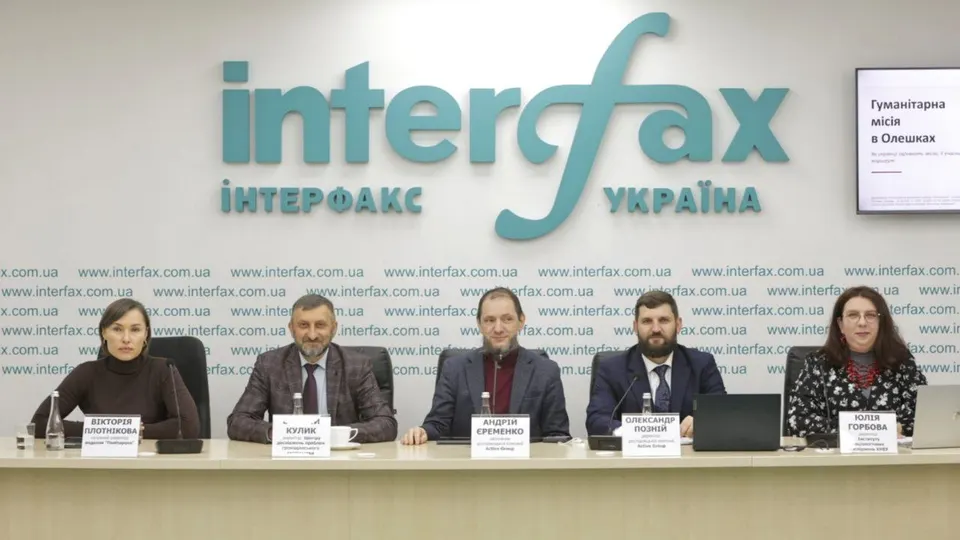
“These elections do not show a linear movement of German society in one ideological direction, but the fragmentation of the electorate. In Mecklenburg-Vorpommern, the protest is concentrated around AdN, in Berlin, the Left became the main recipient of the protest and young urban voice. That is, the common denominator is not ideology, but the decline in the ability of traditional parties to retain different groups of voters within the former model of the political center," said sociologist, co-founder of the Active Group research company Oleksandr Pozniy.
For a sociologist, the mobilization of former non-voters is especially revealing. When parties start receiving tens of thousands of votes from people who previously did not participate in elections at all, this means expanding their electoral field, and not a simple redistribution within the permanent electorate. At the same time, the results of Manuela Schwezig show that a strong personal policy at the regional level can significantly separate the rating of a regional politician from the rating of his party at the federal level. For the CDU, the key problem is not only the result of 4.9%, but the drop in trust in its traditional competence in the economy. If the party is perceived by voters as a force that promised economic changes, it is not was able to quickly demonstrate their results, the protest is beginning to move to political competitors. Therefore, the next months will be primarily a struggle for the restoration of trust, and not only for a change in the personal composition of the leadership." September 21 at 03:33. The final results will be approved after the statutory verification of protocols.