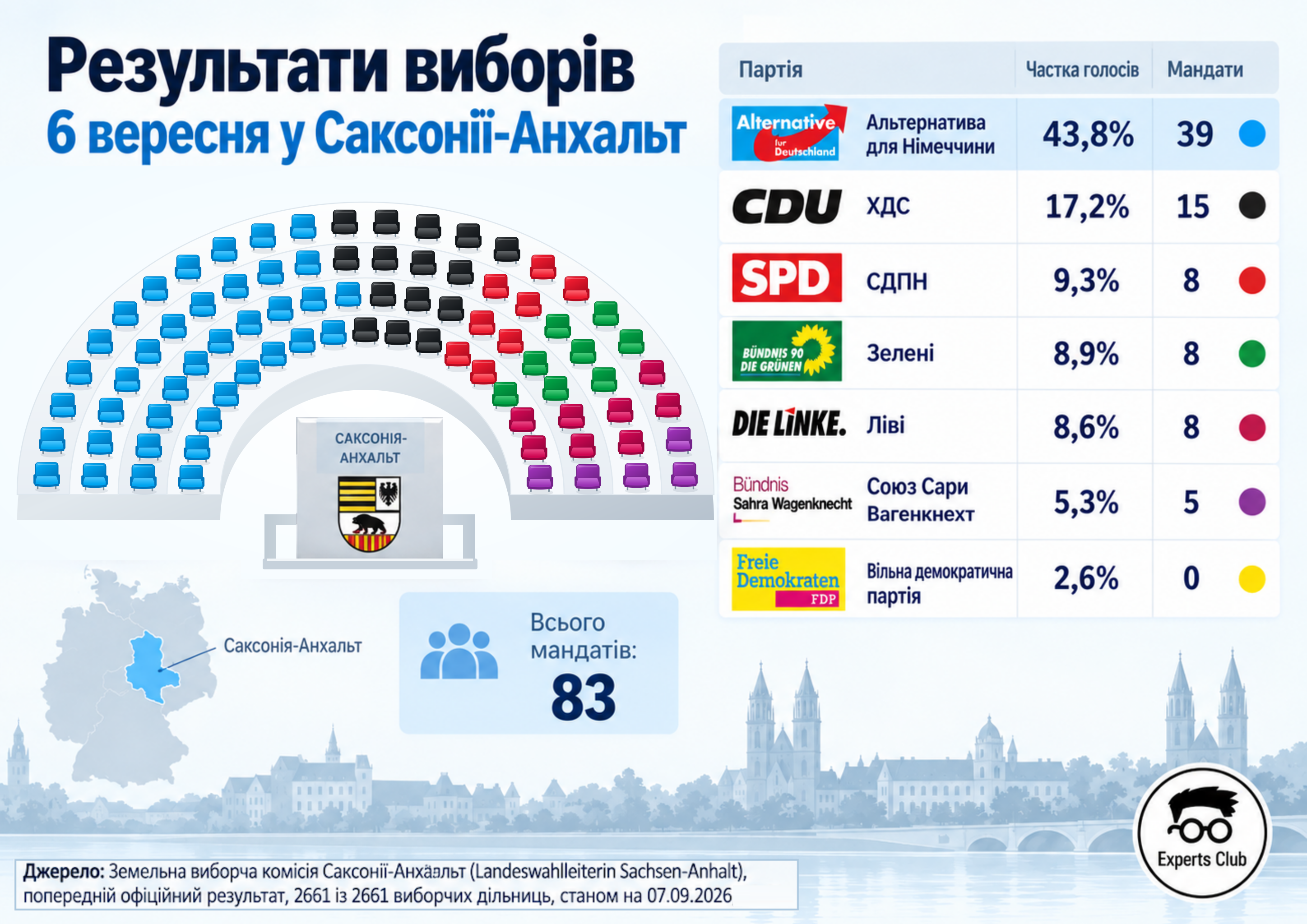
42 deputies are needed to create a majority. Compared to 2021, the AfD gained 23 percentage points, while the CDU lost 19.9 points, from 37.1% to 17.2%. At the same time, the turnout increased from 60.3% to 77.8%. According to estimates of vote transfers provided by Deutschlandfunk, the AfD attracted approximately 170,000 Germans who did not vote in the previous election, and attracted 83,000 people who previously supported the CDU. So, the party won primarily thanks to the mobilization of the local electorate.
The key to the formation of the government is now held by five deputies of the "Sarah Wagenknecht Alliance" (BSW). The simplest arithmetic demonstrates the complexity of the configuration of possible coalitions:
Option | Mandates | Value |
|---|
AfD + BSW | 44 | Enough for the majority |
CDU + SPD + "Greens" | 31 | No majority |
CDU + SPD + "Greens" + "Lefts" | 39 | Parity with AfD |
All five parties except AfD | 44 | The majority is possible with the participation or support of BSW |
AfD + CDU | 54 | Arithmetically possible, but politically CDU rejects cooperation |
There are no agreements on any of these options yet. A stable majority without the AfD requires the cooperation of five parties at once, some of which can support the prime minister and the budget while remaining outside the government. The AfD's most obvious partner is the Sara Wagenknecht Alliance: both forces oppose the sanctions policy against Russia and criticize support for Ukraine. Representatives of BSW in the country declared readiness for talks and cooperation in certain areas. However, as of September 7, there remains a significant distance between the willingness to negotiate and the agreement to elect Ulrich Sigmund as prime minister. BSW proposed a supra-party head of government and stated that it did not want to elect either Sigmund or CDU candidate Sven Schulze.
CDU, SPD, "Greens" and "Lefts" reject cooperation with AfD. Therefore, its shortest path to power is a coalition with the BSW or its support for a minority government. The obstacle is Sigmund's reluctance to make programmatic compromises; the AfD's federal leadership is showing more flexibility. AfD also appealed to some conservative MPs for support. The secret ballot leaves room for deviation from the party line, but there is currently no confirmed group of defectors from the CDU. According to Article 65 of the land constitution, 42 votes are required in the first two rounds of the election of the prime minister. The second round is held within seven days after the unsuccessful first round. If there is no result, within the next 14 days the parliament decides on the issue of early termination of its powers. If the dissolution is not supported, a third round takes place, where a majority of the votes cast is sufficient; abstentions are not taken into account.
Here is an important detail: abstention of the entire BSW alone does not guarantee AfD victory. If Sigmund receives 39 votes and the agreed candidate of the other four parties also receives 39, there will be a tie. Under such a configuration, even one vote or the abstention of one of the rivals can be decisive. The election of the prime minister also does not ensure automatic support for the budget and laws. The new Landtag must convene by October 6; there is no final deadline for the election of the prime minister. Until the transfer of power, the Schulze government continues to perform its duties. The AfD cannot call re-elections on its own.
Even if it remains in the opposition, the AfD will have a significant influence. Its 39 deputies can block changes to the land constitution, which require two-thirds of the members — at least 56 votes. The other parties together have only 44. This gives the party institutional influence independent of ministerial portfolios.
An AfD government would gain powers over education, culture, police, land administration, regional infrastructure and the budget. Land authorities also enforce much of the federal law. Personnel and financial decisions can change everyday practice, but are limited by the Basic Law, federal regulations, EU law and judicial review.
"AfD's victory in Saxony-Anhalt increases political uncertainty in Germany and creates risks for Ukraine on several levels. The regional government has limited ability to directly change the state's foreign policy, but receives administrative resources, representation in the Bundesrat, and much greater public weight. Through these tools, the party can influence the German-wide debate about sanctions, military spending, and even support for Ukrainians. This influence becomes especially noticeable when, when the federal coalition loses the trust of the voters and is forced to look for ways to restore support," says Maksym Urakin, the founder of the Experts Club information and analytical center.
The regional branch of the AfD has been classified by the local constitutional protection service as a reliable right-wing extremist organization since 2023. The party denies this assessment, because it does not mean a court ban on its activities. The program of the AfD itself envisages changes in the activities of this service, so the possible control of the party over the relevant administration creates a conflict of interests.
The AfD proposes to direct cultural funding to the affirmation of German identity and limit inclusive education. For Ukrainians living in Saxony-Anhalt, decisions regarding language support, integration projects, and public organizations will be of primary importance.
Articles 32 and 73 of the Basic Law attribute foreign relations and defense to the competence of the federation. A country can develop international contacts in its spheres, and enter into relevant treaties with the consent of the federal government. It cannot change Germany's alliance commitments on its own. Magdeburg cannot withdraw Germany from NATO or the Eurozone, cancel federal arms export permits or EU sanctions. However, the official status will make it possible to hold meetings with Russian representatives and promote initiatives against Berlin's course.
The federal channel of influence will be the Bundesrat, the representative body of the state governments. Saxony-Anhalt has four out of 69 votes; the ordinary majority is 35. The votes of the land are cast as a single block. AfD's influence on them will depend on the composition of the new government and the procedure for agreeing on its position. Four votes can be decisive in a close result, but an independent veto is not given. Blocking laws that require the consent of the Bundesrat will require allies in other states. Its influence can be particularly noticeable in matters of land finance, administrative duties or the costs of receiving refugees.
The federal budget has a different mechanism, during its formation the Bundesrat can initiate a conciliation procedure and state objections, which the Bundestag (lower house) is able to overcome. Therefore, the version that Saxony-Anhalt will now be able to single-handedly block German military allocations to Ukraine does not correspond to the structure of the budget process.
"For Ukraine, the course of easing sanctions and resuming broad economic cooperation with Russia poses a double risk. It may increase Moscow's available resources and at the same time weaken the willingness of European partners to finance Ukrainian resilience. It is especially dangerous if short-term savings are evaluated separately from long-term security costs. Prolonged instability in Europe affects investment decisions, insurance, logistics and public finances, so these consequences should also be part of the economic calculation", - Maksym Urakin notes.
Faster consequences are possible for the support of Ukrainians inside the land itself. AfD's regional program includes initiatives to reduce social benefits to Ukrainians, prepare for their return, and refuse to recognize them as war refugees at the federal level. At the same time, the party proposes to restore contacts with Russia. Note that temporary protection is determined by European and federal regulations. In July 2026, the EU states agreed to extend it until March 4, 2028. Earth cannot cancel this mode on its own. The real risk is the narrowing of additional regional support and the complication of administrative practice.
The land government cannot legally introduce a general political ban on cargo transit for Ukraine either. However, large-scale transportation, road safety, traffic coordination and civil security require the cooperation of various agencies. The Bundeswehr reports on the federation's agreements with the states to simplify the approval of military convoys. A less constructive and hostile administration is potentially capable of creating delays, additional costs or disputes over individual procedures. This is a possible scenario. In addition, paragraph 35 of the German Road Traffic Regulations establishes special rights for the Bundeswehr and, under certain conditions, for the Allied Forces and their engaged carriers. There are also special arrangements for NATO troops. Their application depends on the type of transportation and the legal conditions.
A political ban on federal defense activities would go beyond the jurisdiction of the land and could become the subject of litigation. The Land government also does not control all German rail and air logistics.
There is military infrastructure in the region. It is important to distinguish between Bundeswehr institutions, multinational programs and NATO command structures.
Publicly known military facilities on the territory of Saxony-Anhalt.
Object | Earth | Confirmed Role |
|---|
Army Combat Training Center in Gardelegen/Letzlingen | Saxony-Anhalt | Bundeswehr Large Training Center |
Klitz training ground | Saxony-Anhalt | Bundeswehr documented training of Ukrainian Leopard 1 A5 crews with Danish instructors |
Logistics Regiment #1 and Battalion #171 in Bursa | Saxony-Anhalt | Bundeswehr Military Logistics and Supply |
Airport Leipzig/Halle | Saxony | Base of operations of the SALIS strategic airlift program with Antonov aircraft |
NCO School in Delich | Saxony | Training of military personnel; The Bundeswehr also reported on the training of Ukrainian servicemen |
Different mechanisms of assistance to Ukraine should not be confused. EUMAM Ukraine is an educational mission of the European Union in which Germany plays a significant role. NATO has a separate NSATU command in Wiesbaden, in the state of Hesse, which coordinates supplies and training, and the PURL mechanism provides for the purchase by partners of the American weapons needed by Ukraine with NATO coordination. None of these structures are subordinate to the government of Saxony-Anhalt.
NATO decisions are made by consensus of member states; the German position is represented by the federal government. The Land Government will not receive a separate vote. If the AfD later determines federal policy, it will be able to review German contributions, participation in programs and support for joint decisions even without formal withdrawal from the Alliance.
"For Ukraine, the determining indicator will be the behavior of the federal government: preservation of funding, delivery rates, training programs and support for joint decisions of allies. At the same time, regional changes that can directly affect Ukrainians in Germany should be monitored - funding for integration, language support and public initiatives. It is here that the consequences of the change of the regional government can manifest themselves faster than in decisions about international security," said Oleksiy Fedinsky, director of the Experts Club information and analytical center.
AfD's foreign policy program is not limited to ending arms supplies. Her federal document of 2025 proclaims the priority of national interests, criticizes values-based politics and envisages greater German independence in a multipolar world. The party opposes the further expansion of NATO and the EU to the east, sees Ukraine as neutral, outside NATO and the European Union. The party associates relations with Russia primarily with the restoration of economic ties and energy supply. In an interview with Reuters in June 2026, Alice Weidel called for the return of Russian oil and gas, presenting cheap energy as an important condition for the success of German industry. This is the central element of its argument in favor of changing the sanctions policy.
The land program concretizes this course with demands to seek the end of energy sanctions and the restoration of the use of Nord Stream. However, the government in Magdeburg itself does not have the authority to implement such promises. The AfD presents the restoration of ties with Russia as a response to high industrial costs. The weak point of this argument is the risk of new energy dependence. For Ukraine, such a course threatens to reduce pressure on the Russian Federation without commensurate security guarantees. At the same time, on February 24, 2022, Weidel and Tino Khrupalla publicly condemned the Russian attack and called for the withdrawal of troops.
In the "peace initiative" of 2023, the AfD proposed a ceasefire, international mediation, a gradual reduction of military support for Ukraine and sanctions, special mechanisms for the occupied territories and new votes under international supervision. Ukraine's partnership with the EU was associated with the refusal of membership in the EU and NATO. For Kyiv, a different sequence is fundamental, when reliable security guarantees and continued assistance pending agreements come first. Therefore, AdN's approach can weaken Ukraine's negotiating position, which needs to understand who will deter a possible repeat attack.
As for NATO, AfD is not limited to a simple slogan of immediate withdrawal. In the federal program, membership remains important until the creation of an independent European military union. The party also assigns a significant role to the OSCE and seeks good relations with the United States. At the same time, the Alternative supports the restoration of the defense capability of the Bundeswehr and the introduction of military service. It also objects to the deployment of long-range American systems in Germany.
Thus, a stronger national army in the AfD model does not necessarily mean more aid to Ukraine, as it depends on the identification of threats and willingness to support partners.
There are also differences within the AfD. In the spring of 2026, Khrupalla's demand for the withdrawal of American troops was opposed by Beatrix von Storch, who emphasized Germany's insufficient readiness for self-defense and the need to coordinate steps with the Allies. Therefore, the specific pace of possible distance from the USA would depend on the internal balance of the party and coalition conditions.
The European policy of the AfD envisages the transformation of the EU into a "union of European nations" with the return of a significant part of powers to the states. The Federal Center for Political Education draws attention to the change in wording: in the 2021 program there was a direct demand to leave the EU, while in the 2025 program the emphasis is on its restructuring. Separately, the party maintains the demand for Germany's withdrawal from the Eurosystem. For Ukraine, this threatens both the blocking of entry and the weakening of collective support tools — financing, sanctions, and long-term programs. Strengthening national blockades would make European decisions less predictable.
"When assessing the consequences of an AfD victory for military aid to Ukraine, it is necessary to clearly understand the division of powers in the German federation. Decisions on foreign policy, defense, allied commitments and major military support programs are made at the federal level. The government of Saxony-Anhalt does not receive a separate vote in NATO and cannot independently cancel federal aid funding to Ukraine. Its representation in the Bundesrat creates opportunities to influence some legislative decisions, but requires interaction with other regional governments," Maksym Urakin emphasized.
In relations with China, the AfD also puts economic interests at the center. In a July 2025 statement, Weidel criticized sanctions threats against Chinese companies over their alleged support for Russia, arguing that it harms German exports. Such an approach may complicate joint Western pressure on the external channels of ensuring the Russian economy and military capabilities.
Further local elections will show to what extent the result of Saxony-Anhalt can be repeated. The next test is on September 20, 2026, when Mecklenburg-Vorpommern and Berlin will vote. In Mecklenburg-Vorpommern, the September Infratest dimap survey for the NDR gave the AfD 35%, the SPD - 32%, the "Left" - 11%, the CDU - 8%, the "Greens" - 5%, BSW - 4%. The survey was conducted on August 26-31. This is a strong position for the AfD, but a much more competitive race for first place than in Saxony-Anhalt. At the same time, 56% of respondents would prefer a government led by the SPD, and 31% - by the AfD. So, first place does not equal the desired premiership. For coalition arithmetic, the passage of the "Greens" and BSW will be essential.
Berlin has a different competition structure. In the Infratest dimap survey released on September 2, CDU received 21%, "Left" - 19%, AfD and "Greens" - 18% each, SDPN - 11%. The AfD may get stronger, but there is no reason to predict a repeat of the 43.8% result here. This is a poll, not a summary of the upcoming vote. In the west of the country, the party also grew, with 18.8% in Baden-Württemberg and 19.5% in Rhineland-Palatinate in the 2026 elections. But these results at the same time show how different its capabilities are in different regions. All-German success will require expanding support beyond the strongest eastern enclaves.
The next tests are the 2027 state elections in Schleswig-Holstein, Saarland, North Rhine-Westphalia, Bremen and Lower Saxony; In 2028 — in Bavaria and Hesse. The next federal elections and voting in Saxony, Thuringia and Brandenburg will be held in 2029. Each cycle can expand the influence of the AfD, but its total depends on regional conditions.
At the federal level, the September ARD-DeutschlandTrend poll showed 27% for the AfD against 21% for the CDU/CSU; "Greens" had 15%, SPD - 13%, "Left" - 12%. The survey from August 31 to September 2 also recorded only 15% satisfied with the work of the government coalition and 13% with the work of Mertz. This is a serious crisis of support for the current government, which was present even before the vote in Saxony-Anhalt.
For Mertz, the result increases the political risk of an early replacement, but does not make it inevitable. The defeat undermines his promise to win back voters from the AfD, and gives regional leaders and the SPD additional arguments to demand a change in the government's course. In his statement on September 7, he called the election results "the most serious defeat of the CDU in recent decades."
"We are all deeply concerned. We did not expect such a development. Since yesterday, something has changed not only in Saxony-Anhalt, but also in all of Germany. And the results of these elections will have consequences. Including for me personally. They will also affect the international situation. If you look only at those who greeted them yesterday, it will show the degree of international attention that the results of these elections are attracting," said the current chancellor.
At the same time, Mertz is not going to resign at the moment, and the public reaction of the top of the CDU is aimed at keeping him as chancellor. Head of the Chancellor's Office. Health Minister Nina Warken, party general secretary Franziska Hoppermann and faction leader Torsten Fry spoke against the personal crisis and for speeding up reforms. Representatives of the SPD, partners of the CDU in the coalition, instead criticize the government's rhetoric and individual social decisions.
Low ratings are now holding back the government coalition's readiness for early elections due to the risk of losing seats. An alternative to the deepening of the crisis could be the replacement of the chancellor agreed by the CDU, CSU and SPD without a new general vote.
The basic law provides for a constructive vote of no confidence: the Bundestag must simultaneously elect a new chancellor by a majority of its members. For the parliament out of 630 seats, this is 316 votes. Voluntary resignation and the election of a successor according to the constitutional procedure are also possible. Loss of popularity or defeat in state elections does not in itself end the chancellor's powers.
Among the possible successors, the most prominent is Hendrik Wüst, the CDU premier of North Rhine-Westphalia. His name has already appeared in the German media as an option to replace Mertz, although he himself rejected the relevance of such a transition. His advantages are the experience of managing a large land and the opportunity to offer a different style of management. The support of the federal CDU, CSU and SPD is needed. Markus Söder, head of the CSU and premier of Bavaria, has his own party support and management experience. His nomination would require the CDU's consent to transfer the chancellorship to its sister party and the SPD's support. This is a possible scenario; Söder himself publicly advocated the stability and support of Mertz.
Torsten Frye is important primarily as the head of a parliamentary faction, able to influence the preservation or change of the majority. He became the leader of the CDU/CSU in the Bundestag on 29 July 2026 after the resignation of Jens Spahn. He can be seen as a potential compromise figure under internal agreements, but now he is defending the current chancellor.
In the SPD, Defense Minister Boris Pistorius is a potential figure. But his chancellorship would require the concession of the CDU/CSU to a junior partner. By coalition logic, this is less realistic than a successor from the Union; there are no confirmed negotiations on the nomination of Pistorius. Vice Chancellor and Finance Minister Lars Klingbeil would be a key negotiator. He does not automatically become Mertz's successor: the chancellor is elected by the Bundestag. His nomination would also require a concession from the CDU/CSU.
For Ukraine, the possible replacement of Mertz within the current coalition is not equal to the implementation of AfD's foreign policy. For example, Wüst supported the development of his country's partnership with the Dnipropetrovsk region, and Pistorius, as Minister of Defense, is responsible for practical military support. At the same time, the personal commitment of the successor does not guarantee constant amounts of aid: budget decisions and terms of the new coalition compromise will be important.
"Ukraine's policy towards Germany should include specific proposals for cooperation with German enterprises, in particular, joint production, energy projects, infrastructure development, participation in reconstruction and the creation of new production links. Such projects require transparent rules, investment protection and clear risk-sharing mechanisms. Support for Ukraine will be politically more stable if German society sees its connection with its own security, employment and long-term economic opportunities," Maksym Urakin notes.
Remaining in the opposition, the AfD will continue to increase political pressure, in particular through the blocking of certain land decisions. In the government of the land, the party will be able to change regional programs and terms of support for Ukrainians. Influence on the federal government would create a different scale of risks — for military financing, sanctions and Germany's position in the EU and NATO.
For Ukraine, AfD's transition from an electoral record to the ability to form governments is decisive. Federalism limits the ability of one country to stop aid, but it does not eliminate the risk of the entire state revising its course under the pressure of a party whose program conflicts with Ukrainian security interests.