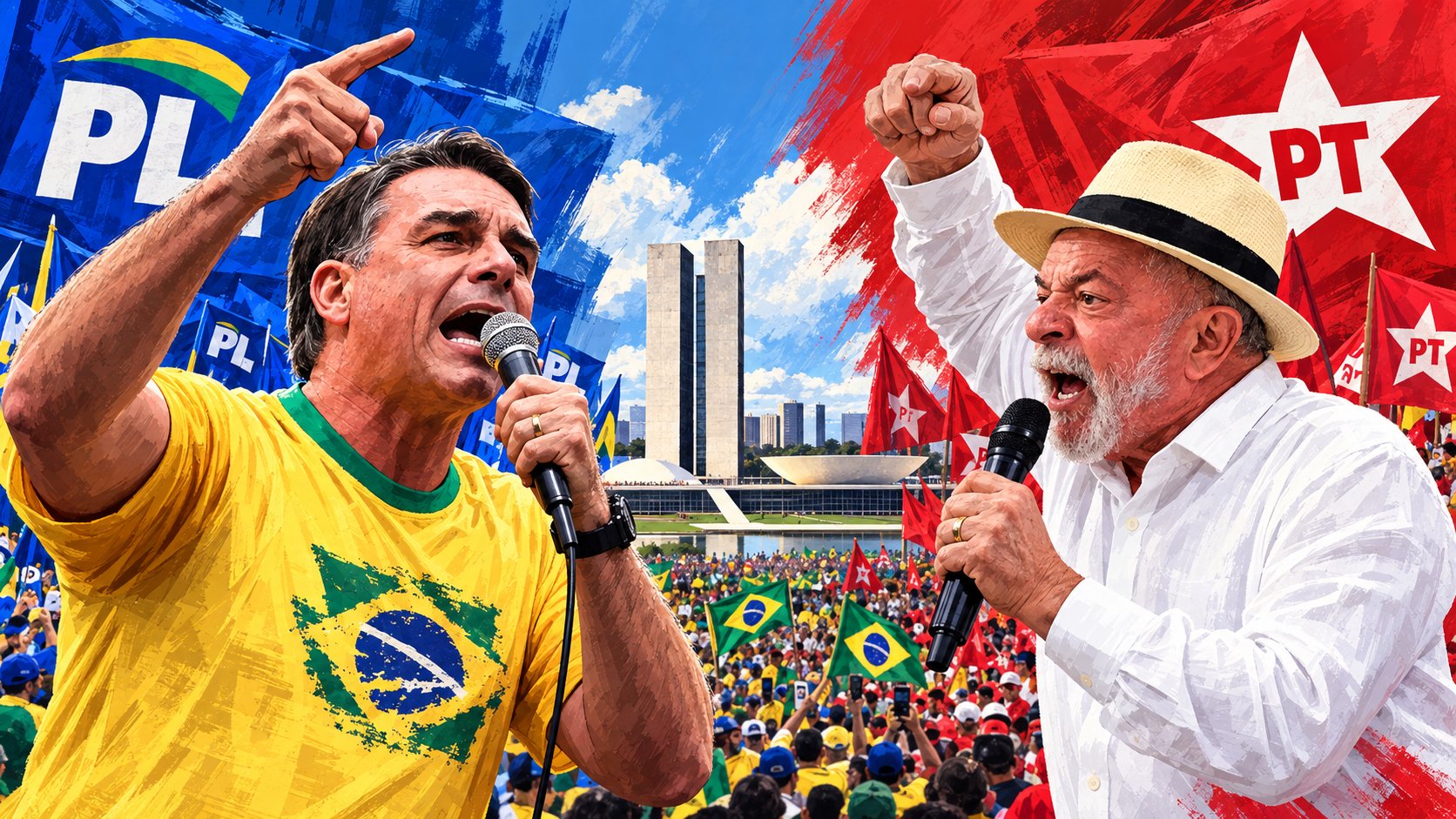
Senator Flavio Bolsonaro, the candidate of the Liberal Party and the eldest son of former President Jair Bolsonaro, won first place in the first round of Brazil's presidential election on October 4, 2026, with 47.03% of valid votes. Incumbent President Luiz Inacio Lula da Silva scored 45.16%. Since no candidate passed the 50% mark, the second round will take place on October 25.
56.10 million voters voted for Bolsonaro, 53.88 million for Lula. The gap was about 2.22 million votes. Writer Augusto Kuri took third place with 2.89%, followed by Renan Santos with 2.24% and Ronaldo Cayadu with 2.18%. Romeu Zema received 0.27%. In total, about 119.3 million valid votes were cast. More than 33.4 million voters, or 21.1% of the electorate, did not come to the polling stations, almost 6 million more ballots turned out to be empty or invalid.
The result of the first round turned out to be unexpected for most pre-election studies. The latest polls before the vote mostly showed Lula with a slight lead or a statistical tie. Reuters notes that a number of studies predicted an approximately three percent advantage for the incumbent president, but in fact Bolsonaro finished the first round almost two percentage points ahead.
According to the director of the research company Active Group, Alexander Poznia, the first round showed that the election finally turned from a referendum on the current president into a direct confrontation between two political models.
"The first round showed that Bolsonaroism in Brazil was not only preserved after the departure of Jair Bolsonaro, but also turned out to be able to transfer political capital to the next generation. For Lula, the problem is that he has already mobilized a significant part of his traditional electorate, while Flavio Bolsonaro has the opportunity to gather the votes of most of the candidates from the right and center-right camps," Pozniy noted.
One of the key factors in the first round was the high turnout of Bolsonaro's supporters and at the same time a record high level of absenteeism. According to Folha de S.Paulo, 33.5 million people, or 21.08% of registered voters, did not vote, the highest number for the first round of presidential elections since 1998. The publication's experts point out that the high level of non-participation could have hit Lula harder, since among those who did not come to the polling station, there is a significant share of less well-off voters, among whom the position of the current president is traditionally stronger.
The main question of the second round is where the approximately 9 million votes of the candidates who dropped out of the race will go, and whether Lula will be able to return some of the voters who did not participate in the first vote.
Political arithmetic still looks more difficult for the current president. Romeu Zema and Ronaldo Cayadu have already announced their support for Flavio Bolsonaro. Bolsonaro was also joined by the Novo, União Brasil, Progressistas and Republicanos parties. Augusto Curie, who received about 3.45 million votes, as of October 8 has not publicly announced the final decision to support one of the candidates.
According to the calculations of the political consulting company Think Policy, cited by Reuters, for Lula to win, it is necessary to attract approximately 62% of voters who voted for conservative candidates in the first round, except for Flavio Bolsonaro.
However, mathematically, the election remains open. The difference between the two finalists is just over 2 million votes, while more than 33 million Brazilians did not vote in the first round. The Associated Press points to this group, as well as undecided voters, as one of the main reserves for both candidates ahead of October 25.
“A gap of two million votes over more than 33 million absentees means that the runoff cannot be considered a foregone conclusion. But the starting positions of the candidates are not the same. Bolsonaro has already received the support of several right-wing candidates and parties, while Lula will have to simultaneously mobilize his own base, attract moderate voters and reduce the level of absenteeism," Oleksandr Pozniy stressed.
Bolsonaro's additional advantage was the result of the parliamentary elections, which took place at the same time as the presidential elections. The Liberal Party won the largest faction in the Chamber of Deputies — 121 seats, and the party's representation in the 81-seat Senate increased from 15 to 28 senators. Together with the closest allies, Bolsonaro's potential bloc can count on approximately 259 deputies and 48 senators, although this is not enough to independently change the Constitution. Constitutional amendments require 308 votes in the Chamber of Deputies and 49 in the Senate.
This means that even if Lula is re-elected, he will face a much more right-wing Congress than in the previous term.
The economic program of the second round is also becoming one of the central issues. Flavio Bolsonaro promises to revise part of the Lula-era tax reform, cut public spending, reduce the number of ministries, reduce the burden on the payroll and return to the privatization of certain state assets. His economic team talks about cutting spending by about 1.5% of GDP, but the specific structure of such cuts has not yet been presented.
Financial markets reacted positively to the result of the first round. Reuters noted a rise in Brazilian assets on expectations of tighter fiscal policy if Bolsonaro wins, with the Bovespa index jumping about 8% after the vote.
Lula, in turn, emphasizes social programs, population incomes, labor rights and protection of existing state support mechanisms. After the first round, his staff began to rebuild the campaign, intensifying work with youth and women, as well as trying to convince voters that some social programs may be at risk in the event of a change of government.
What the betting and forecast markets show
Forecast markets became a separate indicator of expectations before the second round, although they cannot be directly equated with sociological polls.
On the eve of the first round Polymarket estimated the probability of a final victory for Flavio Bolsonaro at about 59% and for Lula at 41%. Earlier on October 1, UOL reported about 62% on Polymarket and 61% on Kalshi for Bolsonaro vs. 37-40% for Lula.
If we conditionally translate the 59% probability into the usual bookmaker's decimal odds without taking into account the margin, this corresponds to about 1.69 for Bolsonaro and about 2.44 for Lula.
However. these numbers should be taken with a significant caveat. Polymarket and Kalshi are prediction markets where probability is determined by the price of contracts rather than the results of a representative survey. In addition, their work in Brazil was limited by the authorities, which sharply reduced liquidity. According to Folha de S.Paulo, Polymarket's daily transactions related to the Brazilian election have dropped by almost 90% since the ban. The largest single bet on Polymarket — about $1.01 million — was chosen for Lula's victory.
Therefore, the data of the betting markets rather demonstrate the expectations of the participants of the financial and political market than is a reliable forecast of the election result.
Geopolitics: the USA or the continuation of the multi-vector course
The foreign political significance of the elections in Brazil goes far beyond the borders of Latin America. The country is the largest economy in the region, one of the founders of BRICS, a member of the G20 and a key trade partner of China.
During his presidency, Lula consistently defended the concept of Brazil's strategic autonomy: the development of relations simultaneously with the United States, China, the European Union, BRICS countries and the Global South. During the current campaign, he also built much of his foreign policy rhetoric around the idea of sovereignty and the inadmissibility of foreign pressure.
Flavio Bolsonaro is offering significantly closer interaction with the administration of US President Donald Trump. He advocated a free trade agreement with the US, joining US security initiatives and closer cooperation on critical minerals. At the same time, even his program envisages maintaining pragmatic economic relations with China, since Beijing remains Brazil's largest trade partner.
"In geopolitical terms, this is not a choice between China and the USA in the literal sense. The Brazilian economy is too closely linked to China for any president to abandon that relationship. But under Bolsonaro, you can expect a noticeable political rapprochement with Washington and the Trump administration, especially in matters of security and strategic resources. Under Lula, a more autonomous line with an emphasis on BRICS and the Global South will be preserved," Oleksandr Pozniy noted.
For Washington, Bolsonaro's victory would mean strengthening the group of right-wing Latin American governments and potentially closer cooperation with the largest country in the region. For Beijing, it would become a politically less comfortable scenario, although the scale of bilateral trade significantly limits the possibility of a sharp reversal of Brazil from China.
Elections are also important for BRICS. Under Lula, Brazil will most likely continue to actively use unification as a tool to strengthen the role of the countries of the Global South and promote the multipolar architecture of international relations. According to Bolsonaro, Brazil's participation in BRICS is likely to remain for economic reasons, but the political emphasis may shift towards relations with the US.
For Ukraine, the difference between the candidates may also matter. Lula adheres to the line of strategic neutrality of Brazil and has repeatedly tried to position the country as a potential mediator in the Russian-Ukrainian war. Under a more pro-American Bolsonaro administration, Brazil's diplomatic line may partially change, although the specific Ukrainian policy of the candidate has not yet been formulated in such detail as to speak of a guaranteed reversal.
"For Ukraine, it is not so much the party affiliation of the future president of Brazil that is important, but what model of relations with the West and BRICS the new administration will choose. Under Lula, the difficult balance between Russia, China, the USA and Europe will continue. Bolsonaro is potentially closer to the American model, but it would be premature to automatically draw a conclusion from this about a sharp change in Brazil's position towards Ukraine," the sociologist emphasized.
What will decide the result of the second round
According to the Experts Club, four factors will be key before the October 25 vote: the mobilization of the 33 million voters who missed the first round, the distribution of the approximately 9 million votes of the candidates who dropped out, the state of the economy and the cost of living, as well as Lula's ability to overcome the momentum that Bolsonaro received after his surprise victory on October 4.
Formally, Flavio Bolsonaro's advantage is less than two percentage points. But politically, his position after the first round was strengthened thanks to the support of right-wing parties and the results of the congressional elections.
For Lula, the most realistic way to victory lies in increasing the turnout among the traditional electorate, primarily low-income groups and residents of the northeast of the country, as well as receiving a large part of the moderate votes of Augusto Curie and other candidates.
The first full-fledged public opinion polls after the first round Datafolha and PoderData should be published on October 8, AtlasIntel on October 9. They will give the first more reliable idea of how much the result of the first round changed the balance of power before the final vote.
The second round of presidential elections in Brazil will be held on October 25, 2026.