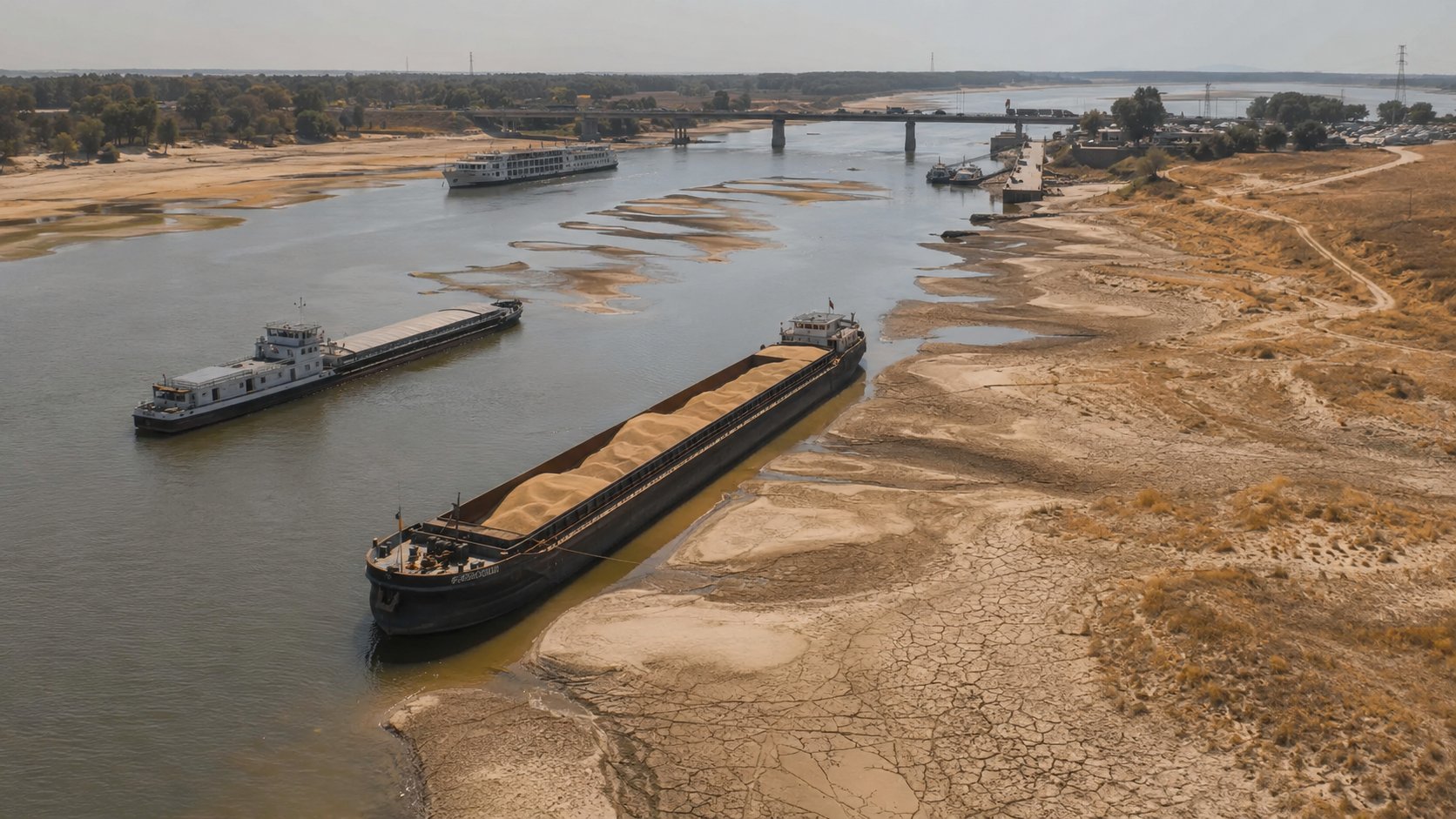
Extreme heat and prolonged drought have led to a sharp drop in the level of the Danube in Romania. In the area of the port of Beshet, the movement of cargo, passenger and cruise ships turned out to be practically stopped, and carriers are forced to reduce loading or look for alternative routes.
According to the National Institute of Hydrology and Water Management of Romania, on July 18, the flow of water at the entrance of the Danube to the country in the Baziash area decreased to 1.7 thousand cubic meters per second. This is about 64% below the multi-year July average of 4.7 thousand cubic meters per second. The forecast for the period until July 25 provides for the maintenance of the flow in the range of 1.65–1.8 thousand cubic meters per second.
On July 19, the Lower Danube Administration recorded negative relative to the conditional zero of the hydropost marks on a significant part of the Romanian section of the river. In Beshet, the indicator was minus 65 cm, in Kalafat - minus 140 cm, in Giurgi - minus 128 cm, and in Chernavode - minus 173 cm. These values do not mean a negative depth, but they indicate an extremely low water level compared to the reference points taken at the water stations.
The most difficult situation occurred near Beshet. Vessels loaded with grain cannot set sail, and the ferry service between Beshet in Romania and Oryahovo in Bulgaria was temporarily suspended. Trucks and cars have to use other border crossings, which increases the distance, delivery time and load on road bridges across the Danube.
Problems have also affected the tourism sector. Several cruise ships heading from Budapest to the Danube Delta were unable to continue their journey. Tour operators began to transport passengers by bus and change travel programs, including sending tourists to Bucharest. Stopping or curtailing cruise routes could reduce revenues for port cities, hotels, restaurants and tour companies along the entire river.
Low water is already affecting Romania's agriculture. In some areas, the level of the Danube turned out to be lower than the minimum mark necessary for the operation of pumping stations, due to which part of the fields remained without irrigation. This increases the risk of reduced yields and further increases in farmers' costs.
Consequences for all Danube countries
If the low water level persists or spreads to other parts of the river, the consequences will be felt by all ten countries through which the Danube flows directly: Germany, Austria, Slovakia, Hungary, Croatia, Serbia, Bulgaria, Romania, Moldova and Ukraine. The Danube is the basis of the most important European transport corridor, connecting the industrial areas of Central Europe with the port of Constanta and the Black Sea.
For Germany and Austria, the main risk will be disruption of cross-border transportation through the Rhine-Main-Danube system. Ships will be forced to accept less cargo, and part of the deliveries may go to rail and road transport. This increases the cost of delivering raw materials, fuel and industrial products. The cruise sector of Vienna, Linz, Passau and other cities may also face the cancellation or reduction of itineraries.
Slovakia and Hungary risk delays in deliveries through the ports of Bratislava, Komarno and Budapest. An additional problem for Hungary will be the reduction of cruise traffic between Budapest and the lower Danube. In the case of prolonged low water, the costs of transporting grain, oil products, metals and mineral raw materials may increase.
For Croatia and Serbia, the decrease in the fairway depth means possible restrictions on the operation of the ports of Vukovar, Novi Sad, Pancevo, Smederevo and Prahovo. Serbian exporters of grain, fertilizers and metallurgical products may face the need to split cargoes between more vessels or reroute them by rail. Imports of petroleum products and industrial raw materials may also become more expensive.
Bulgaria and Romania are already experiencing immediate consequences in the form of the suspension of the Oryahovo-Beshet ferry, restrictions on freight traffic and problems with irrigation. Further lowering of the water may complicate the operation of the river ports of Ruse, Lom, Vidin, Galati, Breila and Constanta, as well as increase the load on bridges and land border points.
For Moldova, the risks are related to the operation of the port of Giurgiulesti and access to the lower Danube. Reducing the permissible draft of ships can lead to a decrease in the volume of one batch, an increase in the price of fuel imports and exports of agricultural products.
For Ukraine, low water poses a threat to the operation of the ports of Reni, Izmail and Ust-Dunaysk. Low depths can reduce the loading of barges and sea vessels, increase the cost of transporting grain, metal, containers and other products, as well as complicate traffic between Ukrainian ports, Constanta and Central Europe.
According to the Danube Commission, a significant part of river transport is grain, food and fodder cargo, iron ore, oil products, fertilizers and metal products. Therefore, prolonged low water can affect not only transport companies, but also prices for agriculture, metallurgy, energy and food industries throughout the region.
The Danube Commission warned in April 2026 that periods of low water and sharp fluctuations in the hydrological situation are becoming a permanent factor that changes the operating conditions of river transport. European countries will have to more actively deepen and maintain the fairway, improve the exchange of navigational data and develop railway routes for the prompt rerouting of cargo.