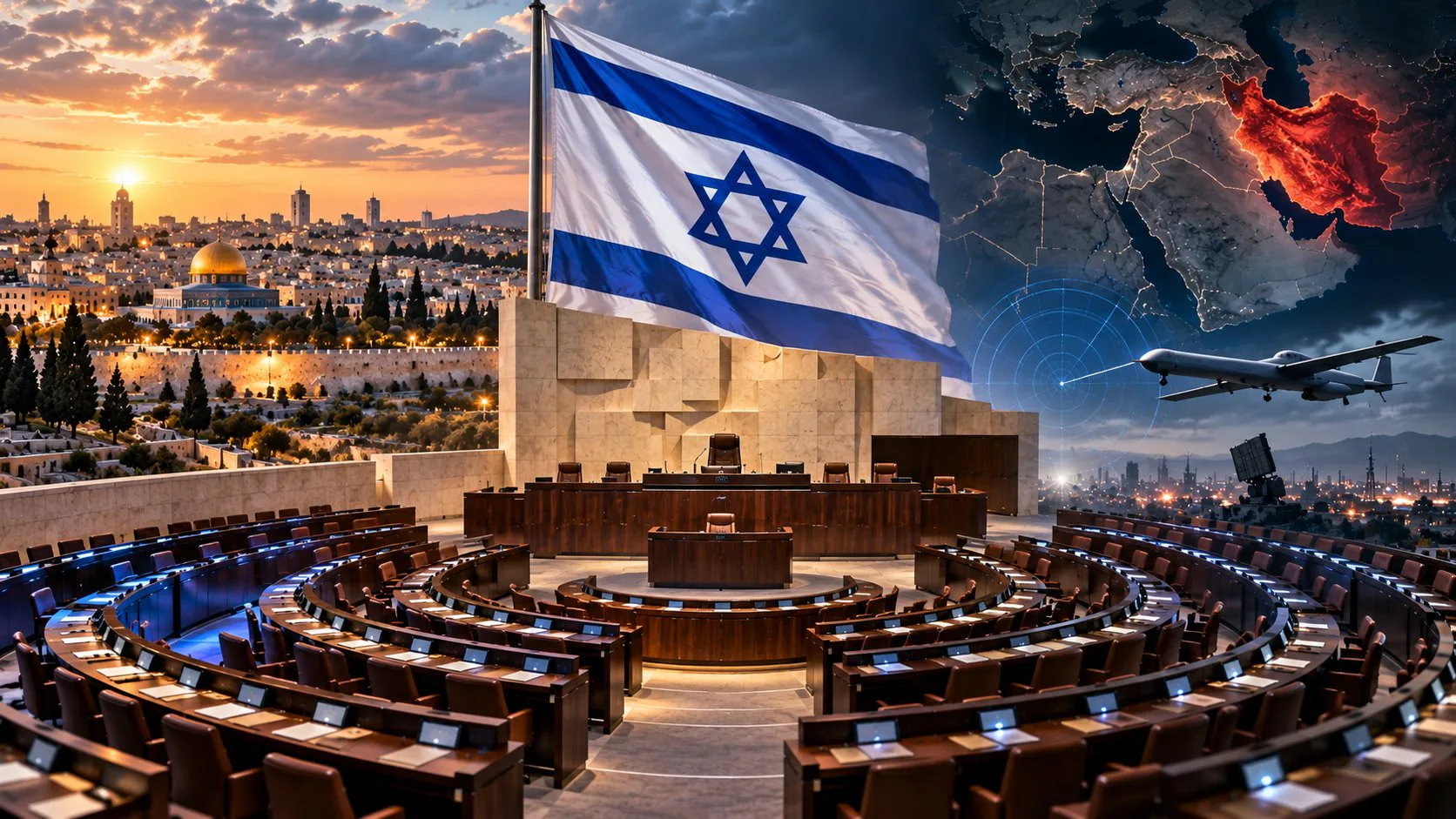
Parliamentary elections in Israel 27 October 2026 did not produce a clear winner. Prime Minister Benjamin Netanyahu's Likud party came in first, but his right-wing religious bloc lost its majority in the Knesset. The opposition led by former Israeli Defense Forces Chief of Staff Gadi Eisenkot also did not secure enough seats. As a result, the country faces protracted coalition negotiations, the consequences of which will be felt far beyond its borders.
The future coalition will determine the intensity of the war with Iran, policy towards Gaza and the West Bank, relations with Washington and Arab states. For Ukraine, prospects for cooperation against Iranian drones open up, but a quick review of Israeli policy towards Russia is not expected.
Parliament without a majority
According to the Israeli Central Elections Committee, published 30 October, Likud won 27 out of 120 seats in the Knesset. Gadi Eisenkot's Yashar party won 21 seats, Naftali Bennett's Be-Yahad union — 12. The United Arab List has 11 seats, the Democratic Party and Ra'am — eight each. Our Home Israel, United Torah Judaism and Otzma Yehudit each won seven seats, Shas and Religious Zionism — six each.
In total, Netanyahu's supporters control 53 seats, the opposition bloc — 48, and Arab political forces — a record 19. At least 61 votes are needed to form a government. Turnout was 77.9%, with over 5.7 million people voting. The final results will be submitted to President Isaac Herzog 4 November, and the new Knesset will be sworn in 10 November.
Netanyahu retained the largest party but not a majority with his allies. The opposition could mathematically have 67 votes with the support of Arab parties, but most of its leaders have previously rejected such a format. Therefore, the record Arab representation does not guarantee participation in the government.
Who can form the government
The first scenario is that Netanyahu convinces part of the opposition to support a new coalition or agrees on a government of national unity. His advantage is his extensive experience in coalition negotiations and the possibility of remaining acting prime minister until a new cabinet is formed. At the same time, for centrists, cooperation with him would mean breaking pre-election promises.
The second scenario is a government led by Eisenkot with the support of Arab deputies, possibly without their inclusion in the cabinet. Such a structure would rely on 48 opposition votes and 19 Arab deputies. Its main risks are conflicts between right-wing, centrist, and left-wing parties, as well as fundamental disagreements over the Palestinian issue.
The third option is a prolonged political crisis and repeat elections in 2027. Netanyahu would then remain acting prime minister. This would complicate long-term planning but would not automatically mean the cessation of military operations.
Consequences for the Middle East
Most likely, the main principles of Israeli security policy will be preserved regardless of the personal composition of the government. After the Hamas attack on October 7, 2023 and the subsequent wars, the Israeli political system has shifted towards a harsher approach to Iran, Hamas, and Hezbollah. Netanyahu and Eisenkot differ on domestic political issues, but both view Iran's military potential as a strategic threat.
The most noticeable differences may be regarding the Palestinian territories. A government involving ultra-right-wing forces is likely to continue supporting the expansion of Israeli settlements in the occupied West Bank and harsh conditions in the Gaza Strip. A centrist cabinet would have more room for negotiations with regional partners, humanitarian agreements, and restoring relations with European states. However, even here, it would not be automatic to expect support for the creation of an independent Palestine.
The fragility of the ceasefire in Gaza, where new strikes and casualties are recorded even after the announcement of a ceasefire regime, will remain one of the key factors. For Egypt and Jordan, preventing regional destabilization is particularly important, while for Saudi Arabia and Gulf states, preventing the war from escalating is crucial. Without at least limited progress on the Palestinian issue, new steps towards normalizing relations between Israel and the Arab world will remain difficult.
War with Iran: the risk of a new escalation remains
The war between Israel and the US against Iran, which began at the end of February 2026, became the central foreign policy issue of the election campaign. Despite periodic ceasefires, there is no final peace agreement. The disputes concern Iran's nuclear program, missile capabilities, the American blockade of Iranian ports, and sanctions against oil exports.
30 October Reuters reported that Qatari mediators returned to Tehran to coordinate a possible compromise with the US. Meanwhile, the Iranian side rejected part of the proposed terms, and Washington insists on including the nuclear issue from the start of the negotiations. Therefore, the diplomatic process continues, but there is insufficient basis to consider the end of the conflict imminent.
For Netanyahu, continuing pressure on Tehran is one of the main elements of his political program. A new escalation may consolidate his right-wing electorate, although military losses and public fatigue can have the opposite effect. Meanwhile, it would be a mistake to think that Eisenkot's victory would mean abandoning the use of force against Iran: the differences would primarily concern coordination with the US, the scale of operations, and the role of diplomacy.
Escalation also threatens countries in the Persian Gulf, shipping in the Strait of Hormuz, and global energy markets. For importers of oil and gas, particularly European economies, this means the risk of price fluctuations, more expensive logistics, and additional inflationary pressure.
What the election results mean for Ukraine
For Kyiv, the Israeli elections have a double meaning. Russia and Iran cooperate in the military-technical sphere, and Shahed drones threaten both countries. Meanwhile, Netanyahu's governments have cautiously approached providing Ukraine with high-tech weapons, maintaining channels of interaction with Moscow.
6 October, President Volodymyr Zelenskyy discussed countering Russian and Iranian 'Shaheds' with Israeli Minister Zeev Elkin. The Ukrainian side directly linked the security of the two countries with the technologies that Tehran has transferred to Russia. Ahead of the vote, Netanyahu also acknowledged that Israel is studying Ukraine's experience in combating drones and investing in relevant solutions.
If the opposition forms a government, there will be an additional political window for exchanging intelligence data, joint development of detection and interception systems for unmanned aerial vehicles, cooperation between defense companies, and closer dialogue with European allies. However, this is an opportunity, not a decision already made to supply Israeli air defense systems to Ukraine.
There is also a reverse risk. Further war with Iran increases the needs of Israel, the USA and the Persian Gulf states for interceptors and air defense systems. Given limited production capacities, this creates additional competition for resources needed by Ukraine to protect its cities and energy infrastructure. Therefore, Ukraine's interest lies not in the escalation of the Middle Eastern conflict, but in its controlled de-escalation along with deepening technological cooperation with Israel.
Forecast: three key factors for the coming months
The first is the ability of Netanyahu or Eisenkot to form a stable coalition. The second is the outcome of US-Iran talks mediated by Qatar and other regional states. The third is the situation in Gaza and the West Bank, which will affect Israel's relations with its Arab neighbors and international partners.
The baseline scenario for late October is a period of political uncertainty with a high probability of continuing tough security policies. Even the arrival of a new prime minister will not eliminate the confrontation with Iran, but it may change the way the war is conducted and the balance between military and diplomatic tools.
For Ukraine, the best outcome would be a combination of less regional escalation, stable Western supplies of air defense systems, and practical partnership with Israel in countering Iranian technologies. The elections 27 October created some opportunities for this, but final conclusions can only be drawn after the formation of a new government or a decision on a repeat vote.
Parliamentary elections in Israel 27 October 2026 did not produce a clear winner. Prime Minister Benjamin Netanyahu's Likud party came in first, but his right-wing religious bloc lost its majority in the Knesset. The opposition led by former Israeli Defense Forces Chief of Staff Gadi Eisenkot also did not secure enough seats. As a result, the country faces protracted coalition negotiations, the consequences of which will be felt far beyond its borders.
The future coalition will determine the intensity of the war with Iran, policy towards Gaza and the West Bank, relations with Washington and Arab states. For Ukraine, prospects for cooperation against Iranian drones open up, but a quick review of Israeli policy towards Russia is not expected.
Election results: parliament without a majority
According to the Israeli Central Elections Committee, published 30 October, Likud won 27 out of 120 seats in the Knesset. Gadi Eisenkot's Yashar party won 21 seats, Naftali Bennett's Be-Yahad union — 12. The United Arab List has 11 seats, the Democratic Party and Ra'am — eight each. Our Home Israel, United Torah Judaism and Otzma Yehudit each won seven seats, Shas and Religious Zionism — six each.
In total, Netanyahu's supporters control 53 seats, the opposition bloc — 48, and Arab political forces — a record 19. At least 61 votes are needed to form a government. Turnout was 77.9%, with over 5.7 million people voting. The final results will be submitted to President Isaac Herzog 4 November, and the new Knesset will be sworn in 10 November.
Netanyahu retained the largest party but not a majority with his allies. The opposition could mathematically have 67 votes with the support of Arab parties, but most of its leaders have previously rejected such a format. Therefore, the record Arab representation does not guarantee participation in the government.
Who can form the government
The first scenario is that Netanyahu convinces part of the opposition to support a new coalition or agrees on a government of national unity. His advantage is his extensive experience in coalition negotiations and the possibility of remaining acting prime minister until a new cabinet is formed. At the same time, for centrists, cooperation with him would mean breaking pre-election promises.
The second scenario is a government led by Eisenkot with the support of Arab deputies, possibly without their inclusion in the cabinet. Such a structure would rely on 48 opposition votes and 19 Arab deputies. Its main risks are conflicts between right-wing, centrist, and left-wing parties, as well as fundamental disagreements over the Palestinian issue.
The third option is a prolonged political crisis and repeat elections in 2027. Netanyahu would then remain acting prime minister. This would complicate long-term planning but would not automatically mean the cessation of military operations.
Consequences for the Middle East: change of tactics without guarantee of change of course
Most likely, the main principles of Israeli security policy will be preserved regardless of the personal composition of the government. After the Hamas attack on October 7, 2023 and the subsequent wars, the Israeli political system has shifted towards a harsher approach to Iran, Hamas, and Hezbollah. Netanyahu and Eisenkot differ on domestic political issues, but both view Iran's military potential as a strategic threat.
The most noticeable differences may be regarding the Palestinian territories. A government involving ultra-right-wing forces is likely to continue supporting the expansion of Israeli settlements in the occupied West Bank and harsh conditions in the Gaza Strip. A centrist cabinet would have more room for negotiations with regional partners, humanitarian agreements, and restoring relations with European states. However, even here, it would not be automatic to expect support for the creation of an independent Palestine.
The fragility of the ceasefire in Gaza, where new strikes and casualties are recorded even after the announcement of a ceasefire regime, will remain one of the key factors. For Egypt and Jordan, preventing regional destabilization is particularly important, while for Saudi Arabia and Gulf states, preventing the war from escalating is crucial. Without at least limited progress on the Palestinian issue, new steps towards normalizing relations between Israel and the Arab world will remain difficult.
War with Iran: the risk of a new escalation remains
The war between Israel and the US against Iran, which began at the end of February 2026, became the central foreign policy issue of the election campaign. Despite periodic ceasefires, there is no final peace agreement. The disputes concern Iran's nuclear program, missile capabilities, the American blockade of Iranian ports, and sanctions against oil exports.
30 October Reuters reported that Qatari mediators returned to Tehran to coordinate a possible compromise with the US. Meanwhile, the Iranian side rejected part of the proposed terms, and Washington insists on including the nuclear issue from the start of the negotiations. Therefore, the diplomatic process continues, but there is insufficient basis to consider the end of the conflict imminent.
For Netanyahu, continuing pressure on Tehran is one of the main elements of his political program. A new escalation may consolidate his right-wing electorate, although military losses and public fatigue can have the opposite effect. Meanwhile, it would be a mistake to think that Eisenkot's victory would mean abandoning the use of force against Iran: the differences would primarily concern coordination with the US, the scale of operations, and the role of diplomacy.
Escalation also threatens countries in the Persian Gulf, shipping in the Strait of Hormuz, and global energy markets. For importers of oil and gas, particularly European economies, this means the risk of price fluctuations, more expensive logistics, and additional inflationary pressure.
What the election results mean for Ukraine
For Kyiv, the Israeli elections have a double meaning. Russia and Iran cooperate in the military-technical sphere, and Shahed drones threaten both countries. Meanwhile, Netanyahu's governments have cautiously approached providing Ukraine with high-tech weapons, maintaining channels of interaction with Moscow.
6 October, President Volodymyr Zelenskyy discussed countering Russian and Iranian 'Shaheds' with Israeli Minister Zeev Elkin. The Ukrainian side directly linked the security of the two countries with the technologies that Tehran has transferred to Russia. Ahead of the vote, Netanyahu also acknowledged that Israel is studying Ukraine's experience in combating drones and investing in relevant solutions.
If the opposition forms a government, there will be an additional political window for exchanging intelligence data, joint development of detection and interception systems for unmanned aerial vehicles, cooperation between defense companies, and closer dialogue with European allies. However, this is an opportunity, not a decision already made to supply Israeli air defense systems to Ukraine.
There is also a reverse risk. Further war with Iran increases the needs of Israel, the USA and the Persian Gulf states for interceptors and air defense systems. Given limited production capacities, this creates additional competition for resources needed by Ukraine to protect its cities and energy infrastructure. Therefore, Ukraine's interest lies not in the escalation of the Middle Eastern conflict, but in its controlled de-escalation along with deepening technological cooperation with Israel.
Three key factors for the coming months
The first is the ability of Netanyahu or Eisenkot to form a stable coalition. The second is the outcome of US-Iran talks mediated by Qatar and other regional states. The third is the situation in Gaza and the West Bank, which will affect Israel's relations with its Arab neighbors and international partners.
The baseline scenario for late October is a period of political uncertainty with a high probability of continuing tough security policies. Even the arrival of a new prime minister will not eliminate the confrontation with Iran, but it may change the way the war is conducted and the balance between military and diplomatic tools.
For Ukraine, the best outcome would be a combination of less regional escalation, stable Western supplies of air defense systems, and practical partnership with Israel in countering Iranian technologies. The elections 27 October created some opportunities for this, but final conclusions can only be drawn after the formation of a new government or a decision on a repeat vote.