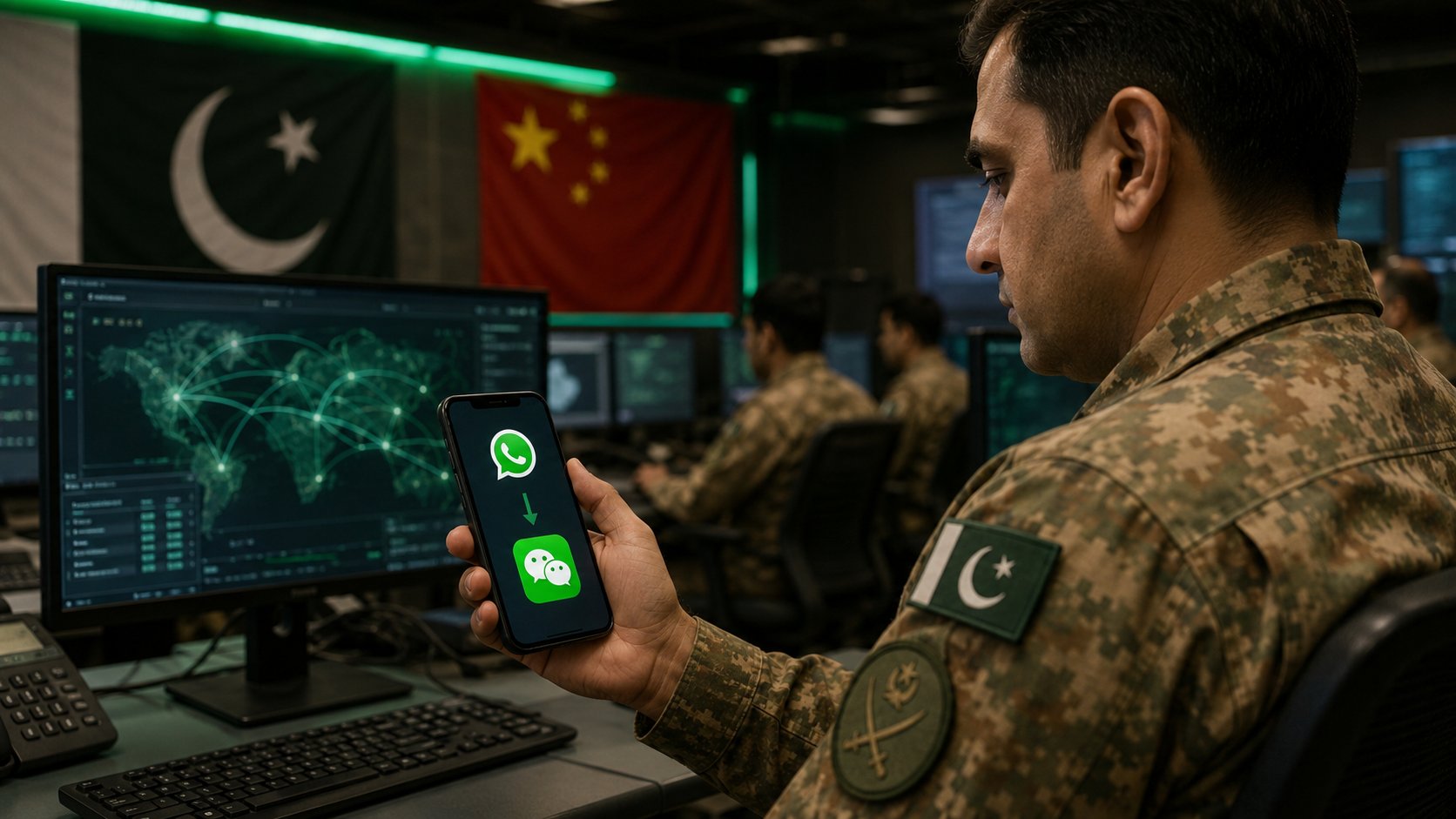
The Pakistani army has ordered to gradually abandon the use of WhatsApp in official correspondence and transfer the official chats of servicemen to the Chinese messenger WeChat, the Indian publication NDTV reported with reference to the internal directive of the Pakistani armed forces.
According to the publication, the command explains the decision by the risks of surveillance, information leaks and hacking of official conversations in WhatsApp. Officers and servicemen have been asked to gradually transfer official communication to WeChat.
At the same time, there is no public confirmation of the decision by the Inter-Agency Public Relations Service of the Armed Forces of Pakistan ISPR or the Ministry of Defense of the country.
If the decision is implemented on the stated scale, it will become a demonstrative example of how the geopolitical orientation of the state begins to extend not only to the purchase of weapons, but also to the digital infrastructure.
NDTV attributes this decision to the growing cooperation between Pakistan and China in the defense, intelligence and cyber spheres. However, the choice of WeChat raises an obvious question from the point of view of information security.
WhatsApp uses end-to-end encryption of messages by default. This does not eliminate all risks: devices, backups, accounts, and communication metadata may remain vulnerable.
But WeChat is built differently. The University of Toronto's Citizen Lab research group found in a technical analysis published in 2024 that WeChat's encryption system protects data transmission between a user's device and the company's servers, but is not end-to-end encryption. Tencent's servers are technically capable of decrypting and processing transmitted messages.
In the past, Citizen Lab has also detected monitoring of files and images transmitted through WeChat, including materials from users registered outside of China.
Therefore, it would be wrong to attribute Islamabad's possible choice solely to WeChat's higher technical security.
More likely, it is a combination of issues of control, trust in the digital platform provider and general the reorientation of Pakistan's military infrastructure to China.
China is already the main foreign supplier of arms to Pakistan.
According to the Stockholm International Peace Research Institute SIPRI, in 2020-2024 China accounted for 81% of Pakistan's major arms imports compared to 74% in the previous five-year period. During the same period, Pakistan's total arms imports increased by 61%.
Pakistan remains one of the top five arms importers in the world for 2021-2025, according to updated SIPRI statistics.
Military cooperation between the two countries covers aviation, naval programs, joint production, training, military training and command interaction.
In May 2026, the head of the Pakistani armed forces, Field Marshal Asim Munir, visited Beijing again. At a meeting with him, Chinese Foreign Minister Wang Yi called Sino-Pakistani relations "unshakable" and emphasized the high level of political trust and practical cooperation between the two countries.
The Chinese side has repeatedly called Pakistan one of its closest strategic partners.
However, it would be inaccurate to call China and Pakistan formal military allies of the NATO type.
There is no public treaty between them on mutual defense, which would oblige China to automatically go to war if Pakistan is attacked. Their relationship is more correctly defined as an extremely deep strategic and defense partnership, which in a number of areas actually acquires the features of a military alliance.
An analytical report by the Takshashila Institution, published in January 2026, also notes that the Sino-Pakistani defense partnership is built on numerous agreements and joint projects, but there is no formal alliance treaty on mutual defense between the countries.
In the defense partnership between Beijing and Islamabad is also based on a common strategic factor — India.
Pakistan views India as its main traditional military rival, while China and India maintain their own territorial and geopolitical disputes.
This has created a stable model in which close relations with Pakistan help Beijing maintain a strategic balance in South Asia and Islamabad to compensate for a much larger economic and India's demographic potential.
Sino-Pakistani military interaction became especially noticeable after the new India-Pakistan crisis of 2025.
At the same time, relations are much broader than the defense sphere. China is implementing the China-Pakistan Economic Corridor (CPEC) in Pakistan, which connects China's western regions with the Arabian Sea. The security of Chinese citizens and CPEC infrastructure has become a separate topic of negotiations between Beijing and Pakistan's military leadership. Reuters reported that China has repeatedly demanded to strengthen the protection of its specialists and projects after attacks on Chinese citizens in Pakistan.
Against this background, the transition of the official communication of the Pakistani army to the Chinese digital platform, if it is officially confirmed, will have a symbolic meaning: dependence on the Chinese defense ecosystem will begin to extend to communication services as well.
Pakistan is not the first: armies have already abandoned popular messengers.
The rejection of the mass commercial messenger by the armed forces itself is not a unique practice.
The most telling example is Switzerland.
In January 2022, the Swiss armed forces banned the use of WhatsApp, Signal and Telegram for official communication and ordered to switch to the Swiss messenger Threema. The decision was explained by data protection requirements and the desire to use a service that is under Swiss and not foreign jurisdiction.
In fact, Switzerland followed the model of digital sovereignty: the military abandoned the most popular international platforms in favor of a national solution.
A similar trend is observed in France. In 2023, the government was ordered to abandon WhatsApp, Telegram and Signal for official communications in favor of the French solutions Olvid and later Tchap. Since September 2025, Tchap has become the main secure messenger for French ministries. This is not exclusively a military system, but the rule also applies to government structures that work with sensitive information.
The Indian Army takes a different approach. In the updated policy at the end of 2025, military personnel were allowed to exchange only general non-classified information via WhatsApp, Signal and Telegram, while maintaining strict restrictions on the publication of official information and the use of a number of social networks.
Thus, the global trend is not so much to abandon WhatsApp itself, but to gradually separate ordinary user communication and official military communication.
Swiss and French examples are significantly different from the intended solution of Pakistan.
Bern and Paris replaced foreign applications with their own or national platforms in order to reduce dependence on foreign jurisdictions.
Pakistan, on the contrary, according to NDTV, is going to replace the American service with a Chinese one.
Therefore, it is not so much digital autonomy that arises here, but a change of technological dependence from one external partner to another's. And that is what makes this story interesting from a geopolitical point of view.
If the directive is confirmed by Islamabad, the decision will be another indication of how deeply the Sino-Pakistani strategic partnership penetrates Pakistan's military infrastructure.