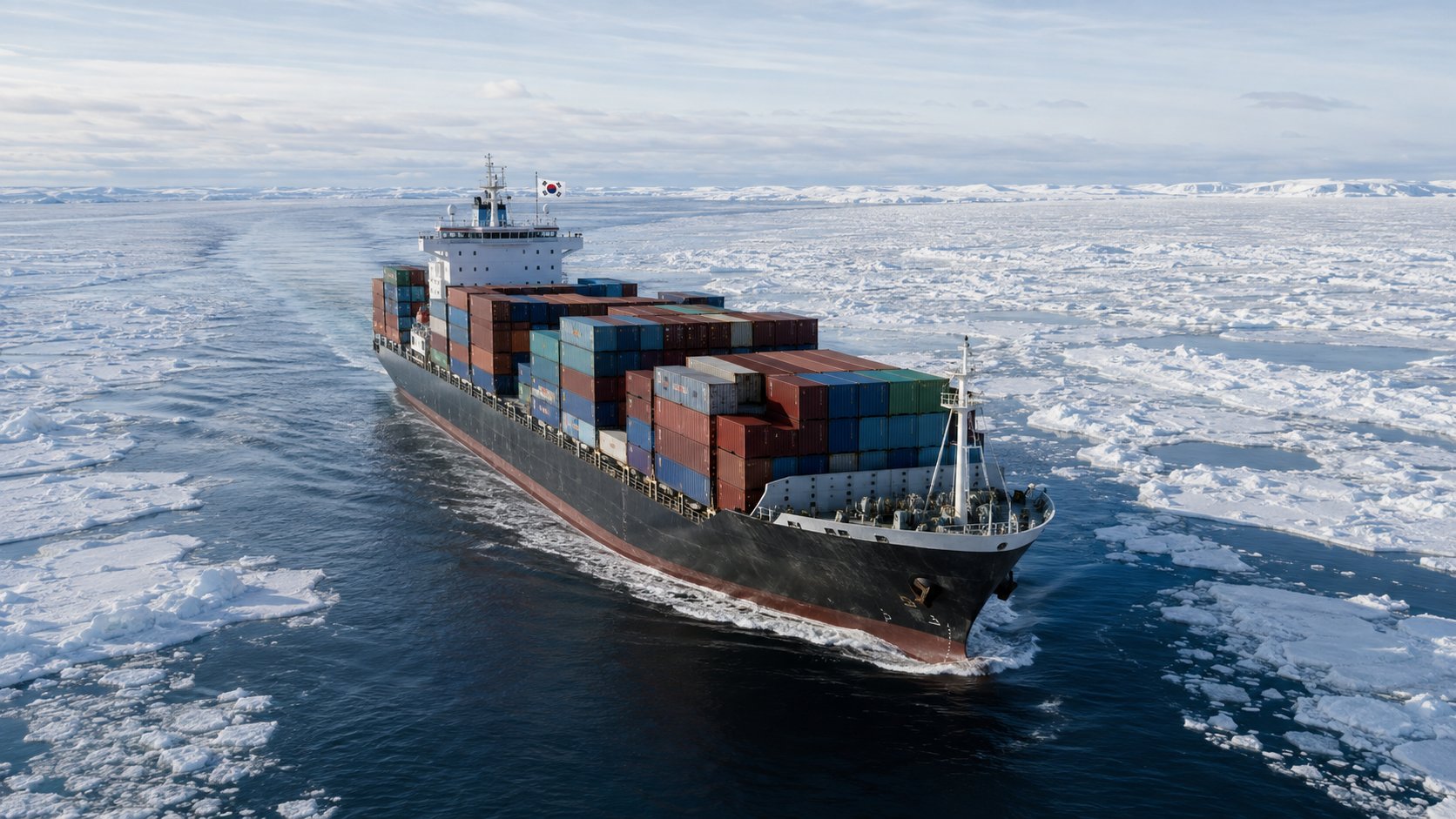
South Korea will send a commercial container ship from Busan to Europe via the Northern Sea Route for the first time on Saturday, August 22, hoping to test whether the Arctic route can cut shipping times by about a third and become a cost-effective alternative to the traditional Suez Canal route.
The 2.7,000 TEU container ship PanStar Acro will depart from Busan and transit the Arctic with calls to Felixstowe in the UK, Rotterdam in the Netherlands and Gdansk in Poland before returning to South Korea. The entire experimental flight, according to operator PanStar, will last about 40-45 days.
If the flight is successful, it will be the first commercial container flight by a South Korean shipping company between Korea and Europe via the Arctic route. Before that, commercial transportation and experimental flights on the Northern Sea Route were carried out mainly by Russian and Chinese companies.
The South Korean government considers the pilot flight as the first stage of preparation for the possible launch of a regular seasonal container service between Korea and Europe by 2030. At the same time, Busan is planned to be developed as one of the Asian centers of Arctic logistics.
The route can be approximately 7,000 km and 10 days shorter
The main potential advantage of the Northern Sea Route is the saving of distance and time. South Korea's Ministry of Oceans and Fisheries notes in its calculations that the traditional route between Asia and Europe via the Suez Canal is about 20,000 km and takes about 30 days, while the Arctic route can reduce the distance to about 13,000 km and the travel time to 20 days.
Thus, it is about:
7 thousand km of distance saving, or about 35%;
10 days of one-way time savings, or about a third of the flight time.
Earlier calculations by South Korea's Ministry of Maritime Affairs directly used a close estimate for the Busan-Rotterdam route: about 22,000 km via Suez versus 15,000 km via the Arctic, with transit times estimated at 40 and 30 days, respectively.
Reuters, citing the South Korean ministry, also notes, that the Northern Sea Route is potentially able to reduce the duration of transportation by up to 35%.
This is especially important now, as security problems in the Red Sea force some carriers to bypass the Suez Canal around the Cape of Good Hope. For the Busan-Rotterdam route, such a detour can add about 2,500 nautical miles and about a week of travel compared to Suez. Therefore, with long-term shipping disruptions in the Red Sea, the relative advantage of the Arctic becomes even greater.
Time saving can give cargo owners an additional financial effect
For companies, the economic effect arises not only from the potential reduction in fuel costs. Delivery of goods 7-10 days faster means that the capital invested in the cargo is returned to circulation for the same period earlier.
PanStar expects to load at least 1.3 thousand TEU of auto components, food, cosmetics and other products on the pilot flight. This is about 48% of the vessel's nominal capacity of 2.7 thousand TEU. Shippers from China and Japan can also participate in transportation.
If we conditionally assume an average cargo cost of $50,000 per TEU, the cost of a 1.3,000 TEU shipment will be about $65 million. At a cost of capital of 8%, an annual reduction in transportation for ten days reduces the cost of working capital frozen in transit by about $140,000 for just one trip.
If average freight cost is $100K per TEU, this effect increases to approximately $285K.
This is not a PanStar forecast, but an illustrative calculation that shows the economic value of reducing delivery time for high value cargo. Such an effect can be especially noticeable for auto components, electronics, equipment and other products with a high cost relative to weight.
Fuel savings can be significant, but far from guaranteed
Reducing distance theoretically also reduces ship fuel costs. Scientific studies of the Northern Sea Route show very different results depending on vessel type, speed, ice conditions and the need for icebreaker escort.
A study of container transport between Asia and Europe, carried out at Chalmers University, estimated a reduction in distance of about 25.1%, sailing time by 25.8%, or about 7.4 days, and fuel consumption by up to 44.2% for the considered scenario.
Other studies give much more cautious estimates. A model of the seasonal use of the Northern Sea Route showed that the annual fuel cost savings for the container fleet could be only 3-5%, as the Arctic route is only available for part of the year.
A paper published in 2024 in Maritime Economics & Logistics estimated the possible reduction in aggregate transport costs between China and the EU if the Northern Sea Route were used by only about 0.98%, according to the authors used assumptions.
Thus, a distance saving of 25-35% does not at all mean a similar reduction in the cost of transportation.
The Arctic route is more expensive to insure and extremely difficult to use all year round
The economy of the Northern Sea Route is worsened by several factors. Container ships must meet the requirements of polar navigation, and Arctic voyages are more expensive to insure. Restrictions on the draft and the size of the vessels do not allow the use of the largest container ships of 15-24 thousand TEU on the route, which provide the effect of scale on traditional routes Asia - Europe.
PanStar itself uses a relatively small container ship of 2.7 thousand TEU. By comparison, the largest ships on routes between Asia and Europe have a capacity of more than 20,000 TEU.
Arctic shipping expert Hyewon Choe told Reuters that more expensive insurance and capacity restrictions increase the cost of transporting a single container. In addition, for conventional container ships, the Northern Sea Route is currently only actually accessible for about three summer months a year.
Therefore, the first Korean flight must answer two different questions at the same time: how quickly can the route be completed and how cheaply can it transport one container.
The second indicator is ultimately more important for commercial shipping than the first.
The pilot flight is still characterized by low loading
A separate factor is loading vessel With PanStar Acro's capacity of about 2.7 thousand TEU, the organizers expect a cargo of about 1.3 thousand TEU. Even if the entire declared volume is loaded, this corresponds to less than half of the nominal capacity of the ship.
For an experimental voyage, such loading is understandable, but for a regular commercial connection, the economy will require a much higher utilization factor of the vessel.
That is why the current voyage is considered primarily as a collection of operational data: South Korea wants to obtain real indicators of fuel consumption, speed of passage of individual sections, insurance costs, navigation costs and vessel operations in polar conditions. This data will then be used to decide whether to launch a regular line.
South Korea plans to create an Arctic logistics hub in Busan
For Seoul, the project makes wider economic sense than a single container flight. The government intends to develop Busan as a container hub for Arctic logistics and Ulsan as a hub for energy cargo. The plans also include the training of specialists in polar navigation, the development of an ice-class container ship, and the creation of a support center for Arctic shipping, which should provide shipowners and shippers with financial, insurance, and logistics services.
China is already trying to gain first-mover advantage. China's Sea Legend Shipping announced the establishment of a regular container service to Europe via the Northern Sea Route. For South Korea, whose economy is largely dependent on exports and maritime trade, the appearance of a Chinese competitor has become an additional incentive to accelerate its own Arctic program.
The route creates sanctions risks for Seoul through Russia
The main political constraint remains that a large part of the Northern Sea Route runs along the Russian Arctic coast.
To prepare the flight, the South Korean side consulted with the Russian authorities and had to obtain the necessary permits. This has worried Western diplomats amid Russia's ongoing war against Ukraine.
"We want to isolate Russia, we don't want to engage with Russia," one European diplomat told Reuters.
Additional risk arises in the event of an emergency. If a container ship gets stuck in ice or needs Russian icebreaking, emergency rescue or other assistance, payments to Russian entities could potentially fall under sanctions restrictions.
Thus, the potential economics of the route are made up of opposing factors. On the one hand, there is a shortening of the journey by about 7,000 km, savings of about 7–10 days per route, lower fuel costs and faster release of cargo owners' capital. On the other hand, there is expensive insurance, limited seasonality, the need for a special vessel, a smaller effect of scale, ice risks, and dependence on the permits and infrastructure of the Russian Federation.
Therefore, the PanStar Acro flight will actually not be the start of a new regular line for South Korea, but the first full-fledged economic test that should show whether the theoretical 30-35 percent time savings can turn into a real reduction in the cost of transportation.