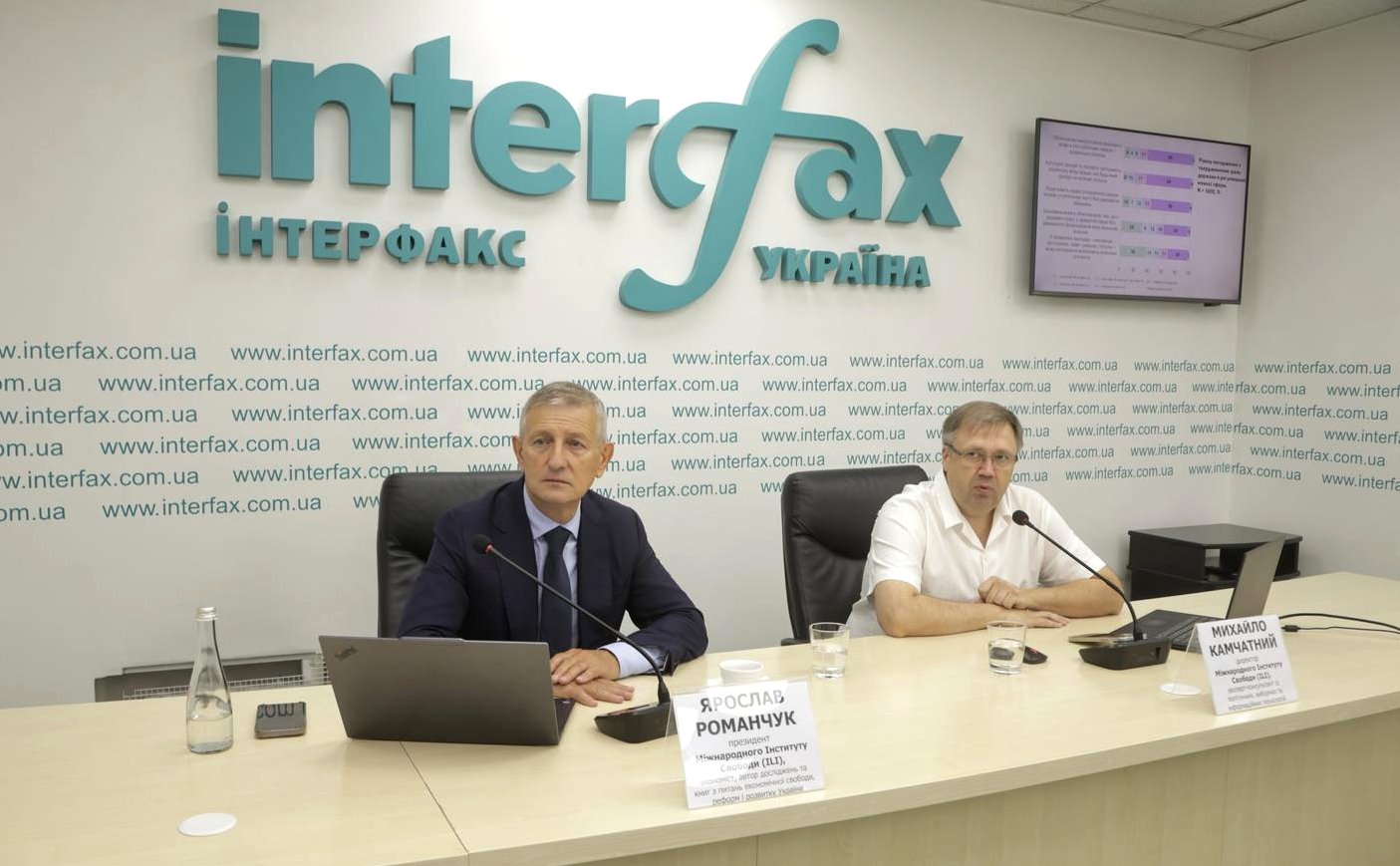
Ukrainians demonstrate a high demand for freedom of speech, personal autonomy and protection of private property, however, in matters of economic and social policy, a large part of society at the same time expects an active role of the state, according to the results of the all-Ukrainian sociological study "The Value of Freedom in Ukraine", presented by the International Institute of Freedom (ILI).
According to the study, 85% of respondents supported the right of citizens to criticize the government without fear of persecution, 67% - guaranteeing freedom of expression even regarding views that may be considered objectionable or offensive. Almost half of the respondents - 49% - spoke against censorship on the Internet even in wartime, and 57% - against punishment by the state for statements or opinions, if they do not pose a direct physical threat.
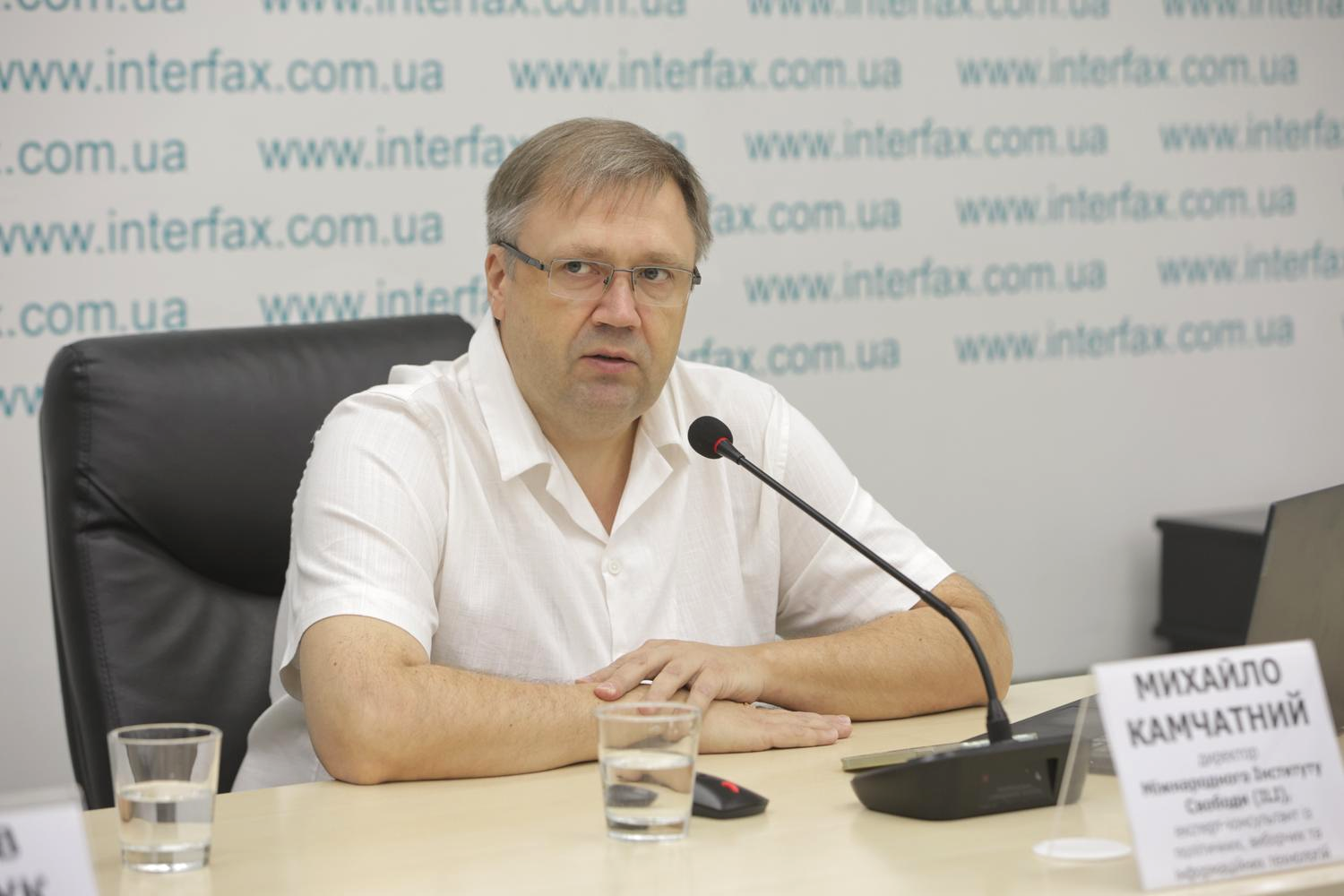
"Almost 85% of Ukrainians, if you combine the answers "completely agree" and "rather agree", support the right to publicly criticize the authorities without fear of persecution. At the same time, about two-thirds believe that freedom of speech should be guaranteed even for views that are perceived as false or offensive. For us, this is one of the most expressive indicators of society's demand for personal freedom", - noted the director of the International Freedom Institute Mykhailo Kamchatny at a press conference at the agency "Interfax-Ukraine" on Wednesday.
Another 68% of those polled opposed the situation when the majority can impose its values on the minority. The ILI believes that the totality of these indicators indicates a pronounced demand for limiting the state's interference in the sphere of personal beliefs and expressions.
At the same time, the ideological self-identification of the respondents turned out to be much less liberal. 52% primarily defined themselves as a free individual with their own values, who is responsible for their own life, 31% - primarily as a citizen of Ukraine. Only 13% identified themselves as supporters of liberal or libertarian views, while 46.5% gravitate towards ideologies that involve a more active role of the state. Almost half – 48% – reported that their political and ideological beliefs had changed or been shaped by the war and its aftermath.
A separate block of research concerned language policy. According to the presented data, 65% of respondents named Ukrainian as their native language, 23.6% identified themselves as bilingual, and 11% named Russian as their native language. At the same time, 76% supported the mandatory use of the Ukrainian language in the public state sphere, while about two-thirds agreed with the right of people to communicate in their native language in public life without state restrictions.
The human right to self-defense also received significant support. About half of the respondents spoke in favor of the right to legally carry weapons for self-defense, and about 80% - in favor of the right to use them to protect life and private property in the event of an illegal home invasion.
More than 80% of respondents agreed that even during martial law, the government should not go beyond the limits established by the Constitution. 53% supported a substantial revision of the current Constitution or the adoption of a new one. 77% of respondents agreed that closing the media or blocking Internet resources can be justified only in the case of proven cooperation with the enemy or coordination of military strikes.
One of the most sensitive issues was the principle of staffing the Armed Forces. 46% of respondents were in favor of an exclusively professional or volunteer army, almost half - in favor of a mixed model that would combine a professional contract basis with mandatory training of youth in peacetime. The traditional mobilization model was supported by 3% of those surveyed, and more than 80% approved the involvement of professional soldiers due to high salaries and benefits.
"We see that the traditional mobilization model does not enjoy the support of citizens - it was chosen by only about 3% of those surveyed. Instead, society is much more oriented toward either a professional volunteer army or a mixed model with a professional core and civilian training in peacetime. More than 80% also support the involvement of the military due to competitive salaries and a system of benefits," Kamchatny noted.
In the economic part of the study, society turned out to be much more polarized. 44% of respondents supported the expanded role of the state in the economy and provision of social services, of which 29% took the most pronounced position in favor of active state regulation. At the same time, 44% of respondents said that they rely primarily on their own strength to ensure their own well-being, and 43.5% expect the state not to interfere in their personal risks.
ILI President Yaroslav Romanchuk, in turn, drew attention to the fact that the attitude of Ukrainians to private property and entrepreneurship is more market-based than their formal ideological self-identification. In particular, 69% of respondents demonstrated an understanding of the concept of private property, and almost 70% agreed with the thesis that excessive bureaucracy and regulation hold back business development.
"Ukrainians in general do not reject private property - on the contrary, in many answers we see an understanding that a private owner manages an enterprise more effectively than a state-appointed manager. This is fundamentally important for the future economic policy: the strategic development of the country should not automatically mean the dominance of state ownership. Private initiative, competition and the protected rights of the owner are needed," Romanchuk emphasized.
He also linked the problems of the business environment with excessive discretionary powers of officials.
"When an official, law enforcement officer or inspector gets the opportunity to interpret a vaguely written norm at his own discretion, a source of discretion arises, and with it, the risk of corruption. Almost 70% of respondents directly say that excessive bureaucracy and regulation is an obstacle to business development. Therefore, laws should be as clear as possible and leave as little room for arbitrary interpretation as possible," the ILI president added.
According to Romanchuk, the results regarding knowledge of economic concepts also indicate the need to update economic education. 46% of respondents heard or read about Marxism, 12% - about monetarism, 4% - about the Austrian economic school. A free-market model of the economy without state intervention was chosen as the most desirable for Ukraine by 18%, a model of active state regulation by 10%, socialism by 6.5%.
Separately, Romanchuk advocated the preservation and development of the FOP institute as a form not only of taxation, but also of self-employment and entrepreneurial culture. He noted that microbusiness should be considered as an important component of the economic and social independence of citizens.
In the social sphere, the ILI president called for more targeted assistance that would take into account not only a person's current income, but also savings, assets, health and other criteria of need. In his opinion, after the war, the issue of combining significant social obligations of the state with the need to preserve conditions for business development will become one of the key issues for fiscal policy.
"Ukraine will have to find a balance between the needs of people who will need social support and rehabilitation, and the economy's ability to finance it. If social obligations are formed without taking into account what tax burden the business can withstand, we will not receive either investments or modernization. Therefore, aid should be as targeted, transparent and tied to the real needs of a specific person," Romanchuk emphasized.
He also advocated the development of alternatives to the exclusively state pension system and wider use of savings mechanisms, and in education and medicine - for competition between state and private service providers. According to Romanchuk, the market model in these areas does not involve a complete refusal of the state to finance, but primarily a change in the mechanisms of distribution of funds and increasing the responsibility of suppliers for the result.
During the discussion after the presentation, Romanchuk separately drew attention to the connection between freedom and responsibility and the quality of legal institutions.
"Freedom without responsibility does not exist. If the right to private property formally exists, but no one is responsible for its violation, then in fact this property is not protected. Likewise in other areas: the law works only when there is a clear mechanism of responsibility for its violation," he summarized.
The research covered issues of personal freedom, state and politics, economy, social sphere, private property and entrepreneurship, taxes, elections, military service, education, medicine, pension provision, individual responsibility and social solidarity.
Sociological survey conducted by New Image and Marketing Group in July 2026 by order of International Freedom Institute. 1,600 respondents who at the time of the study lived in the territory controlled by Ukraine took part in the online survey.