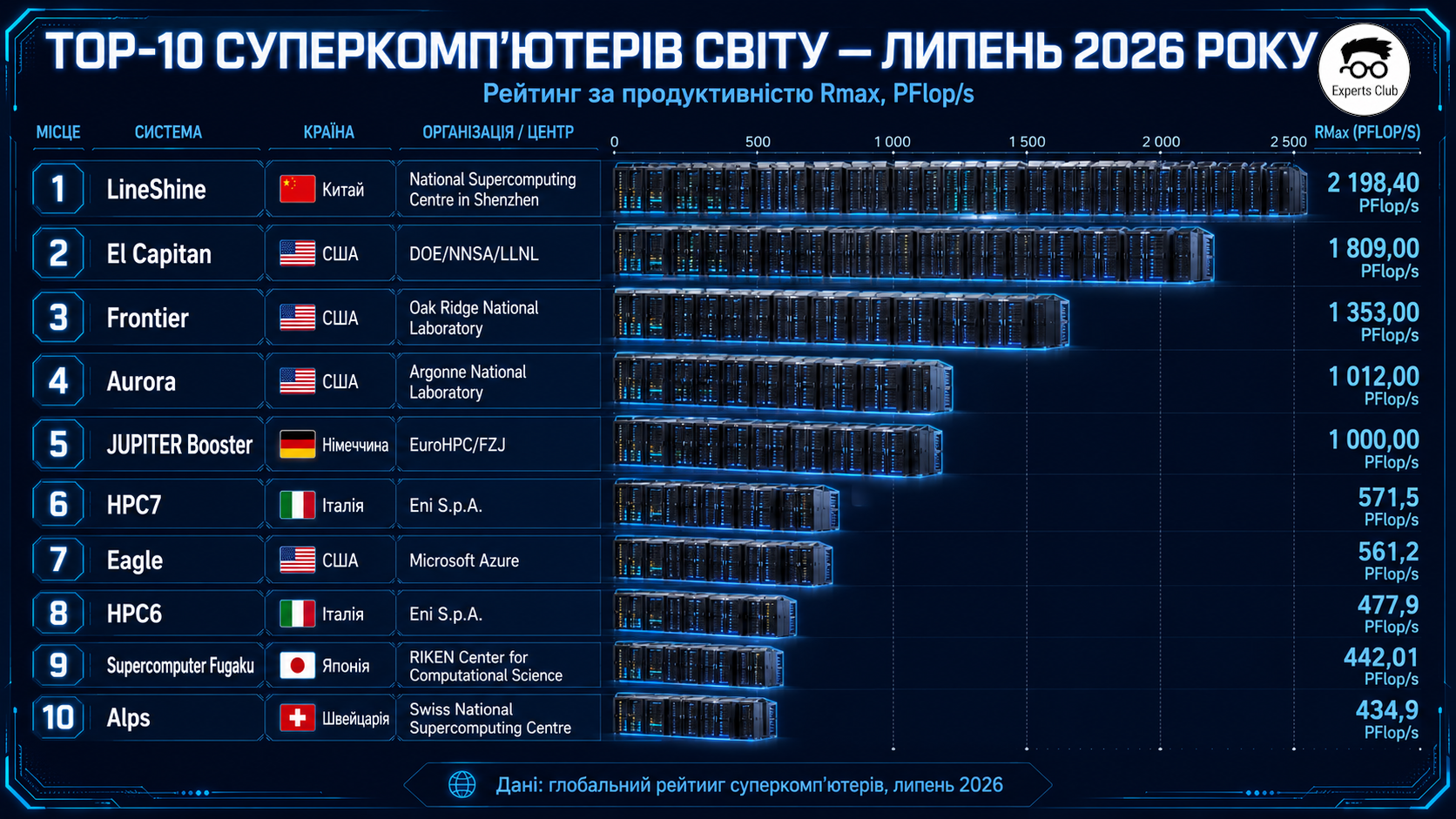
The Chinese supercomputer LineShine took first place in the June TOP500 ranking of the world's most powerful supercomputers, pushing the American El Capitan to second place. This is the 67th edition of the TOP500 ranking, which is updated twice a year - in June and November.
LineShine is installed in the National Supercomputing Center in Shenzhen and built by Shenzhen Cloud Computing Center. According to TOP500, the system showed 2,198 exaflops in the High Performance Linpack test and became the first CPU-only supercomputer in the ranking and exceeded the threshold of 2 exaflops of stable performance. The basis of the system is the Chinese LingKun platform, LX2 processors with 304 cores, LingQi's own network and Kylin OS.
China's return to the first place is symbolic: the Chinese system again topped the TOP500 ranking for the first time since 2017. At the same time, the rating demonstrates not only the technological success of the PRC, but also the preservation of the strong positions of the USA and Europe. Five systems have now passed the exaflop threshold: LineShine in China, El Capitan, Frontier and Aurora in the US, as well as JUPITER Booster in Germany.
In the top five after LineShine is followed by the American El Capitan with a result of 1,809 exaflops, Frontier with 1,353 exaflops, Aurora with 1,012 exaflops and the German JUPITER Booster with 1,000 exaflops. JUPITER remains the first European exaflop supercomputer.
The new structure of the top ten shows that there is no longer a single technological path in the industry. The top 10 simultaneously features Chinese national processors, AMD platforms, Intel architecture, NVIDIA Grace Hopper, Japan's Fujitsu A64FX, and Microsoft Azure cloud infrastructure. TOP500 separately notes that the June top ten demonstrates a high architectural diversification of the world market of high-performance computing.
In the full ranking of 500 systems, the largest number of supercomputers is in the USA - 161.
Followed by Japan - 44, Germany - 41, China - 31, France - 21, South Korea - 19, Italy - 18 and Canada — 17.
These data show that China's leadership in the first position does not mean dominance in the number of installed systems: in terms of the size of the TOP500 fleet, the United States remains the main center of global HPC power.
"Supercomputers are becoming not just a scientific infrastructure, but a factor of technological sovereignty. They determine the capabilities of countries in climate modeling, development of new materials, defense calculations, pharmaceuticals, energy and artificial intelligence. It is fundamentally important for Ukraine not only to have access to international computing resources, but also to form its own long-term HPC strategy," says the founder of the Experts Club analytical center Maksym Urakin.
According to the Experts Club analytical center, the energy factor is extremely important. LineShine consumes about 42.2 MW, while El Capitan consumes about 29.7 MW. Therefore, the race of supercomputers is increasingly becoming not only a race of performance, but also a race of energy efficiency, architectural solutions and access to modern chips. TOP500 also notes that European systems KAIROS, ROMEO-2025 and Levante GPU extension remain the leaders in energy efficiency in the Green500 rating.
For countries not represented in TOP500, in particular Ukraine, this rating is an indicator of a gap in scientific and technological infrastructure. Participation in the global supercomputer race requires not only the purchase of equipment, but also stable energy, personnel, national programs to support computing science, integration of universities, business and the state.
An exaflop supercomputer is a system capable of performing at least one exaflop, that is, one quintillion floating-point operations per second. In other words, we are talking about 1,000,000,000,000,000,000 calculations per second. This level of performance is required for the most complex tasks: modeling of climate and nuclear processes, development of new materials, analysis of large data sets, biomedicine, defense calculations and training of large artificial intelligence models.
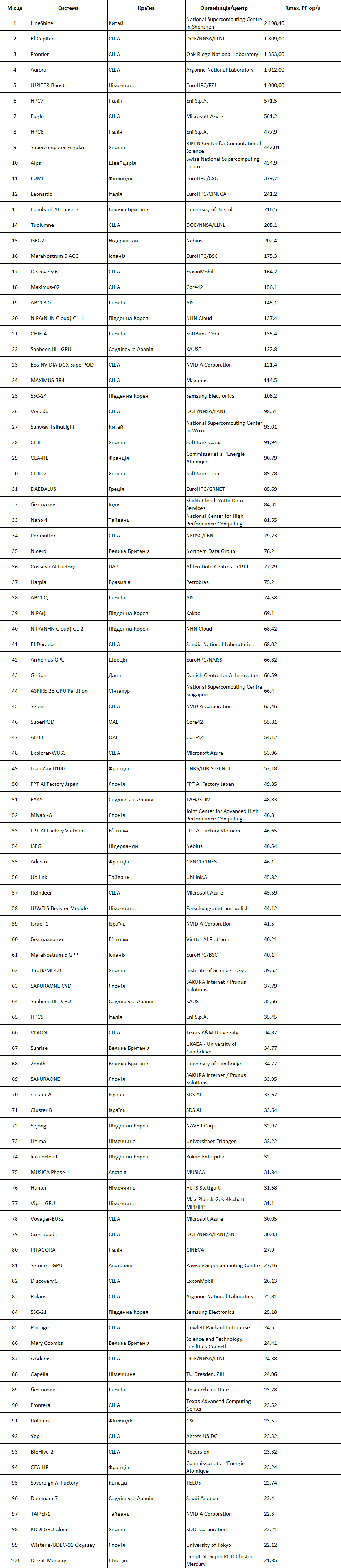
The first hundred of the TOP-500 supercomputers as of June 2026