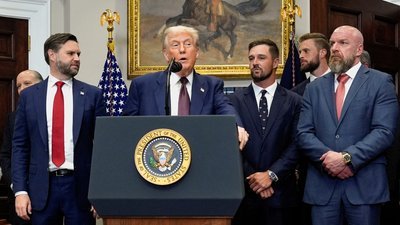
As reported by Open4Business, the administration of US President Donald Trump has proposed introducing a fee of $70,000 for the initial participation of a foreign student in the Optional Practical Training (OPT) program and another $30,000 for further recommendations, including extending the permit for STEM graduates.
The corresponding draft rule by the US Department of Homeland Security (DHS) was published on October 8, 2026 in the Federal Register. This decision has not yet entered into force: the document is at the stage of public consultation, comments are accepted until November 9.
The OPT program allows foreign students with an F-1 visa to temporarily work in the United States in a specialty during or after their studies. Graduates can typically work on OPT for up to 12 months, with additional extensions available for STEM majors.
Under the new scheme proposed by DHS, a certified college or university would have to pay before the institution enters an OPT recommendation into SEVIS. Without proof of payment of the new fee, the student will not be able to obtain a work permit.
If the rule is approved in its current form, the cost of accessing OPT will increase tenfold. Currently, it costs about a few hundred dollars to apply for a work permit, while the proposed model calls for $70,000 for an initial recommendation and another $30,000 for a follow-up.
DHS attributes the reform to the need to combat OPT fraud and abuse, as well as to protect the American labor market. In the draft rule, the agency cites cases of bogus employment of foreign graduates and potential violations in the program discovered by ICE.
Reuters notes that OPT is one of the key ways that foreign graduates of American universities get their first work experience in the United States and then often switch to H-1B work visas. Therefore, the introduction of such a high fee can significantly reduce the number of graduates who remain to work in the country after graduation.
At the same time, the scale of the group that this could potentially affect is very large. According to Open Doors 2025, there were 1.178 million international students enrolled in US colleges and universities in the 2024/25 academic year, accounting for about 6% of all US postsecondary students. Of these, 294,300 people took part in the OPT program, and the number of program participants increased by 21% over the year.
The largest number of foreign students coming to the US are from India — 363,000 people, China — 266,000, South Korea — 42,300, Canada — 29,900, and Vietnam — 25,600.
There are significantly fewer Ukrainian students in American universities, but their number is growing. According to Open Doors 2025, in the 2024/25 academic year, 2,346 students from Ukraine studied or were on OPT in the US, which is 7.5% more than the year before.
For comparison: in the 2023/24 academic year, there were 2,183 Ukrainian students in the US. At that time, about 55% of them studied in bachelor's programs, 26% in master's and postgraduate studies, 14% participated in the OPT program, another 5% were in non-degree programs.
So, if the structure of the Ukrainian student contingent remains approximately at the previous level, the new fees may affect several hundred Ukrainians who, after graduating from American universities, expect to stay in the United States for professional practice. However, Open Doors does not provide the exact number of Ukrainians who are on OPT in 2024/25 in its open summary statistics.
In general, the Ukrainian community in the USA is much larger than the student group. According to the Migration Policy Institute, based on the American Community Survey, there were more than 510,000 immigrants born in Ukraine living in the United States in 2024, and the entire Ukrainian diaspora, including people of Ukrainian origin, was estimated at about 1.4 million people.
Critics of the proposal warn that the new fee could make American universities less attractive to foreign applicants and redirect some students to Great Britain, Canada, Australia and EU countries. The Presidents' Alliance on Higher Education and Immigration has already stated that such a high financial barrier could seriously disrupt the existing system of attracting foreign graduates to the American labor market.
At the same time, the final fate of the initiative has not yet been determined. After the public comment period ends, DHS may modify the draft, withdraw portions of the provisions, or adopt a final rule. In addition, Reuters notes that the new restrictions are likely to face legal action.
https://open4business.com.ua/319780/