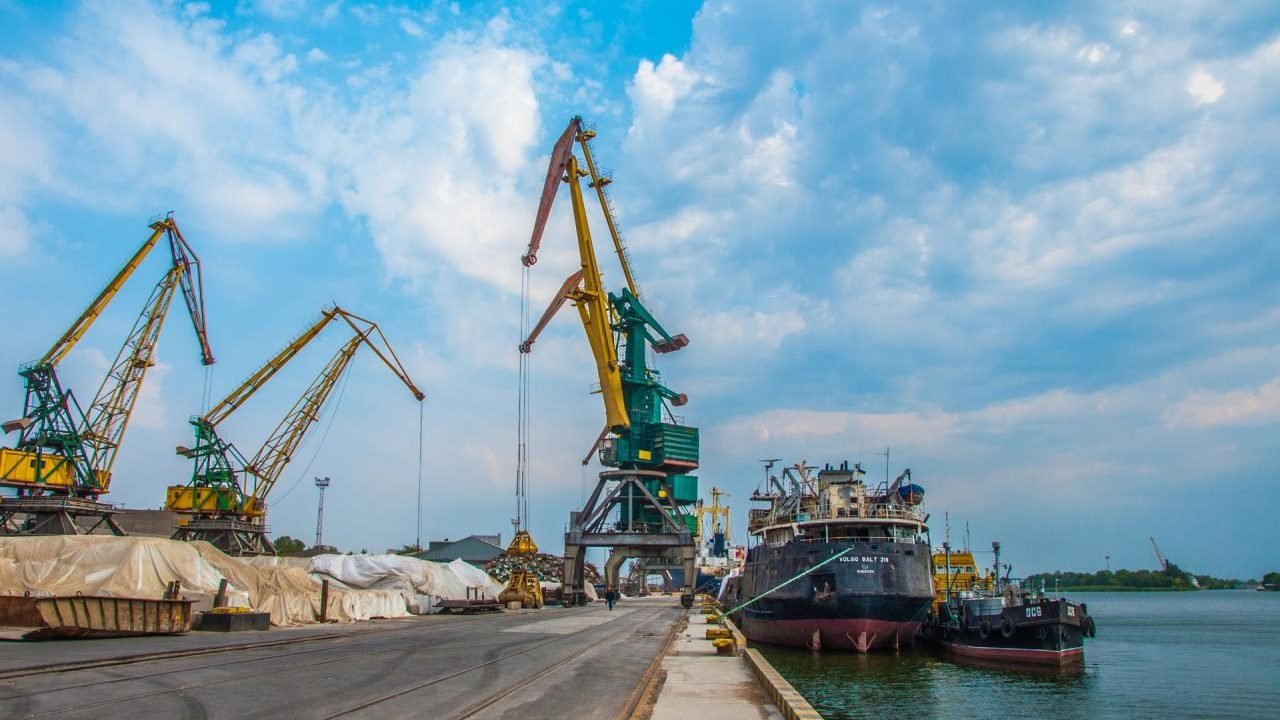
Ukrainian Danube port cluster at the end of July sharply increased the reception of grain carriers against the backdrop of a slowdown in the ports of Great Odesa, however, a critical drop in the water level in the Danube may limit the throughput capacity of an alternative export route.
According to the brokerage company Spike Brokers, the number of grain carriers heading to
Danube ports increased almost sevenfold in a week — from 167 to 1 141
ths. wagons Average daily unloading increased by 17 wagons to 51
cars per day.
At the same time, the number of grain trucks in the direction of the ports of Greater Odessa decreased by approximately 70% — to a record low of 1,356,000 wagons against 4,525,000 a week earlier. Average daily unloading decreased by 160 wagons - to 690, loading - by 203 wagons, to 580 wagons per day.
In July, 1.38 million tons of grain were transported by rail to Ukrainian seaports, which is 37% less than in June. Additional restrictions were the overflow of individual port terminals and delays in the transshipment of grain from wagons to ships.
Thus, the increase in the supply of wagons to the Danube so far looks like a quick market reaction to the slowdown in Great Odessa. However, the capacity of the Danube route is also under pressure due to the rapid shallowing of the river.
At the end of July, the flow of water in the Danube at the entrance to Romania decreased to 1.65 thousand cubic meters per second, compared to the average July level of about 4.75 thousand cubic meters. By August 4, according to the forecast, the indicator may drop to 1.5 thousand cubic meters per second, approaching the historical minimum of 1.4 thousand cubic meters in 1985.
The Romanian Lower Danube Administration recorded a sharp drop in water levels in almost the entire navigable section from Baziash to Sulina back in July. Several barges ran aground near Korabia, and the actual depths in some critical areas decreased to 1.5–1.7 meters. Dredging works are carried out to maintain depths at least at the level of 1.8–2 meters.
The main risk for Ukraine is not necessarily a complete stoppage of the Danube ports, but a reduction in the permissible draft of ships. Barges and vessels of the mixed "river-sea" type will be forced to accept less grain, which will increase the number of voyages, the cost of transportation and the turnover time of the fleet.
Even if the terminals in Reni and Izmail will retain the ability to accept wagons, the slowdown in grain loading on ships may lead to the accumulation of rolling stock at port stations. The gap is already visible: 1,141,000 wagons go to the Danube ports, while the average daily unloading is only 51 wagons.
If this ratio is maintained, the terminals may
again face overflow, after which Ukrzaliznytsia will have to introduce
restrictions on the shipment of individual cargoes or temporary restrictions.
The second risk is related to the increase in queues on the Romanian
sections of the Danube and the Sulin Canal. The ports of Reni and Izmail depend not only
on the depths directly near the Ukrainian berths, but also on the condition of the entire
Lower Danube route. As the Danube Commission points out, a separate shallow
section can become a "weak link" and limit movement along the entire international
corridor.
Shallowing also complicates the transportation of Ukrainian grain
by barges to Romanian Constanta. A decrease in the loading of one barge means the
need to attract more vessels to transport the former amount of
cargo. This increases freight rates, transshipment costs and the risk of fines for
delayed vessels.
The third risk is a simultaneous decrease in the stability of two main
sea routes. The ports of Great Odesa are currently working more slowly due to
overflow of terminals and delays in loading ships, and the Danube, which should
perform the function of a backup route, faces a natural limitation of
throughput capacity.
This factor becomes especially sensitive during the arrival of grain
of the new harvest. The increase in logistics costs can reduce purchase prices in
Ukraine, delay the execution of export contracts and increase the difference between
prices in Ukrainian ports and on the world market.
On June 24, the Administration of Sea Ports of Ukraine began operational dredging in the waters of the Izmail port. The works should
restore the design depths near the moorings and allow using
the maximum possible draft of ships and the size of ship batches. They were
planned to be completed within two months.
However, the deepening of the bottom inside the Ukrainian port cannot
fully compensate for the decrease in the water level in the Romanian and cross-border
sections of the Danube. In order to maintain stable traffic, synchronous work of
Ukraine and Romania, operational marking of the fairway, constant measurements of
depths, dredging of critical sections and regulation of vessel queues will be required.
The Ministry of Infrastructure previously called dredging
one of the main "bottlenecks" of Danube logistics and discussed with
the European Commission and Romania the coordination of traffic, the use of digital PRIMUS systems and measures in case of a reduction in the carrying capacity of the Odesa-Danube route.
Danube ports remain a strategic reserve of Ukrainian foreign trade.
After the start of a full-scale war, their throughput
was increased to 35 million tons per year. At the same time, the actual transshipment decreased
from 17.4 million tons in 2024 to 8.9 million tons in 2025, and for 2026 the authorities
previously predicted about 5 million tons.
The current increase in the arrival of grain trucks indicates that
business is ready to quickly return to the Danube route in case of
problems in Greater Odessa. However, the river's record shallowing may not allow ports
to fully accommodate this additional flow and turn cargo diversion
by rail into a new logistics bottleneck.