Forbes together with the analytical company Statista published the first World's Top Performing Banks rating, which included 500 of the most efficient banks from 89 countries of the world. Unlike the traditional rating of Forbes World's Best Banks, which is based mainly on customer surveys, the new list is built on the objective financial indicators of banks, according to the analytical center Experts Club.
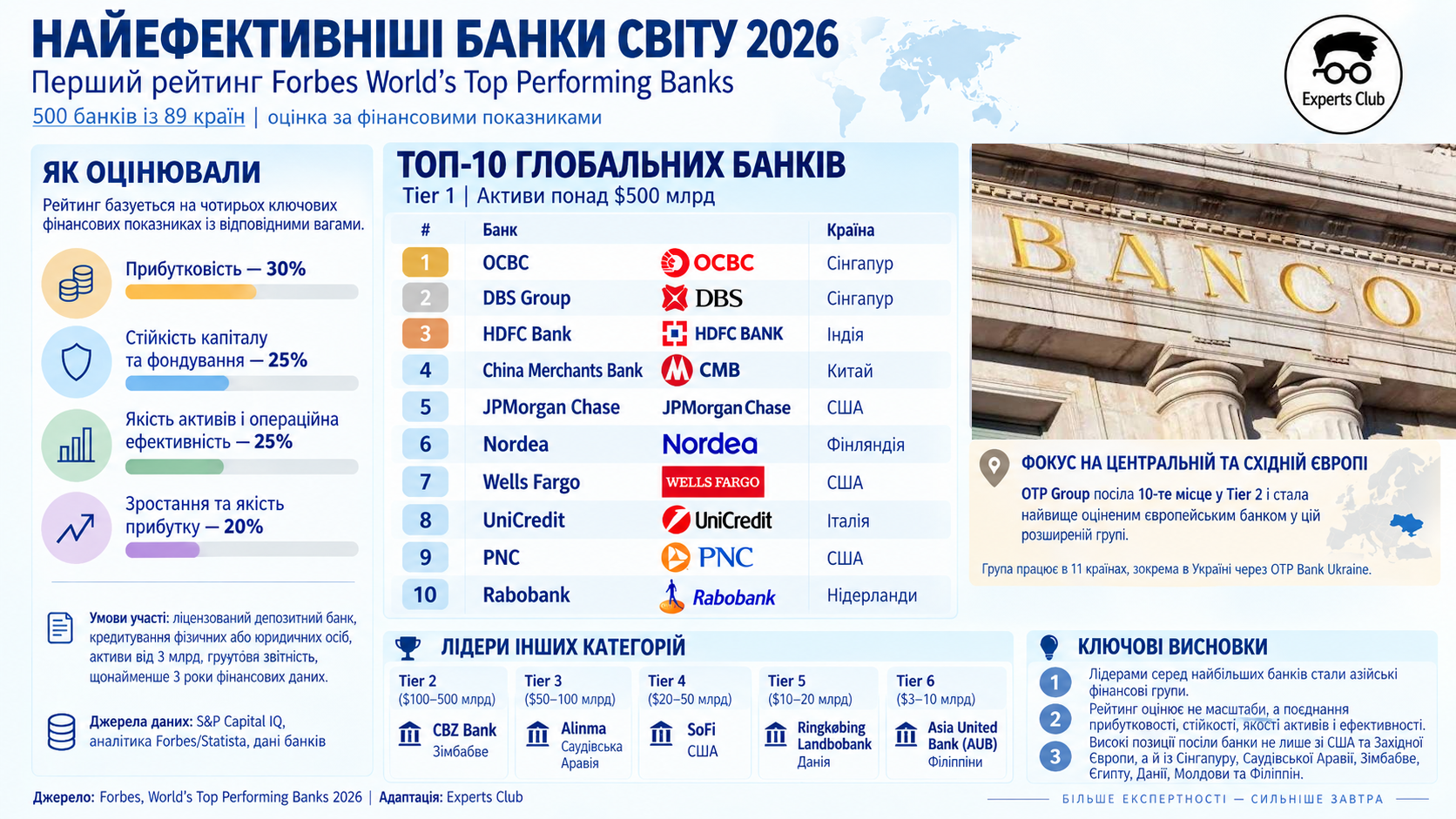
Banks were evaluated according to four blocks of indicators. Profitability accounts for 30% of the final assessment, capital and funding stability - 25%, asset quality and operational efficiency - another 25%, and profit growth and quality - 20%.
During the profitability assessment, the return on average assets, cost-to-income ratio and net interest margin were taken into account, in particular. The growth block included the dynamics and stability of profits and the growth of client deposits over a three-year period. Sustainability was assessed through capitalization and funding structure, including loan-to-deposit ratios, and asset quality through credit risks and balance sheet strength. Forbes and Statista data were obtained from S&P Capital IQ, own analytics and directly from banks.
To participate, a bank must be a licensed deposit organization, engage in lending to individuals or legal entities, have at least $3 billion in assets, publish audited financial statements and provide at least three consecutive years of financial data.
So that a small bank with high profitability is not directly compared to JPMorgan or China's largest banks, Forbes divided participants into six groups:
Tier 1 - global banks: assets over $500 billion.
Tier 2 - large banks: $100-500 billion.
Tier 3 - upper medium-sized banks: $50-100 billion.
Tier 4 - medium-sized banks: $20-50 billion.
Tier 5 - lower medium-sized banks: $10-20 billion.
Tier 6 - small banks: $3-10 billion.
Top 10 most efficient global banks with assets over $500 billion
Place | Bank | Country |
|---|
1 | OCBC | Singapore |
2 | DBS Group | Singapore | rowspan="1">China Merchants Bank
China |
5 | JPMorgan Chase | USA |
6 | Nordea Bank | Finland |
7 | Wells Fargo | USA |
8 | UniCredit | Italy |
9 | PNC Financial Services | USA |
10 | Rabobank | Netherlands |
The largest category is dominated by Asian banks: Singapore's OCBC and DBS took the first two places, the third - the Indian HDFC Bank, the fourth - China Merchants Bank. JPMorgan Chase became the first American bank in fifth place. The best result among EU banks was shown by the Finnish Nordea - sixth place, while the Italian UniCredit took the eighth place.
At the same time, the size of the bank itself did not determine the position in the rating. For example, JPMorgan Chase, with assets of about $4.9 trillion, took only fifth place, while the much smaller OCBC, with assets of about $525 billion, came in first. This confirms that Forbes did not evaluate the scale of the business, but the combination of profitability, growth, balance sheet quality and efficiency.
Leaders of the remaining five categories
In Tier 2 among banks with assets of $100-500 billion, Forbes gave first place to CBZ Bank from Zimbabwe, and Saudi Awwal Bank from Saudi Arabia. Hungarian OTP Bank took 10th place, becoming the highest-rated European bank of this size group.
In Tier 3 with assets of $50-100 billion, the first two positions went to Saudi Arabian banks: Alinma took first place, Arab National Bank - second. Among the prominent representatives of this category, the American East West Bank was in the sixth position.
In Tier 4, which unites banks with assets of $20-50 billion, the American digital bank SoFi became the leader, and the largest private bank of Egypt Commercial International Bank Egypt (CIB) took the second place.
In Tier 5 with assets of $10-20 billion, the Danish Ringkøbing Landbobank took the first place, the American International Bancshares from Texas took the second place. Thus, it was the Danish bank that became one of the two European winners of separate size categories of the rating.
In Tier 6, among banks with assets of $3-10 billion, the Philippine Asia United Bank (AUB) won, and the second place was taken by the Moldovan maib. maib's score is one of the highest for Central and Eastern European banks in the entire Forbes ranking.
Thus, the winners of the six categories look like this: OCBC - Singapore, CBZ Bank - Zimbabwe, Alinma - Saudi Arabia, SoFi - USA, Ringkøbing Landbobank - Denmark and Asia United Bank - Philippines.
Analysis of the geography of the rating shows that high banking performance in 2026 is not concentrated exclusively in the USA and Western Europe. Singapore leads among the largest banks, Saudi Arabia is particularly strong in the medium-sized banks segment, and Zimbabwe, Egypt, the Philippines, Denmark and Moldova are among the leaders in individual categories.
For Central and Eastern Europe, one of the most notable results was 10th place of OTP Group in the category of large banks. Forbes attributes the position of the Hungarian group to organic growth, consolidation of acquired banks and significant investments in digital technologies. According to the group itself, at the end of the second quarter of 2026, its total assets amounted to about EUR131 billion, and the client base - about 17.5 million people.
OTP Group operates in 11 countries of Central and Eastern Europe and Central Asia: Hungary, Bulgaria, Slovenia, Croatia, Serbia, Montenegro, Albania, Moldova, Ukraine, Russia and Uzbekistan. Thus, the result of OTP is directly relevant for the Ukrainian banking market, where the group operates through OTP Bank Ukraine.
According to the data of OTP Group at the end of the first quarter of 2026, about 36% of the group's assets were in Hungary, 19% - in Bulgaria, 13% - in Slovenia, 8% - in Croatia, 7% each - in Serbia and Russia, about 3% - in Uzbekistan and 2% - in Ukraine. The rest were in Montenegro, Albania and Moldova.
The group's presence in Ukraine and Russia at the same time remains an important context when evaluating OTP. In the basic prospectus of the group, it was reported that by the end of 2025, the Russian division formed about 7% of the consolidated assets of OTP, the Ukrainian - about 3%. The group itself has previously announced efforts to reduce Russian exposure after the start of a full-scale war.
According to the Experts Club, the new Forbes methodology gives a slightly different picture of the global banking industry than the classic ratings of the largest banks. The size of assets or market capitalization here is only a condition of assignment to the group, but does not determine the winner. Therefore, a giant with several trillion dollars in assets can be inferior to a significantly smaller competitor if it demonstrates a better combination of profitability, loan portfolio quality, capitalization and efficiency.
Another important difference is that the rating cannot be read as a single list from the first to the 500th place. For example, Ringkøbing Landbobank's first place among banks with assets of $10-20 billion does not mean that it is financially more efficient than JPMorgan, which took fifth place among global banks: they were evaluated against different groups of comparable size competitors.
For the European banking sector, the results are mixed. Europe did not take first place among global banks, but received four positions in the top 10 of the largest category - Nordea, UniCredit, Rabobank and, if we take into account the geographical presence wider than the EU, a significant number of other banks in the following size groups. In addition, European banks became the leaders of Tier 5, took second place in Tier 6 and showed a high OTP result in Tier 2.
A total of 500 banks from 89 countries were included in the World's Top Performing Banks 2026. Forbes published the ranking on September 9, 2026, and Statista confirms that this is the first edition of the list built on the financial KPIs of profitability, growth, sustainability and asset quality.
Original source: Forbes, World's Top Performing Banks 2026, published on September 9, 2026.