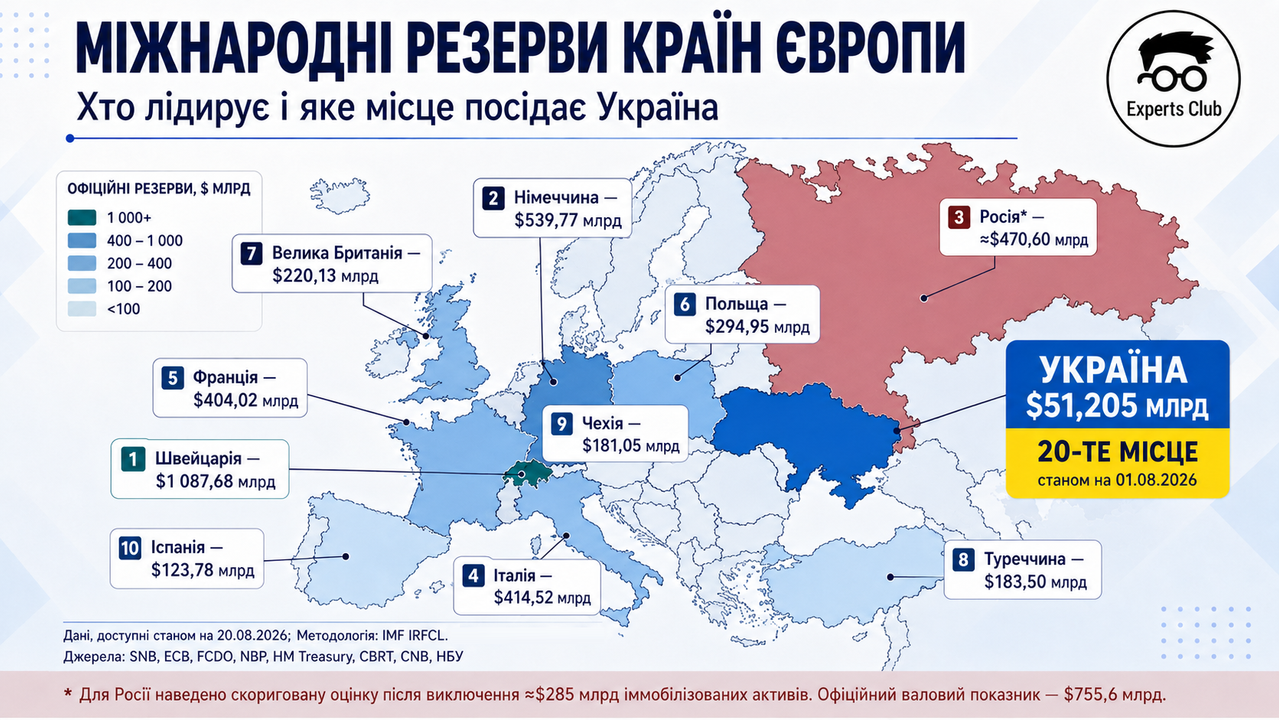
Switzerland remains the largest holder of official international reserve assets in the broad European sample. However, after excluding the immobilized part of Russia's reserves, the second place goes to Germany, while the Russian Federation drops to the third position. With reserves of about $51.2 billion, Ukraine ranks 20th with Kazakhstan or 19th without it.
The rating is based on the latest data available as of August 20, 2026. It covers official reserve assets according to the IMF IRFCL methodology: foreign currency, monetary gold, special drawing rights, reserve position with the IMF and other assets that meet the criteria of international reserves. Broader balance sheet assets of central banks and the aggregate reserve index of the European Central Bank were not taken into account.
The comparison has a number of methodological limitations, since central banks publish statistics with different frequency, so one operative slice combines weekly, monthly and, for some small countries, secondary estimates. Some indicators are directly denominated in dollars, others require conversion from euros or national currencies. The dynamics of the dollar value of reserves can also reflect changes in exchange rates and gold prices, not just the central bank's decision to purchase or sell assets.
"The absolute volume of international reserves cannot be mechanically equated with the economic power of a state. For a correct assessment, it is necessary to take into account the coverage of imports, short-term foreign debt, the currency structure of the portfolio and the real liquidity of assets. A large face value can create a false sense of security if a significant portion of the funds are unavailable or subject to restrictions. Therefore, such a rating should be the starting point for the analysis, and not its final result," emphasized Maksym Urakin, economist and founder of the Experts Club information and analytical center.
Switzerland's leadership is not in doubt, but its indicator needs to be clarified. As of June 30, 2026, the standardized volume of official reserve assets of the Swiss National Bank amounted to $1.0877 trillion. The initial estimate of $1.1205 trillion was obtained from the broader balance sheet positions of the SNB, which are not identical to international reserves in the sense of the IMF.
Germany, taking into account the actual freezing of part of the Russian reserves, comes in second place with an indicator of $539.77 billion. A significant part of its reserve position, as in other large countries of the Eurozone, is formed by monetary gold. The high dollar value of such a portfolio partly reflects its market revaluation, so the growth of reserves does not always mean the actual arrival of new assets.
The indicator of Russia needs special attention. The Bank of Russia reported $755.6 billion in gross international reserves as of August 14, 2026. At the same time, in its own report for 2025, the regulator first states the total volume of reserves, and then directly admits that part of its foreign currency assets remains frozen. This gives reason to conclude that the blocked assets were not removed from the gross statistical indicator.
This practice does not correspond to the economic logic of reserves. Paragraph 6.110 of the BPM6 methodology of the IMF provides that assets, access to which is blocked by a foreign jurisdiction, must be reclassified, since they cannot be used for currency interventions or financing the balance of payments.
Therefore, a working adjustment for approximately $285 billion of immobilized Russian sovereign assets in the jurisdictions of the EU and other G7 countries was used for the rating. This assessment was given by the British Foreign Office, and in March 2026 it was repeated by the British ambassador in Moscow. After subtracting this amount, Russia's figure decreases from $755.6 billion to approximately $470.6 billion, or by 37.7%. At the same time, legally, these Russian assets are not confiscated, because the ownership of the principal amount is preserved, but the possibility of managing it is blocked.
"The situation with Russian reserves demonstrates the fundamental difference between legal ownership of an asset and the real possibility of using it. Formally, the central bank can continue to account for blocked funds on its balance sheet, but they do not perform the main function of international reserves — they cannot be quickly directed to interventions or external payments," Maksym Urakin noted.
After the first three are Italy with $414.52 billion and France with $404.02 billion. Poland has almost $295 billion and is significantly ahead of Great Britain, gross whose reserves at the end of July amounted to $220.13 billion. Turkey and the Czech Republic form the next close pair — $183.50 billion and $181.05 billion, respectively. style="min-width: 25px;">
Place | Country | Indicator for ranking, $ billion | Date | Source |
|---|
1 | Switzerland | 1 087.68 | 06/30/2026 rowspan="1">2 | Germany | 539.77 | 31.07.2026 | ECB RAS |
3 | Russia* | ≈470.60 | 31.07.2026 | FCDO |
4 | Italy | 414.52 | 07/31/2026 | ECB RAS |
5 | France | 404.02 | 31.07.2026 | ECB RAS |
6 | Poland | 294.95 | 31.07.2026 | NBP |
7 | Great Britain | 220.13 | 07/31/2026 | colspan="1" rowspan="1">8
Turkey | 183.50 | 08/14/2026 | CBRT |
9 | Czech Republic | 181.05 | 31.07.2026 | CNB |
10 | Spain | 123.78 | 07/31/2026 | ECB RAS |
11 | Netherlands | 113.80 | 31.07.2026 | ECB RAS |
12 | Denmark | 108.11 | 30.06.2026 | ECB RAS |
13 | Norway | 90.69 | 31/07/2026 | 86,12
| 31.07.2026 | ECB RAS |
15 | Sweden | 75.91 | 15/08/2026 | Riksbank |
16 | Hungary | 74.11 | 31.07.2026 | MNB |
17 | Kazakhstan** | 63.72 | 31.07.2026 | National Bank of Kazakhstan |
18 | Portugal | 63.12 | 07/31/2026 | ECB RAS |
19 | Belgium53.98 underline-offset-2" href="https://data.ecb.europa.eu/data/datasets/RAS/RAS.M.N.BE.W1.S121.S1.LE.A.FA.R.F._Z.USD.X1._X.N.ALL">ECB RAS |
20 | Ukraine | 51,205 | 31.07.2026 | NBU |
21 | Austria | 50.99 | 31/07/2026 | ECB RAS |
22 | Serbia | 35.03 | 07/31/2026 | National Bank of Serbia |
23 | Greece | 22.37 | 31.07.2026 | ECB RAS |
24 | Finland | 22.07 | 31.07.2026 | ECB RAS |
25 | Slovakia | 18.43 | 31/07/2026 | ECB RAS |
26 | Belarus | ≈15.2 | ≈03.2026 | OMFIF |
27 | Azerbaijan | ≈14.5 | ≈03.2026 | OMFIF, Central Bank of Azerbaijan |
28 | Ireland | 13.65 | 31.07.2026 | ECB RAS |
29 | Bosnia and Herzegovina | ≈9.3 | ≈03.2026 | OMFIF |
30 | Albania | ≈8.7 | ≈03.2026 | OMFIF, Bank Albania |
31 | Bulgaria | 8.34 | 31.07.2026 | ECB RAS |
32 | Iceland | ≈7.6 | ≈03.2026 | OMFIF, CBI of Iceland |
33 | Georgia | 7.53 | 31/07/2026 | National Bank of Georgia |
34 | Lithuania | 7.14 | 31.07.2026 | ECB RAS |
35 | Latvia | 6.05 | 31.07.2026 | ECB RAS |
36 | North Macedonia | ≈6.0 | ≈03.2026 | OMFIF |
37 | Moldova | 5.97 | 31.07.2026 | National Bank of Moldova |
38 | Armenia | ≈5.5 | ≈03.2026 | OMFIF, CBA of Armenia |
39 | Croatia | 3.68 | 31.07.2026 | ECB RAS |
40 | Slovenia | 3.55 | 07/31/2026 | ECB RAS |
41 | Luxembourg underline-offset-2" href="https://data.ecb.europa.eu/data/datasets/RAS/RAS.M.N.LU.W1.S121.S1.LE.A.FA.R.F._Z.USD.X1._X.N.ALL">ECB RAS |
42 | Cyprus | 2.82 | 31.07.2026 | ECB RAS |
43 | Estonia | 2.33 | 31.07.2026 | ECB RAS |
44 | Montenegro | ≈2.2 | ≈03.2026 | OMFIF, CB Montenegro |
45 | Malta | 1.68 | 31.07.2026 | ECB RAS |
46 | Kosovo*** | ≈1.5 | ≈03.2026 | OMFIF, CB of Kosovo |
47 | San Marino | ≈0.8 | ≈03.2026 | OMFIF |
* For Russia, the adjusted estimate is given after excluding approximately $285 billion in immobilized assets. The official gross index of the Bank of Russia is $755.6 billion.
** Kazakhstan is included as a transcontinental state. The assets of the National Fund of Kazakhstan are not included in the specified $63.72 billion.
*** Kosovo is a partially recognized state and is not a member of the UN. Its independence, in particular, is not recognized by five EU states — Spain, Cyprus, Greece, Romania and Slovakia. The inclusion of Kosovo in the table has an exclusively statistical purpose and does not imply a position regarding its international legal status. Reference of the European Parliament.
Values with the sign "≈" mostly come from OMFIF Global Public Investor 2026 and have the status of secondary estimates. For Denmark, Norway, Romania, Serbia and Moldova, conversion to dollars was applied at official or reference exchange rates. This makes the table useful as an operational reference, but does not turn it into a statistically homogeneous rating for a single date.
Ukraine had $51.205 billion in international reserves as of August 1, 2026. In a broad sample, this is the 20th place — between Belgium with $53.98 billion and Austria with $50.99 billion. Without Kazakhstan, Ukraine rises to the 19th position. The preliminary conclusion about the 21st or 20th place arose due to the use of outdated May indicators of Belgium and Austria.
In July, the volume of Ukrainian reserves almost did not change: it decreased from $51.27328 billion on July 1 to $51.20536 billion on August 1. The decrease was $67.92 million, or 0.13%. At the same time, from the historical maximum of $57.674 billion recorded on February 1, reserves decreased by $6.46864 billion, or by 11.22%. The claim of a "$6.1 billion reduction from the peak" was inaccurate: roughly the difference occurs when comparing the August figure to the end of 2025, not the February peak.
"Reserves at the level of $51.2 billion remain a significant currency buffer and enable the National Bank to smooth out excessive exchange rate fluctuations and ensure critical external payments. At the same time, the absolute indicator itself should not create the impression of complete security. The foreign exchange market of Ukraine remains structurally deficient, and the stability of reserves depends on the rhythm of international financing, the volume of NBU interventions, debt payments, and the economy's ability to increase export revenue. Therefore, the main question is how stable are the sources of their replenishment," Maksym Urakin emphasized.
The country's place in the absolute rating of reserves is not an independent assessment of its financial stability. A large economy naturally needs a larger currency buffer, while a smaller country may have a relatively small reserve portfolio, but a better ratio of reserves to imports and external debt. For the UK, it is important to distinguish between gross and net reserves. For Russia, the availability of assets is decisive. For the countries of the Eurozone, national reserves function within the Eurosystem and are not completely autonomous currency funds. If imports significantly exceed exports for a long time, the budget depends on external financing, and the production and investment potential does not expand, reserves perform mainly a stabilization function. They give the state time and reduce the risk of a sharp currency shock, but do not replace investments in processing, energy, logistics and export production. Without such changes, macro-financial stability will continue to depend to a large extent on external support," concluded Maksym Urakin.
For Ukraine, the coverage of future imports, the ratio of reserves to short-term foreign debt, the schedule of receipt of international aid, the volume of foreign exchange interventions and future state payments remain decisive. Therefore, the 20th place in the extended European sample describes the absolute scale of the reserve portfolio, but does not give a final answer regarding its sufficiency.