Analytical center Experts Club presented a new short video dedicated to changes in the composition of the world's 20 largest economies by the volume of gross domestic product, calculated by purchasing power parity. The analysis shows the gradual shift of the center of the world economy from North America and Western Europe to Asia, as well as the strengthening of large developing countries with large populations and growing domestic markets.
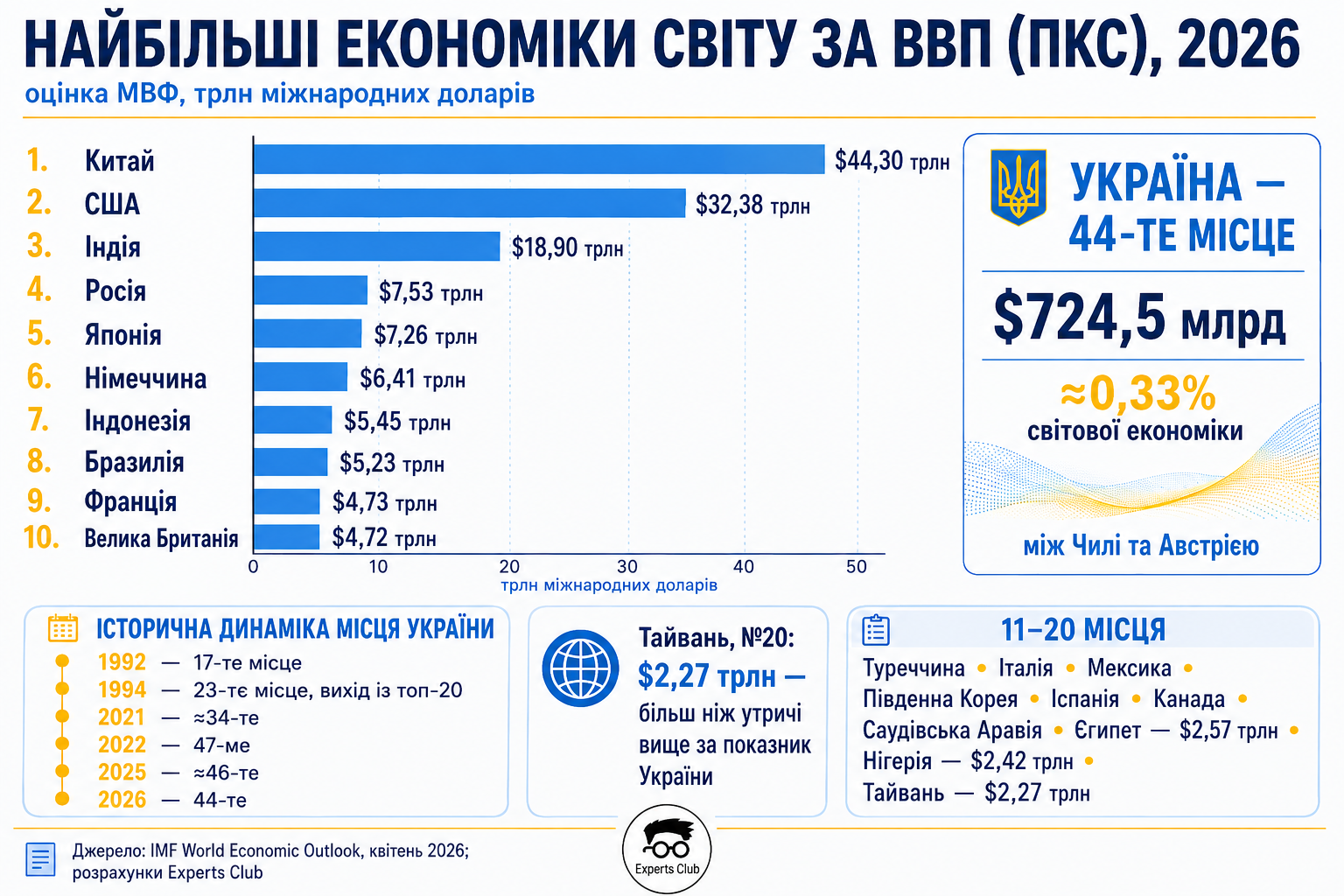
According to the calculations of the Experts Club based on the April database of the World Economic Outlook of the International Monetary Fund, in 2026 China will remain the world's largest economy by GDP per PPP. Its figure is estimated at $44.3 trillion in international dollars. The USA is in second place with $32.4 trillion, and India is in third place with $18.9 trillion. Russia occupies the fourth position with an indicator of about $7.5 trillion, Japan - fifth with $7.3 trillion, Germany - sixth with $6.4 trillion. This is followed by Indonesia, Brazil, France and Great Britain. The second ten largest economies include Turkey, Italy, Mexico, South Korea, Spain, Canada, Saudi Arabia, Egypt, Nigeria and Taiwan.
These figures are the IMF's estimate for 2026, not the final annual results. The complete World Economic Outlook database was published in April 2026 and contains statistics and forecasts until 2031.
China and India became the main winners of the global redistribution
In the early 1990s, the structure of the world economy looked much different. In 1992, the first place was taken by the USA, the second by Japan, and the third by Germany. China was only on the sixth position, India - on the ninth, Indonesia - on the 14th. By 2026, China had risen to first place, followed by India to third and Indonesia to seventh. South Korea moved from the 18th position in 1992 to the 14th, Turkey from the 15th to the 11th.
The growth of Asian countries is associated with population growth, urbanization, expansion of industrial production, infrastructure development and the formation of large domestic consumer markets. The rise of China was especially noticeable. In 1992, its GDP economy was almost five times smaller than that of the United States, while now China's is about a third larger than that of the United States. India has also closed significantly behind the largest economies. Its GDP by PPP in 2026 is almost three times higher than that of Japan or Germany.
Western Europe maintains its position, but loses relative weight
The countries of Western Europe are still widely represented among the world's largest economies, but their relative positions are gradually decreasing. Germany moved from third place in 1992 to sixth in 2026. Italy dropped from fifth to 12th, France from seventh to ninth, Great Britain from eighth to tenth. The Netherlands, which was in the top twenty in the early 1990s, later left it. Australia has also periodically entered the top 20, but is now outside it.
This dynamic does not mean an absolute reduction of European economies. Their GDP continues to grow, but the economies of Asia, the Middle East and some African countries are growing faster. The PPP GDP indicator further strengthens the position of developing countries, as it takes into account differences in domestic prices. One international dollar should reflect the comparative volume of goods and services in different economies regardless of the market exchange rate of the national currency.
Egypt and Nigeria entered the world top 20
One of the important trends of recent decades has been the strengthening of the positions of large African countries. According to the IMF's estimate for 2026, Egypt ranks 18th with GDP per PPP of about $2.57 trillion, Nigeria ranks 19th with $2.42 trillion. Their presence in the top twenty is primarily due to the scale of the population and domestic markets. At the same time, a high aggregate GDP does not automatically mean a high level of well-being of citizens. To assess the standard of living, it is necessary to separately take into account GDP per capita per capita, labor productivity, the structure of the economy, income distribution and the quality of public services.
Ukraine left the top 20 as early as 1994
After the collapse of the USSR, Ukraine was for some time among the twenty largest economies in the world by GDP per capita. According to the calculations of the Experts Club based on the historical series of the IMF, in 1992 Ukraine ranked 17th with an indicator of about $433 billion in international dollars. In 1993, it was in the 19th position, and in 1994 it dropped to the 23rd place and finally left the top twenty.
In 2000, Ukraine was in about 35th place, in 2010 - in 31st place, and on the eve of full-scale war, in 2021, it was in about 34th place positions After a sharp contraction of the economy in 2022, Ukraine dropped to 47th place. The World Bank estimated a drop in real Ukrainian GDP in 2022 of approximately 29%. In the following years, the economy partially recovered. According to the IMF, in 2025 Ukraine took approximately 46th place, and in 2026 it may rise to 44th position. Ukrainian GDP according to the PPP in 2026 is estimated at approximately $724.5 billion in international dollars. This is about 0.33% of the world economy. Ukraine is located between Chile and Austria, ahead of Peru, the Czech Republic, Iraq and Norway.
"Ukraine's departure from the top twenty did not take place in recent years, but in the first half of the 1990s. Since then, the world has changed significantly: China, India, Indonesia, Turkey and other developing countries have been building up industry, infrastructure and domestic consumption, while Ukraine has been going through long-term structural crises, population loss and lack of investment," noted Maksym Urakin, founder of the Experts Club think tank.
According to him, a full-scale war further widened the gap between Ukraine and the world's largest economies due to the destruction of enterprises, energy, transport infrastructure and reduction of labor resources. As of the end of 2025, direct losses to Ukraine were estimated at more than $195 billion, and the needs for recovery and reconstruction for the next decade - almost $588 billion.
Ukraine's return to the top 20 will require many years of rapid growth
The world's 20th economy, Taiwan, has a gross domestic product (GDP) of about $2.27 trillion. This is more than three times higher than the Ukrainian rate. Therefore, the return of Ukraine to the top twenty cannot be ensured only by short-term post-war recovery. This requires long-term growth in productivity, increased investment, the return of a part of the population, the development of the processing industry, and the expansion of the export of products with high added value.
"The main conclusion of the rating is not the location of the country itself, but the speed of its movement relative to other states. Even growth of a few percent per year may not be enough if competitors are growing faster. Ukraine needs a model of anticipatory development, designed for at least two decades," Urakin emphasized.
Experts Club notes that GDP ratings by PCS make it possible to assess the scale of national economies and their role in world production, but should not be used as the only indicator of economic success. The USA, for example, is inferior to China in terms of aggregate GDP per GDP, but significantly ahead of it in terms of GDP per capita, the level of development of the financial market and the value of high-tech companies.
The main global trend remains the gradual shift of economic weight to Asia and the countries of the Global South. In the coming decades, this process will be supported by demographic growth, urbanization and the expansion of the middle class in India, Indonesia, Africa and other developing regions.