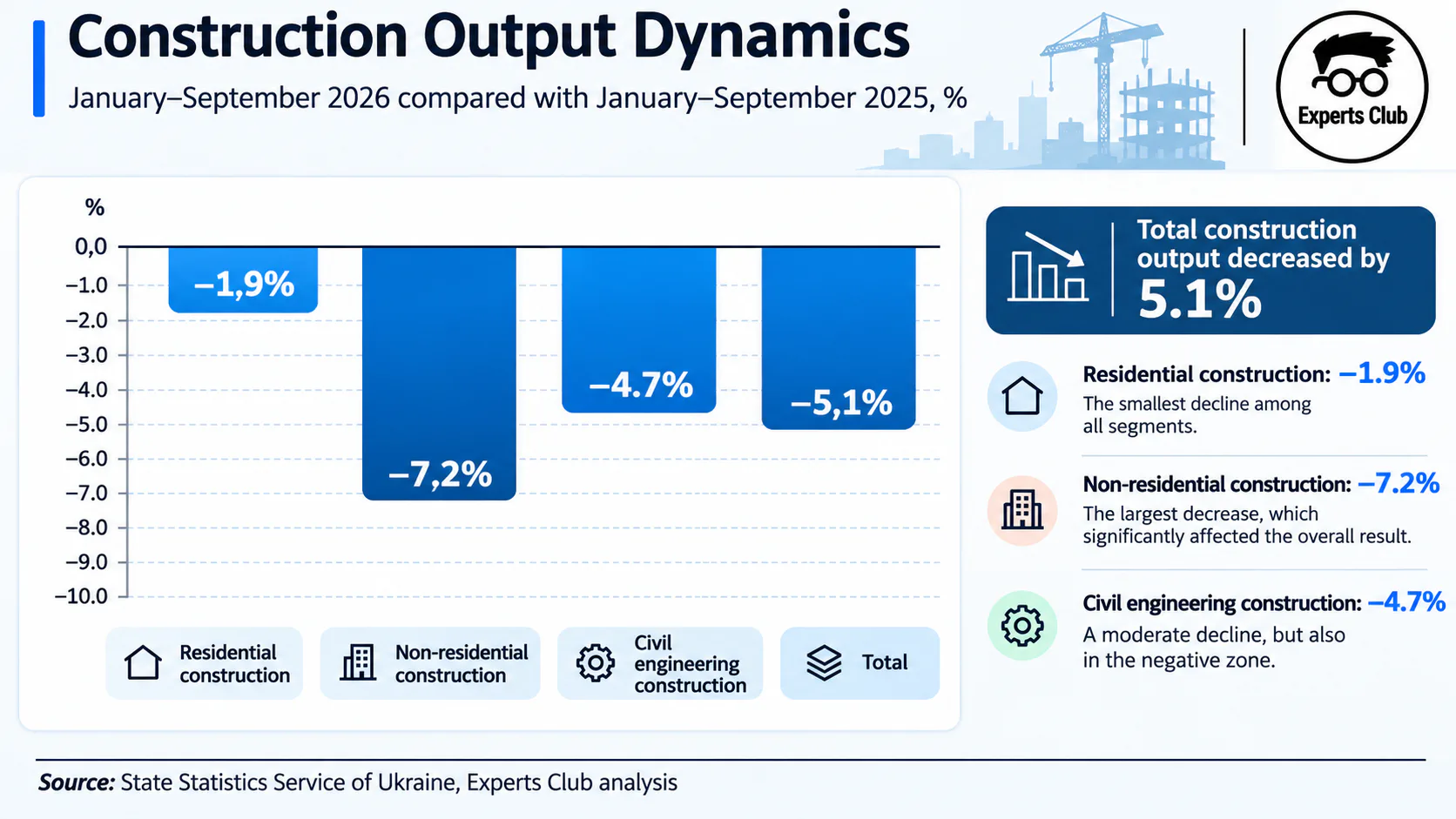
According to the State Statistics Service's report dated November 9, 2026, construction output declined by 5.1% over the nine months, although it increased by 23.2% in September compared with the corresponding month of the previous year.
The nine-month results indicate that negative dynamics persisted in all three main construction segments. The smallest decline was recorded in the residential sector, where volumes fell by 1.9%. Non-residential construction declined by 7.2%, while civil engineering construction fell by 4.7%.
At the same time, the situation changed noticeably in September. The volume of civil engineering construction increased by 51.9% compared with September 2025, while residential building construction grew by 5.7%. In contrast, non-residential construction declined by 13.2%.
The September recovery significantly improved the overall market performance. In January–August, the decline in construction stood at 9.9%, while after including September it narrowed to 5.1%.
However, these figures do not yet provide grounds to conclude that a sustainable recovery has begun. Such a conclusion requires confirmation of positive dynamics over the next several months.
Residential construction: the smallest decline among the main segments
Residential construction proved relatively resilient to the overall market contraction. In January–September, the physical volume of work declined by 1.9%, while in September it increased by 5.7% year on year.
According to Experts Club, activity in this segment may be supported by the completion of previously launched residential complexes, repairs to damaged buildings, housing restoration, and projects in relatively safer regions.
At the same time, construction output should not be equated with the number of apartments sold or the floor area of housing commissioned. These are separate statistical indicators.
To assess the situation, it is also important to take into account changes in the structure of demand. Under wartime conditions, buyers pay greater attention to project completion status, energy supply autonomy, security, and developers' reputations.
Non-residential construction: the largest decline over nine months
The non-residential segment ended the nine months with a decline of 7.2%, the worst result among the three main categories of construction output.
September's dynamics were particularly revealing: while the overall construction market grew by 23.2%, the volume of non-residential building construction fell by 13.2%. This segment includes industrial, warehouse, retail, office, administrative, and other facilities.
The deterioration in its performance may be associated with high capital expenditures, risks of property damage, limited access to financing, and businesses' caution regarding long-term investments.
At the same time, individual subsegments may demonstrate opposite trends. In particular, demand for warehouses, logistics complexes, manufacturing facilities, and protected infrastructure depends on location and the needs of specific enterprises.
Civil engineering construction: September became a turning point
In January–September, the volume of civil engineering construction declined by 4.7%, but in September it increased by 51.9% compared with the corresponding month of 2025. Compared with August, September growth in this segment amounted to 79.3%. It should be noted that this is a month-on-month comparison without automatic adjustment for seasonal effects.
Civil engineering construction includes roads, bridges, pipelines, energy networks, utility infrastructure, and other specialized facilities.
According to Experts Club, this segment could become one of the key areas of the future recovery of Ukraine's construction market.
Its long-term development will depend primarily on the availability of budget financing, the attraction of international funds, the implementation of reconstruction programs, and the timely conduct of procurement procedures.
Construction prices: an increase of 27.1% over the year
One of the most important indicators of 2026 was the acceleration in construction costs. According to State Statistics Service data dated November 9, construction prices increased by 27.1% in September compared with September 2025 and by 1.5% compared with August of the current year.
The largest monthly price increase was recorded in transport infrastructure construction, at 2.4%. Residential building construction became 1.7% more expensive, while non-residential building construction costs rose by 1.6%. This means that nominal expenditure on construction projects may increase even when the physical volume of work declines.
For investors and developers, this situation creates additional risks of cost overruns, revisions of contract prices, and postponement of new projects.
At the same time, the construction price index does not measure price increases for every individual building material. Separate commodity indices and production statistics are required to analyze cement, reinforcing steel, concrete, or glass.
Building materials market: potential for local production
According to the European Business Association, which presented the results of an industry study involving the Kyiv School of Economics, Ukraine's pre-war building materials market was valued at approximately $16 billion. More than 130,000 people were employed in the sector, and its annual growth rate before the full-scale invasion was around 10%.
According to estimates presented by the industry community, Ukrainian enterprises could potentially produce up to 90% of the building materials needed for the country's reconstruction. This estimate describes production capabilities, rather than the actual share of Ukrainian-made products in the market in 2026.
Experts Club analysts believe that developing domestic materials production could become an important condition for reducing import dependence and cutting logistics costs during reconstruction.
However, realizing this potential requires investments in production capacity, equipment modernization, energy efficiency, and workforce training.
Cement: domestic demand and export restrictions
The state of the cement industry is particularly important for the construction sector because cement is used to produce ready-mixed concrete, reinforced concrete structures, and many other building materials.
According to industry sources, domestic cement consumption remains significantly below its pre-war level. Ukrainian producers partially compensate for limited domestic demand through exports, primarily to European Union countries.
At the same time, starting in 2026, the European Carbon Border Adjustment Mechanism (CBAM) became an additional challenge for enterprises. The Ukrcement Association had previously warned about difficulties in exporting products to the EU.
On October 12, the Interdepartmental Commission on International Trade initiated a review of anti-dumping measures concerning cement imports from Turkey. The existing measures were extended for the duration of the review. The State Customs Service published the relevant announcement on October 16, 2026.
According to Experts Club, future developments in the cement industry will depend on domestic construction activity, export conditions, energy costs, and transport logistics.
Metal products: a sharp decline in Ukrainian production
Construction is one of the major consumers of rolled metal products, reinforcing steel, pipes, steel beams, and metal structures. According to data from the Ukrmetallurgprom association analyzed by GMK Center, Ukrainian metallurgical enterprises reduced steel production by 19.8% in the first nine months of 2026, to 4.46 million tonnes. Rolled metal output declined by 23%, to 3.73 million tonnes.
In September, steel production amounted to only 131,000 tonnes, while rolled metal output stood at 137,000 tonnes. Russian attacks on metallurgical production facilities significantly affected enterprise operations.
Experts Club forecast: prospects for the construction market in 2027
According to the Experts Club analytical center, the medium-term prospects of Ukraine's construction market will be determined primarily by the scale of reconstruction financing, the availability of investment capital, the security situation, and the development of domestic building materials production.
Under favorable circumstances, potential areas of growth could include the restoration of housing stock, modernization of energy infrastructure, construction of industrial and logistics facilities, and reconstruction of transport and utility infrastructure.
At the same time, rapid increases in construction costs may limit investment efficiency and reduce the physical volume of work that can be completed within a fixed budget.
The September 2026 recovery is a positive signal, but it has not yet offset the market contraction recorded over the nine months. A transition to sustainable growth requires stabilization of investment demand, predictable project financing, and restoration of the construction industry's production base.
This material was prepared on the basis of official statistics and published industry studies. The Experts Club assessments presented in the text are analytical conclusions, rather than the results of a separate survey or a new statistical model developed by the center.