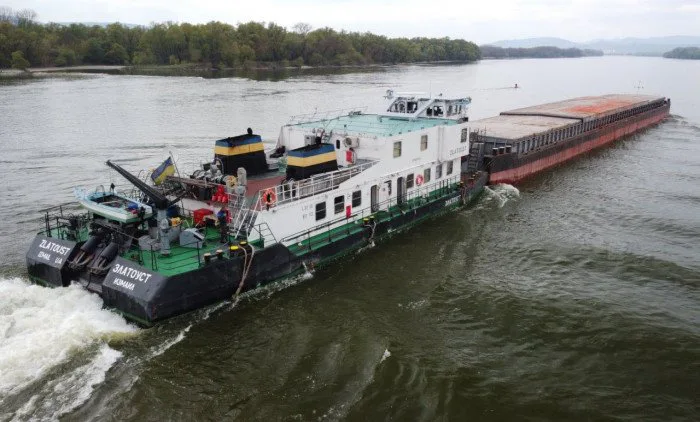
After record growth in 2022–2023 and a subsequent decline in cargo handling, Ukraine's Danube Corridor is once again gaining strategic importance for the country's foreign trade. According to the information and analytical center Experts Club, the combined cargo turnover of the ports of Izmail, Reni and Ust-Dunaisk could reach 25–30 million tonnes annually in the medium term if the river, port, railway and border infrastructure of Ukraine, Romania and Moldova is modernised in a coordinated manner. At the same time, this range represents an analytical scenario rather than an officially confirmed design capacity or a forecast of guaranteed demand: experience in 2026 demonstrated that navigation safety, low water levels and administrative delays can rapidly change the economics of transportation.
The Experts Club study was prepared as of November 19, 2026, based on statistics from the Danube Commission, the Ukrainian Sea Ports Authority, materials from the European Commission, Ukrainian transport authorities, the European Bank for Reconstruction and Development, and international environmental organisations. Its objective is to assess not only potential tonnage but also the resilience of the entire logistics chain, including delivery costs, the availability of vessels and terminals, border crossing capacity, and environmental consequences. The key conclusion is that the Danube's potential cannot be realized through the isolated expansion of individual berths: investment is needed in a system of interconnected routes rather than in competing infrastructure facilities.
From Crisis Logistics to a Long-Term Transport Corridor
Russia's full-scale invasion in February 2022 forced Ukraine to restructure its foreign trade routes amid restricted access to its traditional Black Sea ports. It was then that the Danube ports of Izmail, Reni and Ust-Dunaisk were transformed from predominantly regional transport hubs into a critically important channel for exports of agricultural products, metallurgical raw materials and other bulk cargoes. Their competitive advantage was their geographical location: through the Lower Danube, they are connected to Romanian ports and the Black Sea, while upstream they are linked to the industrial and commercial centers of Central Europe. However, even under conditions of extraordinary demand, cargo turnover was determined not only by the number of berths but also by fleet availability, water depths, vessel clearance procedures and the ability to deliver cargo from Ukraine's inland regions on time.
In 2023, the Ukrainian maritime corridor began restoring direct connections between the Greater Odesa ports and global markets, gradually changing the distribution of export flows. For many large shipments of grain and raw materials, deepwater Black Sea terminals are economically preferable because they reduce the number of transshipment operations and allow the use of large-tonnage vessels. Therefore, the decline in Danube cargo handling in 2024–2025 should not automatically be interpreted as infrastructure deterioration or a loss of its strategic importance. Rather, it demonstrated the transport market's ability to redistribute cargo among several channels depending on security, tariffs, shipment volumes and delivery times.
In 2026, a new wave of Russian attacks on ports and civilian shipping once again confirmed the vulnerability of excessive export concentration along a single route. In its first-half review, the Danube Commission recorded damage to berths, warehouses, engineering utilities and individual vessels resulting from attacks on Ukrainian Danube infrastructure that had already begun in January. Under these circumstances, the alternative route ceased to serve merely as insurance against short-term disruptions and became an element of national economic resilience. The availability of several technically independent routes enables exporters to maintain supplies even when one section of the transport system is forced to reduce its operating intensity.
The changing role of the Danube is also evident at the European level: on March 6, 2026, the European Commission, Ukraine, Romania and Moldova confirmed the continuation of Danube Action Plan 2.0 under the EU–Ukraine Solidarity Lanes initiative. The parties agreed to improve navigation, information exchange between ports and responses to potential traffic disruptions, as well as to expand cooperation concerning railway and road connections. At their July 29 meeting, they again confirmed the need for alternative routes amid threats to merchant shipping in the Black Sea. This approach signifies a gradual transition from emergency transportation arrangements to the development of an integrated cross-border corridor with common service quality standards and coordinated investment.
From a practical standpoint, the project's international status is important because the most problematic sections are not always located in the country where economic losses arise. A Ukrainian terminal may have available berths but remain idle because of restrictions on a Romanian canal; a Romanian port may have spare storage capacity but fail to receive cargo because of a railway bottleneck in a neighboring country. Therefore, the benefits of corridor development should be assessed at the level of the entire route from sender to recipient, rather than through the performance indicators of an individual national authority. This also requires coordinated traffic priority rules and transparent tariffs, particularly during periods of rapidly increasing demand.
Cargo Turnover: Confirmed Results and the Limits of Scenario-Based Growth
Statistics provide the clearest illustration of how quickly the role of Ukraine's Danube ports has changed. According to a Danube Commission study published in October 2026, their combined cargo handling increased from approximately 16.5 million tonnes in 2022 to 32.021 million tonnes in 2023, before declining to 17.396 million tonnes in 2024 and 8.907 million tonnes in 2025. In January–June 2026, the figure amounted to 3.401 million tonnes, compared with 4.464 million tonnes during the same period of 2025, representing a decrease of approximately 23.8%. These figures reflect the operations of the port cluster and should not be confused with separate indicators for river transportation, grain exports or the combined cargo turnover of Romanian ports.
Period | Combined cargo handling at Ukrainian Danube ports |
|---|---|
2022 | Approximately 16.5 million tonnes |
2023 | 32.021 million tonnes |
2024 | 17.396 million tonnes |
2025 | 8.907 million tonnes |
January–June 2025 | 4.464 million tonnes |
January–June 2026 | 3.401 million tonnes |
Sources: Danube Commission, shipping market reviews; Ukrainian Sea Ports Authority. Historical statistics from the Ukrainian Sea Ports Authority were used for 2022.
In the record year of 2023, Izmail accounted for approximately 20.26 million tonnes of cargo handling, Reni for 10.07 million tonnes and Ust-Dunaisk for 1.69 million tonnes, bringing the total to more than 32 million tonnes. In 2025, the volumes handled by these ports declined to approximately 7.63 million, 1.10 million and 184,000 tonnes, respectively, with the sharpest contraction occurring against the backdrop of cargo redistribution toward the Black Sea route. The decline in the combined figure between 2023 and 2025 reached approximately 72%, but such a substantial decrease primarily reflects changes in wartime logistics conditions. For assessing investment prospects, it is more important to understand which elements of the record-performing system of 2023 remain operational and which require restoration or adaptation to new constraints.
Operational data for the third quarter of 2026 demonstrate a reversal in cargo flows. According to a statement by Ukraine's Minister for Communities and Territories Development, Mykola Kalashnyk, published on October 30, average monthly cargo handling at the ports of Reni, Izmail and Ust-Dunaisk increased from approximately 560,000 tonnes in January–June to almost 1.5 million tonnes in July–September. However, an important clarification is necessary: this referred specifically to the third-quarter monthly average, not a separate October result or a confirmed year-round capacity. The rapid response demonstrates the flexibility of operators, but it does not eliminate dependence on a limited fleet, the intensity of military attacks and hydrological conditions.
Based on historical figures, Experts Club identifies three conditional development scenarios for the medium term. The conservative scenario envisages 8–12 million tonnes annually if current risks and competition from deepwater ports persist; the baseline expansion scenario anticipates 15–20 million tonnes with improved coordination of navigation, railway deliveries and terminal handling; and the intensive scenario projects 25–30 million tonnes under comprehensive modernization and a favorable combination of demand, security and navigation conditions. These ranges are not the result of a published engineering calculation of the maximum capacity of each berth and do not mean that the market will provide the corresponding cargo volumes at any tariff level. They should be used as a framework for comparing investment decisions and subsequently refined on the basis of technical inspections, water-level scenarios and long-term contracts with cargo owners.
At first glance, the target range of 25–30 million tonnes appears moderate compared with the 2023 result, but a direct comparison between the two periods has methodological limitations. Record cargo handling was achieved under specific circumstances when shippers had fewer alternatives, while high system utilization may have been accompanied by queues, additional expenses and intensive infrastructure operation. Consistently handling a similar volume year after year will require higher levels of predictability and safety, as well as more competitive transportation costs. In particular, the volume handled during the most successful month cannot be extrapolated to an entire year without examining how many days navigation remains possible at low water levels and how the fleet's effective cargo capacity changes.
According to Experts Club, investment planning should be based not on maximum theoretical tonnage but on a range of sustainable capacity levels under different market conditions. The first scenario should model the normal operation of Black Sea ports and relatively low Danube utilization; the second, a partial shift of exports to the river route; and the third, the emergency transfer of substantial cargo volumes within a short period. For each scenario, the need for vessels, warehouse space, railway wagons and personnel should be assessed separately, together with the cost of maintaining reserve capacity. Such an approach would help avoid investment in facilities that are needed for only a few months under adverse developments for the country.
Corridor Geography and the Role of Romanian and Moldovan Ports
The Ukrainian-Romanian Danube Corridor is effectively a network in which river, maritime, railway and road transportation intersect. The first group of routes connects Izmail and Reni with the Black Sea through the Lower Danube and the Romanian-administered Sulina Canal; the second connects them with the Romanian ports of Galați and Brăila, from which further transportation across the EU is possible. The third group comprises road and railway connections through Moldova and Romania, with subsequent transshipment to water transport, while the fourth provides upstream connections along the Danube to Bulgaria, Serbia, Hungary, Slovakia, Austria and Germany. The Rhine–Main–Danube system theoretically provides access to logistics hubs in the Rhine basin, although the commercial feasibility of such a long route for a particular cargo depends on vessel draft, lock transit times and the number of transshipments.
The Romanian port of Constanța remains the most important international hub, connecting the river network with global maritime shipping lines. Barges and river-sea vessels can deliver bulk cargo from Danube ports, after which shipments are consolidated for transportation by large-tonnage seagoing vessels to the Mediterranean, Africa, Asia and other regions. Thanks to this function, Constanța is important not only as a transshipment point for Ukrainian grain but also as a location where competing cargo flows from several countries converge. The better the port coordinates railway deliveries, storage and vessel arrival schedules, the lower the likelihood that additional Ukrainian transit will cause delays for Romanian exporters and higher tariffs for all customers.
Industry publications citing the Constanța port administration indicate that approximately 1.03 million tonnes of Ukrainian grain passed through the port in January–September 2026, compared with 321,000 tonnes during the same period of 2025, representing an increase of more than threefold. Total grain exports through the port over the nine months amounted to approximately 15.8 million tonnes, while its combined cargo turnover reached around 51.55 million tonnes. Consequently, Ukrainian grain accounted for a noticeable but still relatively small segment of Constanța's overall grain flow, which is important when assessing the actual interdependence of the markets. The growth of Ukrainian shipments also does not mean that all of these products were transported through Ukrainian Danube ports: some cargo may have arrived via other transport routes.
Private-sector investment confirms interest in expanding transshipment infrastructure. In July 2026, the Transport Trade Services group announced the completion of the Canopus Constanța project, worth approximately €23 million, which increased the grain terminal's storage capacity to 180,000 tonnes. The significance lies not only in the additional storage volume but also in the development of cargo reception facilities for barges and road transport, which increases the terminal's flexibility during periods of uneven deliveries. Nevertheless, even a large warehouse does not eliminate shortages of vessels or railway connections, so investment projects should be evaluated in conjunction with all subsequent operations until the cargo reaches the maritime market.
The second important integration point is the Giurgiulești International Free Port in Moldova, located at the intersection of the transport systems of three countries. In 2026, the European Bank for Reconstruction and Development completed the sale of ICS Danube Logistics, the port operator, to the Romanian state-owned company Port of Constanța, which became its sole owner. According to the EBRD, more than 70% of Moldova's waterborne import and export transportation passes through Giurgiulești, while the new owner has undertaken commitments concerning the infrastructure's long-term development and modernization. The transaction creates opportunities to coordinate terminal services, routes and investment schedules between the Moldovan and Romanian segments, but it does not in itself guarantee lower tariffs or unrestricted access for all carriers.
For Ukraine, the potential synergy lies in the creation of a complementary Constanța–Galați–Giurgiulești–Reni–Izmail system. Under this model, different terminals could specialize in specific cargo categories, redistribute volumes when neighboring hubs become congested and jointly improve information exchange. However, economic benefits are possible only in the absence of discriminatory tariffs and with continued competition among shipowners, freight forwarders and storage operators. If integration results solely in the concentration of market power, part of the expected benefit from modernization may be absorbed by higher service costs.
Additional potential is associated with land transport infrastructure. The Ukrainian-Romanian memorandum signed in September 2026 provides for the development of road border crossing points and access roads, railway connections, simplified border procedures and expanded capacity for handling Ukrainian cargo at Romanian ports. The updated bilateral strategy mentions 17 border crossing points, including ten new proposals, although not all of them directly serve Danube cargo flows. Therefore, when selecting projects, it is important to avoid automatically classifying all border infrastructure investments as part of the Danube Corridor and instead calculate the actual impact of each facility on specific freight connections.
Cargo Structure and the Economics of Multimodal Transportation
Agricultural exports remain the main potential cargo base, including wheat, corn, barley, oilseeds and processed oilseed products. These commodities are shipped in large volumes, are relatively well suited to river transportation and are particularly sensitive to changes in logistics costs per tonne. For agricultural producers, the ability to choose between the Black Sea, the Danube and land border crossings reduces the risk of supply disruptions and strengthens their negotiating positions when concluding transportation contracts. However, the river option is not necessarily cheaper than direct maritime shipment: additional transshipments, queues and storage can offset the advantage of the barge transportation cost itself.
A second promising area includes iron ore, pellets, rolled steel and other metals, as well as construction and industrial cargo. Their considerable weight makes water transportation attractive where sufficient cargo volumes exist and the overland delivery distance to the terminal is relatively short. For Ukrainian industrial enterprises, additional access to Central European markets may become particularly important after production capacity is restored and energy supplies normalize. However, such a route requires appropriate handling equipment, specialized facilities and coordinated schedules; otherwise, the benefits of water transportation will be lost during transshipment between railways and barges.
On the import side, fuel, petroleum products, mineral fertilizers, certain chemical raw materials, equipment and materials for rebuilding damaged facilities are particularly important. A stable return cargo flow increases vessel utilization and can reduce the average cost per voyage because carriers distribute their fixed costs between the two directions. At the same time, operations involving hazardous cargo require specialized terminals, fire protection, spill prevention equipment and strict compliance with environmental standards. Economic efficiency in this area must be weighed against potential accident damage and the costs of maintaining emergency response readiness, rather than being determined exclusively by the tariff per tonne.
Containerized and general cargo, machinery, steel structures and non-standard equipment could form a separate market niche. Developing these services requires regular sailings, convenient railway connections, predictable delivery times, standardized document processing and the ability to track cargo throughout the route. Unlike seasonal grain transportation, container services are particularly dependent on stable schedules, so periodic canal disruptions or the absence of return cargo flows significantly complicate the establishment of a commercially sustainable service. For this reason, containerization prospects should be linked primarily to specific industrial and trade supply chains rather than to an abstract increase in overall port capacity.
Assessing the Danube's competitiveness requires more than comparing river freight rates with the cost of transportation by seagoing vessels. Total logistics costs include road or railway delivery, loading, transshipment, waiting times at the canal, storage, customs clearance, insurance, potential demurrage charges and the maritime leg to the final buyer. When the military situation changes, even a relatively inexpensive route may become more costly because of insurance premiums and prolonged waiting times, while during low-water periods costs may increase because of restrictions on the vessels' effective cargo loads. This is why Experts Club proposes that the main indicator of modernization should not be cargo handling volume itself, but the total cost and predictability of delivering one tonne of cargo from sender to recipient.
A comprehensive analysis must also account for differences in customer requirements. A major grain trader may prioritize the lowest tariff and the handling of a large shipment; an industrial importer may prioritize meeting equipment delivery deadlines; and a fuel supplier may require uninterrupted supplies under stricter safety requirements. The same infrastructure project affects these groups differently, meaning that a single indicator of "additional millions of tonnes" does not reflect the full economic value of investment. A more accurate assessment can be achieved by modeling logistics chains for different cargo categories and analyzing the market's willingness to pay for specific service quality.
Bottlenecks: The Sulina Canal, Railways, Fleet and Climate
Transit through the Sulina Canal, which connects the Lower Danube with the Black Sea, remains the most visible organizational constraint. In August and September 2026, rising demand for the Danube route amid threats to Black Sea shipping led to the accumulation of dozens of vessels, with waiting times exceeding two weeks for some voyages. Industry participants cited the limited number of pilots, clearance procedures and the need for safe traffic regulation among the causes. In September, a system of preliminary vessel inspections before entry into the canal was agreed upon, but the sustainability of this solution should be evaluated based on actual reductions in queues across different seasons and traffic conditions.
Romania's PRIMUS project is intended to improve signaling, navigation equipment, traffic monitoring and pilotage services on the Sulina Canal. Planned measures include implementing information systems, modernizing traffic control services and providing the technical equipment required for safer vessel transit under difficult visibility conditions. However, the existence of the project does not mean that all vessel categories have already been granted unrestricted round-the-clock navigation rights, and any changes to navigation rules must be supported by current regulations and practical results. The most rational approach is the gradual expansion of navigation windows where safety, hydrological conditions and vessel specifications allow it.
The second group of constraints concerns railway connections, where the transition between Ukraine's 1,520 mm gauge and the European 1,435 mm standard requires cargo transshipment, bogie exchange or other technological solutions. In addition, delivery speed depends on locomotive availability, the condition of access tracks, sufficient wagon numbers and the coordination of schedules with river terminals. Even expensive berth expansion will not produce the expected effect if a port cannot consistently receive and dispatch the required daily cargo volumes. Therefore, investments in railway infrastructure should be considered together with terminal projects and the modernization of border procedures.
The third constraint is the availability of river vessels, particularly barges, tugboats and specialized vessels suitable for operation at limited water depths. Additional cargo volumes cannot be achieved solely by constructing warehouses if there are insufficient vessels and crews on the market or if their loading capacity decreases during the low-water season. Fleet aging also affects fuel consumption, environmental performance and the frequency of technical stoppages. Corridor development requires incentives for fleet renewal, repair and maintenance services, but procurement decisions must account for actual seasonal demand to avoid prolonged idling of expensive assets.
Hydrological risks became particularly acute in 2026. At the EU Strategy for the Danube Region forum on November 3, Manfred Seitz, Director General of the Secretariat of the Danube Commission, pointed to record-low water levels along a substantial section of the river from Kelheim to Sulina and noted that some loaded vessels had been forced to navigate with drafts of approximately 1.3–1.5 meters. This is not a universal restriction applicable to all river sections and vessels, but rather an illustration of the scale of the problem under the most difficult conditions. A reduction in permissible draft directly decreases the cargo weight transported per voyage, requires additional vessels and increases the cost per tonne-kilometer even when port operators' tariffs remain unchanged.
The energy dimension of low water levels is particularly revealing. In late July 2026, the Hungarian energy company MVM reported that the Paks Nuclear Power Plant was operating at approximately half of its nominal capacity due to falling Danube water levels and that a further reduction in electricity generation might become necessary. This example demonstrates competition for water resources among shipping, energy, industry, agriculture and natural ecosystems. Consequently, deepening navigation channels and changing water-use regimes cannot be assessed solely in terms of benefits to carriers: cross-sectoral hydrological calculations and coordination of the interests of all river basin users are necessary.
Military threats constitute a separate category of risks for which traditional infrastructure solutions have limited effectiveness. For Ukrainian ports, protecting personnel and energy supplies, enabling rapid restoration of damaged berths, maintaining backup communications and flexibly redistributing cargo among neighboring hubs are critically important. For shipowners, the decisive factors remain the availability of voyage insurance, crew safety and access to reliable information about threats. Even substantial investments in terminals will not deliver their full benefits if commercial operators consider the risks associated with a particular route unacceptable.
Environmental Sustainability as a Condition for Modernization
The Danube Delta is one of Europe's most valuable wetland ecosystems, located in Romania and Ukraine and enjoying international environmental protection status. Its condition depends on the distribution of water and sediment, seasonal flooding, water quality and the resilience of numerous habitats. Therefore, projects intended to increase the capacity of river routes must consider their impact not only on the navigable channel but also on surrounding natural systems. In this case, environmental requirements are not an external obstacle to economic development but a condition for the durability and legitimacy of infrastructure investment.
Dredging in certain sections can improve navigation safety and reduce draft restrictions, but its consequences vary significantly depending on location, methods and the scale of work. Large-scale intervention can alter sediment transport, shoreline dynamics, floodplain inundation patterns and spawning grounds, including beyond the territory of the country carrying out the works. According to Experts Club, priority should be given to localized maintenance measures based on up-to-date hydrographic surveys, hydrodynamic modeling and independent environmental impact assessments. Where transboundary consequences are possible, consultations with neighboring countries as required under international obligations are necessary, along with transparent publication of baseline data and monitoring results.
Increased shipping activity raises requirements for preventing petroleum spills, managing ship-generated waste, controlling the transport of hazardous substances and preparing for emergencies. Heavy traffic also increases the likelihood of noise, localized pollution and the spread of invasive species through vessel operations. These risks can be reduced through traffic management systems, properly equipped emergency response services, port reception facilities and regular environmental monitoring. The costs of these measures should be included in investment plans from the outset rather than treated as secondary expenses after new facilities become operational.
In 2025, the Danube Commission, the International Commission for the Protection of the Danube River and the International Sava River Basin Commission updated the agreed principles for inland navigation development and environmental protection in Joint Statement 2.0. This approach envisages the joint achievement of transport and environmental objectives, the application of adaptive management and the preservation of the natural functions of waterways. In September 2026, the relevant commissions discussed moving from the document's adoption to its practical implementation, including under conditions of low water levels and climate change. Such a framework is particularly important for the Ukrainian-Romanian-Moldovan corridor because it allows projects to be assessed against comparable criteria and reduces the likelihood of transboundary conflicts.
Climate scenarios must become a mandatory component of transport planning through 2030 and beyond. A facility designed to maintain certain depths under long-term average conditions may prove economically vulnerable to recurring droughts, sudden floods and rising water temperatures. Preference should therefore be given to solutions that remain effective across a wide range of hydrological conditions, including adaptable vessels, more accurate forecasting, flexible cargo flow management and multimodal alternatives. This increases the resilience of both the transport system and the natural environment on which it depends.
Economic Benefits for Ten Countries and Financing Opportunities
The Danube flows through or along the borders of ten countries, while its drainage basin covers 19 countries and, according to the International Commission for the Protection of the Danube River, is home to tens of millions of people; the commission's materials frequently cite an estimate of approximately 79 million inhabitants. Therefore, the development of navigation on the Lower Danube can affect not only Ukraine, Romania and Moldova but also domestic markets across Central and Southeastern Europe. However, the benefits are distributed unevenly and depend on the economic structure of each country, the location of enterprises, port conditions and the availability of alternative transport connections. An international investment program must take these differences into account; otherwise, costs and benefits will be distributed disproportionately among countries.
For Ukraine, the main benefit is greater resilience of exports and imports and reduced dependence on a single Black Sea route, while for Romania, it is increased demand for services provided by Constanța, the Sulina Canal, inland ports and the railway network. Moldova can use the development of Giurgiulești and transit railway connections to expand its own trade and logistics services. At the same time, the economies of the three countries are interested not merely in increasing transit tonnage but in reducing total transportation costs and improving business predictability. Competition for individual cargo flows should be combined with joint efforts to eliminate bottlenecks affecting the entire route.
Bulgaria could gain additional opportunities for the ports of Ruse, Lom and Vidin, while Serbia could benefit through the industrial and logistics centers of Belgrade, Novi Sad and Smederevo. Grain, fuel, metals, construction materials and equipment transportation are important for both countries, but the commercial returns depend on reliable navigation along the middle and lower sections of the river. Hungary is interested in transporting agricultural and industrial products, developing inland terminals and maintaining reliable waterborne connections with the Balkans and the Black Sea. At the same time, its experience with low water levels in 2026 demonstrates that transport strategy must be coordinated with energy security and water resource management objectives.
Croatia can strengthen the role of the Danube port of Vukovar and connections with the Sava basin, while Slovakia can use the Bratislava and Komárno hubs to transport raw materials, metals and oversized products. Austria has industrial and logistics centers in Vienna, Linz and Enns, for which improved navigation could expand the range of available eastbound routes. Germany is interested in connecting Bavarian transport hubs with the Danube and, through the inland waterway system, with Central European markets. Additional indirect effects may arise for the Czech Republic, Slovenia, Bosnia and Herzegovina, the Netherlands and Belgium, although the magnitude of these effects requires separate calculations for specific cargoes and transport chains.
The project's international scale makes it possible to attract financing not only from national budgets but also through European transport network development mechanisms, international banks and private investors. The European Commission reports that more than €2.8 billion has been mobilized to improve the entire EU–Ukraine Solidarity Lanes system, including €1.55 billion in grant support under the Connecting Europe Facility. It is important to emphasize that these amounts cover railway, road, digital and other projects across several routes and do not constitute a dedicated budget for Danube development. For the same reason, the announced financing amounts cannot be directly compared with the cost of a specific program to expand the ports of Reni or Izmail: its budget must be developed separately on the basis of project documentation.
To attract private capital, infrastructure projects should be divided into several groups with different return-on-investment models. Commercial grain, container or fuel terminals can be developed primarily through investments by operators and cargo owners, while maintaining a safe navigation channel, border infrastructure and information systems often have the characteristics of public infrastructure and require government or blended financing. Restoring facilities damaged by the war may additionally involve grant support and international risk insurance mechanisms. At the same time, all projects must undergo economic efficiency assessments, transparent selection procedures and environmental reviews regardless of their funding sources.
Priorities for 2027–2030 and Performance Criteria
During the first stage, in 2027, Experts Club proposes focusing on measures capable of improving the efficiency of existing infrastructure without large-scale construction work. These include a joint digital system for managing queues and vessel arrivals, coordinated data exchange on water depths and vessel drafts, improved hydrological forecasting, greater pilot availability and reduced duplication of inspections. An important practical outcome should be a single list of critical constraints across the entire route, identifying the responsible agencies, possible deadlines for their elimination and the expected economic impact. This list should be updated regularly as circumstances change so that investment decisions are not based on outdated information about cargo flows.
During the second stage, in 2028–2029, priorities could include targeted terminal modernization, railway connection development, renewal of the river fleet and the creation of conditions for regular container services and return cargo flows. When selecting projects, preference should be given to solutions that eliminate constraints for several cargo categories simultaneously and remain in demand when the deepwater Black Sea ports resume normal operations. Every major project should be accompanied by an independent cost-benefit analysis that considers military risks, seasonal water-level fluctuations, carbon emissions and other environmental consequences. The payback of port infrastructure should be calculated under several cargo turnover scenarios rather than exclusively under an optimistic trajectory.
The third stage, 2030 and beyond, envisages the establishment of a resilient international network with coordinated navigation rules, transparent commercial conditions and a higher degree of technical interoperability. In September 2026, European transport ministers from Danube countries reaffirmed the objective of achieving adequate navigation conditions on the TEN-T network sections by 2030 while complying with environmental legislation. For Ukraine, this creates an opportunity to connect the recovery of industrial regions with European infrastructure development programs and access to new markets. However, the purpose of such integration is not an unconditional pursuit of maximum tonnage, but the availability of several reliable routes as market and political conditions change.
The performance evaluation system should include at least six interconnected indicators: the average total delivery cost per tonne of cargo, the actual transit time along the route, variations in delivery times between voyages, the number of days with navigation restrictions, infrastructure utilization rates, and emergency and environmental safety indicators. For public investment, it is also necessary to consider the economic value of avoided trade disruptions and the route's ability to absorb additional volumes when cargo is redirected during a crisis. The share of return cargo transportation that reduces empty vessel movements should be recorded separately. If tonnage increases while delivery costs, queues and environmental risks grow even faster, such an outcome cannot be considered a genuine success of modernization.
In the long term, the corridor's efficiency will depend on the quality of management no less than on the volume of capital investment. Common data exchange formats between Ukrainian, Romanian and Moldovan ports, predictable rules for accessing services, dispute resolution mechanisms and the ability to introduce coordinated anti-crisis measures quickly are necessary. Transparent statistics on queues, service costs and actual throughput capacity will enable investors to assess demand more accurately and cargo owners to select routes based on economic rather than solely administrative factors. It is precisely management coordination that can generate benefits even where the physical expansion of the canal or construction of new berths is constrained by hydrological and environmental conditions.
Experts Club Conclusions
Ukraine's Danube Corridor has already demonstrated its ability to handle substantial cargo flows during crisis periods: more than 32 million tonnes handled in 2023 is a confirmed historical result. At the same time, the decline to 8.9 million tonnes in 2025 and transportation constraints in the first half of 2026 show how strongly utilization depends on the competitiveness of Black Sea ports and external circumstances. The recovery in demand during the second half of 2026 does not eliminate climatic and organizational risks; it merely emphasizes the need to keep alternative capacity in operational condition. Therefore, the target range of 25–30 million tonnes annually should be considered a possibility under a favorable combination of conditions rather than a guaranteed result of any individual investment program.
According to Experts Club, the optimal strategy for Ukraine, Romania and Moldova is to create a complementary multimodal transport network capable of rapidly redistributing cargo among ports, railways and road routes. It should combine management coordination, modernization of terminals and access infrastructure, adaptation of the river fleet to low water levels, competitive access to infrastructure and compliance with international environmental obligations. The economic criterion for its success will not be a record achieved by an individual port, but a reduction in delivery costs and uncertainty for businesses, combined with greater resilience of foreign trade. Only under such an approach can the Danube simultaneously serve as an alternative wartime route and a permanent component of the European transport system.
Methodology and Sources. This material was prepared as of November 19, 2026, based on available statistical reviews and statements from relevant authorities; operational indicators for 2026 and annual statistics are presented with their respective periods clearly distinguished. The ranges of 8–12 million, 15–20 million and 25–30 million tonnes represent scenario-based estimates by Experts Club, not an official forecast or confirmed engineering capacity of the ports; additional feasibility studies and environmental assessments are required for investment decisions. When comparing routes, it is important to consider that some statistical publications reflect port cargo handling, while others report exports of specific commodities or river traffic, and these indicators cannot simply be added together.
Main verified open sources: Danube Commission — Market Observation, January–June 2026; European Commission — Danube Action Plan 2.0, March 2026