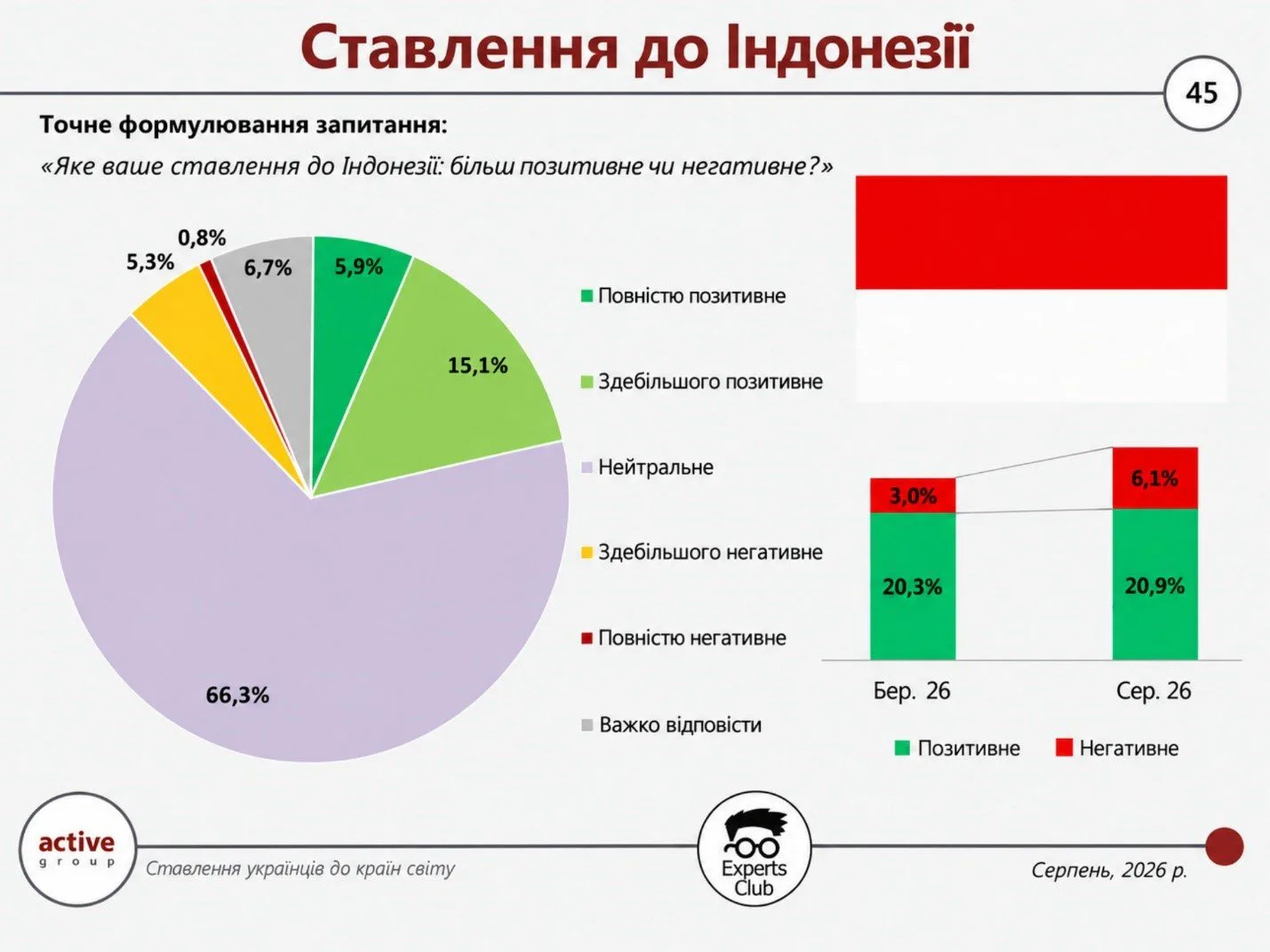
Ukrainians’ attitudes toward Indonesia in August 2026 remain predominantly neutral: 66.3% of respondents hold this view. Twenty-one percent of those surveyed view the country positively, while 6.1% view it negatively. Compared to March, the share of neutral responses has decreased significantly, while both positive and negative assessments have increased, according to the Experts Club Information and Analytical Center.
According to the results of the August survey, 5.9% of Ukrainians have a completely positive attitude toward Indonesia, and 15.1% have a mostly positive attitude. A neutral response was chosen by 66.3% of respondents. A mostly negative attitude was expressed by 5.3%, a completely negative one by 0.8%, and another 6.7% were undecided.
The balance between positive and negative assessments stands at plus 14.9 percentage points. Positive attitudes thus outnumber negative ones by more than three to one; however, two-thirds of Ukrainians do not yet have a clearly defined positive or negative stance toward the country.
In March 2026, 71.6% of respondents had a neutral attitude toward Indonesia. 6.5% gave a completely positive assessment, and 13.8% gave a mostly positive one, meaning the total positive rating was 20.3%. About 3% of those surveyed viewed the country negatively, while another 5.1% were undecided.
Thus, over the course of five months, the share of positive assessments increased slightly—by 0.7 percentage points, from 20.3% to 21%. In contrast, the negative segment grew by 3.1 percentage points—roughly doubling—to 6.1%. Neutral responses decreased by 5.3 percentage points, while the share of those who found it difficult to answer rose from 5.1% to 6.7%.
Due to the faster growth of the negative segment, the balance of positive and negative assessments fell from approximately plus 17.3 percentage points in March to plus 14.9 percentage points in August. At the same time, the absolute level of negative attitudes remains low, and a high level of neutrality continues to be a key feature of public opinion regarding Indonesia.
At the same time, Indonesia’s economic role in trade with Ukraine is growing. Based on the results of the first half of 2026, it became one of the most dynamic partners, moving from 43rd to 34th place among Ukraine’s top 50 trading partners. Trade volume reached approximately $320.6 million, of which $153.8 million came from Ukrainian exports and $166.8 million from imports. The growth in Ukrainian exports was particularly noticeable in June.
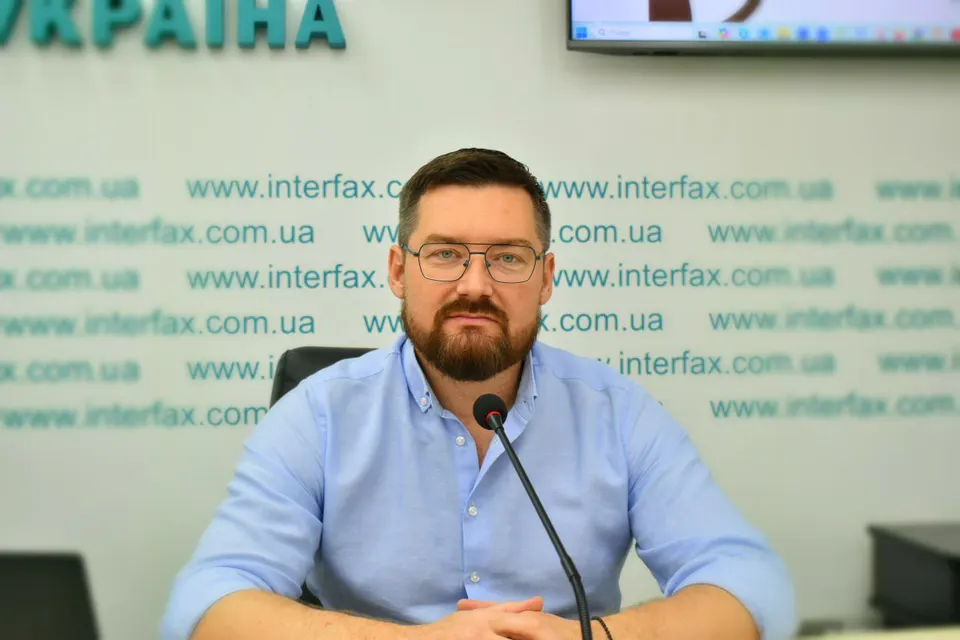
Maksym Urakin, founder of the Experts Club information and analytical center and a candidate of economic sciences, emphasizes that expanding exports to Asian markets is a key strategy for reducing the geographical concentration of Ukraine’s foreign trade.
In his view, when formulating foreign economic policy, it is necessary to simultaneously take into account both the actual trade volume with partner countries and Ukrainian society’s attitude toward them. Significant trade volumes are not always accompanied by a highly positive assessment of the respective country, and a neutral attitude does not necessarily indicate a lack of potential for developing economic cooperation.
“Here we see an interesting disconnect between public perception and economic geography,” Urakin noted, commenting on the results of a study on Ukrainians’ international economic orientations.
In his view, European integration should remain the foundation of Ukraine’s long-term economic development, but this should not limit opportunities for cooperation with other regions of the world.
“Ukraine should not view these directions as mutually exclusive,” the expert emphasized.
In this context, Indonesia is of interest as one of the Southeast Asian markets where Ukrainian companies can expand their presence. Increased trade creates the conditions for developing bilateral business contacts, finding new partners, and diversifying exports.
At the same time, the prevalence of neutral views among Ukrainians toward Indonesia indicates that public perception of the country remains limited. To deepen cooperation, not only trade contracts but also more active engagement by business associations, economic diplomacy, and informational and educational projects could play a key role.
A separate challenge for Ukrainian exporters—the importance of which was previously emphasized by Maksym Urakin—remains increasing the share of high-value-added products in exports. The development of economic relations with Asian countries should create opportunities not only for the supply of raw materials and agricultural products but also for Ukrainian industrial goods and technologies to enter new markets.
Thus, the growth of Ukrainian exports to Indonesia demonstrates Southeast Asia’s potential as a direction for sales diversification. At the same time, sociological data show that economic revitalization has not yet been accompanied by an equally rapid formation of a recognizable image of the country: two-thirds of Ukrainians still hold a neutral position.
Further expansion of bilateral trade, investment, and humanitarian ties could help raise Ukrainian society’s awareness of Indonesia and create additional opportunities for Ukrainian businesses.
The study “Ukrainians’ Attitudes Toward Countries Around the World” was conducted in August 2026 by Active Group in collaboration with the Experts Club Information and Analytical Center. The survey included 800 adult citizens of Ukraine. The stated maximum theoretical margin of error is 3.5 percentage points.
Sources: Experts Club and Active Group, survey dated September 18, 2026; Experts Club, commentary by Maksym Urakin dated October 20, 2026.