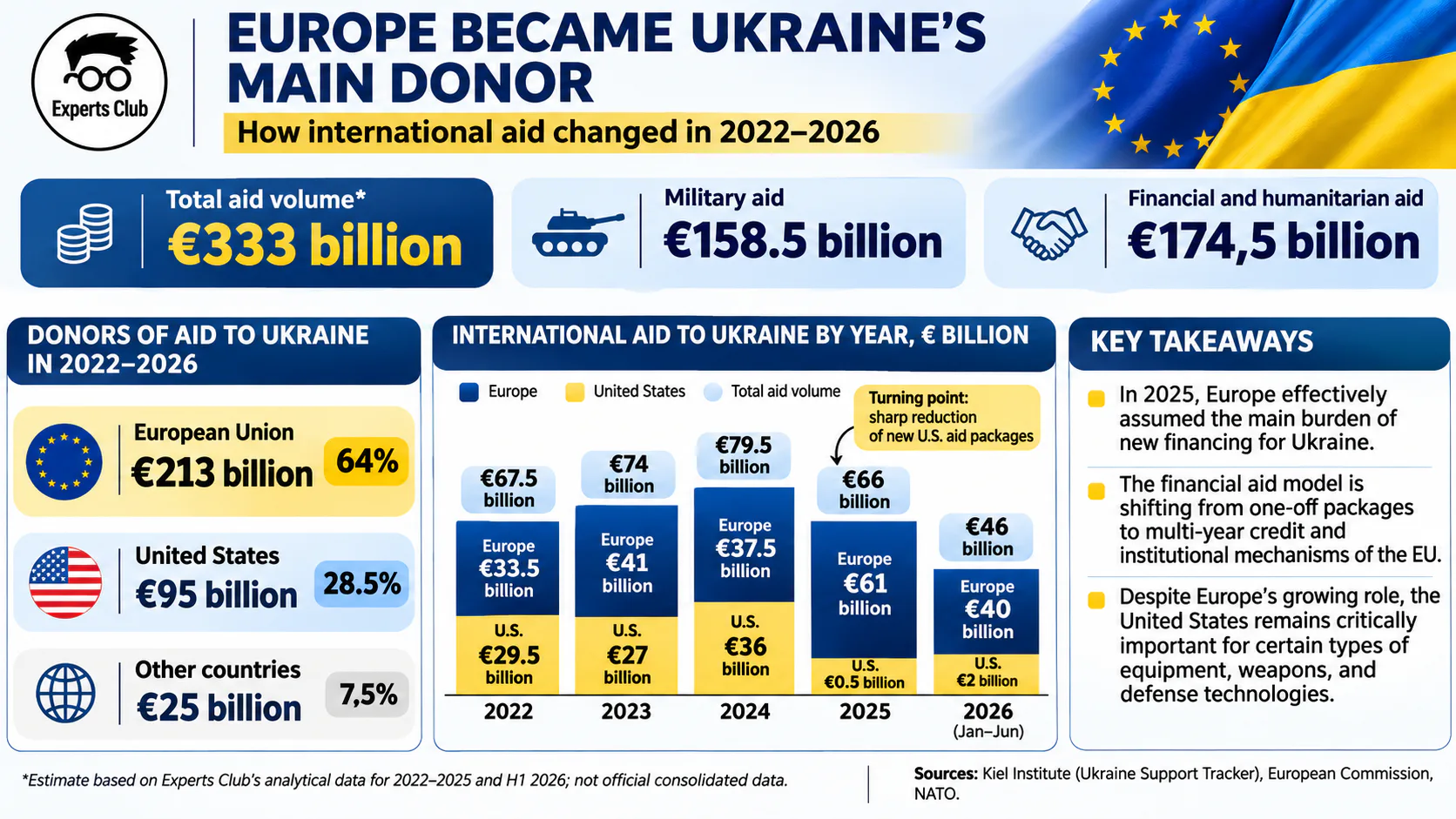
Independent research confirms the general direction of these changes, although its quantitative findings differ from those presented in the original infographic. In particular, a Kiel Institute study published on February 11, 2026, found that new European military aid allocations increased by 67% in 2025 compared with the annual average for 2022–2024, while financial and humanitarian assistance rose by 59%. According to the Ukraine Support Tracker methodology, new US military allocations declined to approximately €0.4 billion, while researchers recorded no new American financial or humanitarian allocations in 2025. Consequently, the main outcome of this transformation was not simply an increase in Europe's share, but a gradual transfer of responsibility for the long-term financing of the Ukrainian state and a substantial portion of its defense needs to European institutions and national budgets.
International Aid Dynamics: From US Military Leadership to European Financial Dominance
The first stage of international support for Ukraine emerged in 2022, when Russia's full-scale invasion created an urgent need to maintain the country's defense capabilities, stabilize public finances, and meet the basic needs of the civilian population simultaneously. The United States played a leading role in supplying weapons, ammunition, air defense systems, and specialized military equipment, while European countries and EU institutions actively expanded financial, humanitarian, and social assistance. For Europe, support for Ukraine was linked from the outset not only to foreign policy commitments but also to its own security, the stability of energy and food markets, and the need to accommodate millions of Ukrainian refugees. This established a model in which different groups of donors specialized in particular forms of assistance, although this division of responsibilities subsequently began to change.
The original infographic estimates total assistance in 2022 at €67.5 billion, including €32 billion in military aid and €35.5 billion in financial and humanitarian support. The American military component amounted to €17.5 billion, the European component to €13 billion, while other countries contributed approximately €1.5 billion. At the same time, Europe already exceeded the United States in financial and humanitarian assistance, with €20.5 billion compared with €12 billion. This distribution demonstrates that Europe's transition to financial leadership was not a sudden development in 2025 but a process that had been taking shape since the beginning of the war, when the EU started establishing mechanisms for regular budgetary support.
Period | Military aid | Financial and humanitarian aid | Europe, total | United States, total | All donors |
|---|
2022 | €32 billion | €35.5 billion | €33.5 billion | €29.5 billion | €67.5 billion |
2023 | €40 billion | €34 billion | €41 billion | €27 billion | €74 billion |
2024 | €35 billion | €44.5 billion | €37.5 billion | €36 billion | €79.5 billion |
2025 | €30.5 billion | €35.5 billion | €61 billion | €0.5 billion | €66 billion |
January–June 2026 | €21 billion | €25 billion | €40 billion | €2 billion | €46 billion |
Total | €158.5 billion | €174.5 billion | €213 billion | €95 billion | €333 billion |
Source: Experts Club arithmetic calculations based on the original infographic. Figures are rounded and do not constitute an officially verified consolidated statistical series. The 2026 figures cover only the first half of the year, while the category "Europe" is not fully defined in the original image's methodology.
In 2023, support for Ukraine gradually became more systematic as international partners began moving from individual emergency decisions toward regular financing programs. According to the original chart, total assistance increased to €74 billion, military aid reached €40 billion, and European military support slightly exceeded the American figure for the first time, at €20 billion compared with €19 billion. Financial and humanitarian assistance amounted to €34 billion, including €21 billion from European donors. These figures indicate a gradual convergence in the military contributions of the United States and Europe, although their respective roles remained different in terms of the technologies and equipment supplied.
The most important European financing instrument in 2023 was the €18 billion Macro-Financial Assistance Plus (MFA+) program, implemented by the European Union to provide predictable financing for Ukraine's state budget. The final installment was received in December 2023, with the funds used to maintain government functions, social services, and macroeconomic stability. For Ukraine's economy, the program's significance lay not only in the amount of financing but also in the regularity of disbursements, which enabled the Ministry of Finance to plan expenditures several months ahead. This experience became the foundation for the larger multi-year European mechanisms introduced in subsequent years.
In 2024, according to the original infographic, total international support for Ukraine reached €79.5 billion, the highest figure among the full calendar years from 2022 through 2025. Of this amount, €35 billion represented military aid and €44.5 billion financial and humanitarian assistance, with American and European donors maintaining broadly comparable overall contributions. In the military category, Europe provided €18 billion compared with €16 billion from the United States, while American financial and humanitarian assistance stood at €20 billion against €19.5 billion in European support. This configuration reflected a transitional period in which Washington remained one of the main sources of new aid packages, while the European Union was already building its own long-term financing architecture.
A strategic milestone was the launch of the Ukraine Facility in March 2024, providing a financial package of up to €50 billion for 2024–2027 through loans, grants, and investment instruments. Its distinctive feature was the link between budget disbursements and the implementation of agreed reforms aimed at modernizing public administration, developing the economy, and advancing Ukraine's European integration. At the same time, G7 countries agreed on the Extraordinary Revenue Acceleration (ERA) initiative, designed to mobilize approximately $50 billion in loan financing, with debt servicing linked to revenues generated by immobilized Russian sovereign assets. As a result, international support began shifting from predominantly direct budget grants and bilateral loans toward more complex financial arrangements involving European guarantees and revenues derived from Russian assets.
A fundamental turning point occurred in 2025, when the reduction in new American aid packages effectively forced European donors to reconsider the scale of their involvement. According to the original chart, European support increased from €37.5 billion in 2024 to €61 billion in 2025, or approximately 63%, while American assistance declined from €36 billion to €0.5 billion. Consequently, Europe's share of annual aid under this methodology exceeded 92%, although this proportion should not automatically be applied to other international statistical systems. Independent data from the Kiel Institute confirm the direction of the change but show that European compensation was uneven across types of assistance and individual donor countries.
According to the Ukraine Support Tracker, the 67% increase in new European military allocations in 2025 relative to the annual average for 2022–2024 was insufficient to fully preserve the overall volume of military assistance. Taking into account the sharp decline in American contributions, total new military allocations remained approximately 13% below the annual average for the preceding three years. In the financial and humanitarian category, the overall decline was smaller, at around 5%, reflecting European institutions' greater capacity to compensate for the reduction in US resources in budget financing. Therefore, Europe's success in replacing American assistance was most evident in the financial sphere, while securing certain critical categories of military equipment remained a considerably more complex challenge.
For Ukraine's state budget, this transformation means greater predictability of medium-term financing but also a concentration of risks within a relatively limited group of institutions. On the one hand, large European lending programs make it possible to develop financial plans covering several years, maintain social expenditures, and reduce the need for emergency decisions. On the other hand, political disagreements among EU member states, delays in reform implementation, or changes in borrowing conditions could simultaneously affect a substantial share of Ukraine's external financing. For this reason, the increase in Europe's overall commitments should be accompanied by diversification of funding sources and the maintenance of sufficient state budget liquidity reserves.
European Donors, the Defense Industry, and Continued Dependence on the United States
Europe's growing role has been accompanied by an important change in the structure of the donor system: budgetary assistance is increasingly concentrated at the EU institutional level, while military support remains largely dependent on decisions taken by individual governments. According to the Kiel Institute, the share of joint EU mechanisms in European financial and humanitarian allocations increased from approximately 50% in 2022 to almost 90% in 2025. At the EU level, this means a greater role for collective financing instruments that can distribute the burden among member states according to the size of their economies. However, a similar degree of centralization has not yet been achieved in military assistance, as deliveries continue to depend on national stockpiles, manufacturing contracts, and government policy decisions.
Germany remains the leading European national donor, combining substantial bilateral military commitments with contributions to the European Union's joint budgetary mechanisms. A European Parliament study based on Kiel Institute data as of June 30, 2026, identified the Netherlands and Denmark among the next largest European contributors. At the same time, Nordic and Baltic countries stand out for the high level of assistance provided relative to their GDP, demonstrating the considerable difference between absolute aid figures and the actual burden borne by a donor's economy. Objective comparisons between countries must take both indicators into account, since a smaller economy may provide less assistance in monetary terms while committing a significantly greater share of its resources.
According to the Kiel Institute, Northern Europe accounted for approximately one-third of new European military allocations in 2025, despite representing only around 8% of the combined GDP of the 31 European donors covered by the Tracker. Meanwhile, Western European countries provided approximately 62% of Europe's military assistance, while Southern Europe's share remained comparatively small. Such concentration creates a risk of an uneven distribution of costs and dependence on the political positions of a few countries with the largest defense budgets. Unless the burden is distributed more widely, the long-term sustainability of European military assistance will increasingly depend on the fiscal capacity and industrial decisions of a relatively narrow group of states.
Outside the European Union, the United Kingdom, Canada, Japan, and Norway remain important partners for Ukraine, although their contributions differ substantially in structure. According to the European Parliamentary Research Service, by the end of June 2026, Canada's total allocated bilateral assistance was estimated at approximately €14.3 billion, Japan's at €12.2 billion, and Norway's at €11.2 billion, while the United Kingdom retained its position as one of Ukraine's principal military partners. Japan is particularly important for budget financing, infrastructure reconstruction, and economic assistance, while Norway uses multi-year government programs to finance defense and civilian requirements. These differences mean that donor rankings based on total amounts do not always reflect each country's practical contribution to Ukraine's specific needs.
Another important factor is the technological dependence of Europe and Ukraine on the American defense industry. This primarily concerns certain air defense systems, interceptor missiles, ammunition, and specialized equipment for which European manufacturers cannot always provide suitable alternatives in the required quantities. Consequently, increasing European defense budgets does not automatically guarantee rapid growth in actual deliveries, since production cycles, component availability, and contract execution may require considerable time. For Ukraine, it is critically important that new European financing decisions be accompanied by realistic schedules for manufacturing, procurement, and equipment deliveries.
One mechanism combining European financing with American industrial capacity is the Prioritised Ukraine Requirements List (PURL), which allows partners to purchase urgently needed US-made military equipment for Ukraine. As of June 2026, NATO reported that allies had committed to financing more than $6 billion worth of American military equipment through this mechanism. In a statement dated November 17, 2026, NATO Secretary General Mark Rutte reported that combined commitments under PURL and US Foreign Military Sales for Ukraine had exceeded $10 billion. These figures refer to different dates and somewhat different financing categories, so they should not be directly compared as if they represented a single unchanged statistical series.
Under PURL, European and other partner countries provide financing, while some of the equipment comes from American military stockpiles or is manufactured by US companies. This means that the reduction in Washington's new direct budgetary assistance does not equate to an end to the American defense industry's involvement in supporting Ukraine. According to the Kiel Institute, European donors purchased at least €3 billion worth of military assistance from US defense companies during the first half of 2026, representing approximately 30% of European military allocations made through industrial procurement. Thus, Europe's financial leadership coexists with substantial transatlantic industrial interdependence that cannot be overcome quickly simply by increasing budget appropriations.
At the same time, the transition toward larger-scale defense procurement creates opportunities to expand domestic production in Ukraine and EU countries. Particularly promising areas include joint production of unmanned systems, ammunition, electronic warfare equipment, certain air defense components, and dual-use technologies. From an economic perspective, investment in manufacturing capacity differs from a one-time purchase of finished products because it can generate long-term technological expertise, new jobs, and export potential after the war. However, achieving these benefits requires multi-year orders, intellectual property protection, stable supply chains, and sufficient predictability in government procurement.
International Assistance in 2026: New Loans, Budget Revenues, and Methodological Differences
The first six months of 2026 marked a transition from individual emergency aid packages toward the implementation of the European Union's large-scale Ukraine Support Loan mechanism. According to the original infographic, total international assistance in January–June amounted to €46 billion, including €40 billion attributed to Europe, €2 billion to the United States, and €4 billion to other donors. The military component was estimated at €21 billion, while financial and humanitarian assistance amounted to €25 billion. However, these figures require particularly cautious interpretation because of possible differences in how multi-year commitments, resource allocation dates, and actual financial transfers are recorded.
In its Ukraine Support Tracker update published on August 13, 2026, the Kiel Institute reported a significant increase in European allocations during May and June following the launch of the Ukraine Support Loan. Over those two months, European institutions allocated nearly €11 billion, including €4.3 billion in military assistance and €6.7 billion in financial and humanitarian support. At the same time, according to the Institute's methodology, average monthly financial and humanitarian allocations in the first half of 2026 were 41% lower than in 2025. This result cannot be mechanically reconciled with the original infographic without access to its underlying data, so the €25 billion estimate should be treated only as a figure from that particular image rather than independently confirmed international statistics.
A fundamentally important development was the European Union's approval of the €90 billion Ukraine Support Loan for 2026–2027. Approximately €60 billion of the program is intended for defense procurement and the development of Ukraine's defense-industrial capacity, while €30 billion is allocated to budgetary support and macroeconomic stability. Decisions establishing the program's financing arrangements were adopted during the first half of 2026, and on April 23 the Council of the EU completed the key legislative procedures and provided for up to €45 billion to be made available in 2026. From an economic perspective, this represented the creation of a major new instrument that simultaneously supports defense, government operations, and Ukraine's capacity to meet its social obligations.
The first Ukraine Support Loan disbursements began in June 2026, when the European Commission transferred €3.2 billion in macro-financial assistance on June 25 and €3.9 billion for drone procurement on June 30. The program subsequently covered additional defense payments and budgetary financing, including €4.36 billion disbursed on November 5, 2026, of which €3.7 billion represented macro-financial assistance and €658 million the defense component. Certain payments are also made through the Ukraine Facility, which links part of the financing to the implementation of agreed reforms. This multi-layered structure complicates statistical accounting because new loan resources may be channeled through an existing program and appear in different announcements as financing under the relevant instruments.
On November 16, 2026, the Council of the European Union approved what was then the largest single payment to Ukraine under the Ukraine Facility, amounting to almost €8 billion. Approximately €5 billion of this amount is to be financed from Ukraine Support Loan resources available in 2026, while the decision followed Ukraine's fulfillment of more than 20 reform milestones under the Ukraine Plan. As of the date of the announcement, the decision concerned approval of a payment expected to be made subsequently, rather than confirmation that the entire amount had already reached Ukrainian government accounts. This distinction is essential for analyzing international assistance because financing decisions and the actual receipt of funds may fall into different reporting periods.
Equally important are the figures published by Ukraine's Ministry of Finance, which reflect actual budget revenues and government financing requirements. At the Ukraine Donor Platform meeting on November 10, 2026, Finance Minister Sergii Marchenko reported that Ukraine had received approximately $30 billion in international budgetary support since the beginning of the year, while another approximately $20 billion in agreed financing was expected before year-end. The sources of support included the EU, IMF, Japan, Canada, the United Kingdom, Sweden, Norway, the World Bank, the Council of Europe Development Bank, and the ERA mechanism. These figures describe state budget financing rather than the full value of military, financial, and humanitarian assistance, so they cannot be added to Ukraine Support Tracker totals or the figures shown in the original infographic.
Understanding Ukraine's financial resilience requires distinguishing not only the amount of resources agreed upon but also the schedule of their disbursement. A large loan covering two years cannot automatically be used to meet all current expenditures if its installments depend on specified conditions or the completion of procurement procedures. At the same time, defense funds directed to weapons manufacturers do not necessarily pass through the same budgetary channels as financing for social benefits or government institutions. Assessments of the state's solvency should therefore be based on forecasts of actual cash flows rather than solely on the total nominal value of international aid packages.
Another important issue concerns the growing share of credit instruments in European assistance. According to the European Parliamentary Research Service, approximately 86% of the financial assistance provided to Ukraine by EU institutions within the relevant statistical coverage consisted of loans, including borrowing under the ERA initiative. A substantial share of these loans is provided on highly concessional terms, featuring long repayment grace periods, interest subsidies, or special servicing arrangements funded by income generated from immobilized Russian assets. Nevertheless, a loan is economically different from a grant, and assessments of future debt sustainability must consider not only the resources received but also the legal repayment conditions, maturities, and sources of debt servicing.
Ukraine gains an important advantage from the transition toward predictable European lending programs, as these can reduce the need for short-term emergency financing and support the stability of government expenditure. At the same time, compliance with structural reforms, anti-corruption requirements, public procurement rules, and other conditions linked to disbursements becomes increasingly significant. Delays in implementing agreed measures may postpone installments even when partners remain committed to the overall financing programs. Consequently, the ability of government institutions to fulfill program requirements on time becomes a factor in macroeconomic security, alongside the overall level of international political support.
Why Announced Aid Does Not Equal Resources Actually Received
One of the most significant problems in international statistics on assistance to Ukraine is the difference between political pledges, legally established commitments, budget appropriations, and resources actually transferred. Different governments and research organizations may record the same program at different stages of its implementation, leading to substantial discrepancies in aggregate estimates. For example, announced multi-year financing may be fully included in commitment statistics even though its actual disbursement will continue over several subsequent years. Without distinguishing between these stages, international donor rankings may create a misleading picture of both Ukraine's current financial resources and the real contributions of individual donors.
Military assistance covers a broad range of activities, including direct transfers of weapons from stockpiles, procurement of new equipment, ammunition production financing, military training, maintenance, and logistical support. The monetary valuation of such assistance depends on whether equipment is assessed using its historical book value, replacement cost, contractual price for new items, or a specific national methodology. Consequently, deliveries of physically similar equipment may have different nominal values in international statistics. When assessing defense capabilities, it is important to compare not only the monetary value of deliveries but also the actual quantity, technical condition, delivery schedule, and availability of resources required for subsequent operation.
Financial assistance also includes instruments with different economic characteristics, such as grants, budget loans, guarantees, macro-financial programs, international bank financing, and resources distributed through special EU mechanisms. Not all of these instruments directly increase the cash balances available to the government, because some funds may be directed toward procurement, investment projects, risk guarantees, or servicing previously established liabilities. Humanitarian assistance, meanwhile, may be provided as goods, services, medical equipment, food, and support for people affected by the war. Therefore, the total value of international assistance is a much broader indicator than the volume of foreign currency transferred to Ukraine's state budget.
A separate category consists of European countries' expenditures on Ukrainian refugees residing outside Ukraine. These expenses have considerable social and humanitarian significance, but they are mostly incurred within the countries hosting displaced people and do not constitute direct resource transfers to the Ukrainian state. Depending on the methodology, they may be included in broader government estimates of support for Ukraine or recorded separately from bilateral assistance. This distinction frequently explains major differences between official political announcements and independent research databases.
Germany provides a particularly revealing example, as its government reported approximately €100 billion in cumulative support for Ukraine in 2026, including assistance already provided and future commitments. In a study published on October 8, 2026, the Kiel Institute found that approximately €35.9 billion of this amount primarily consisted of expenditures within Germany, including support for Ukrainian refugees, while another €22 billion represented future military aid commitments. Researchers classified approximately €41.7 billion as bilateral assistance to Ukraine that had already been provided or budgeted for current periods, distinguishing it from domestic expenditures and future pledges. This example does not diminish the importance of German support, but it demonstrates how strongly international comparisons depend on the definition of assistance itself.
To establish an objective assessment framework, Experts Club proposes using at least four successive stages: politically announced support, legally established commitments, budgetary or contractual allocation of resources, and the actual transfer of money or equipment. Non-repayable grants, concessional loans, defense deliveries, and donors' domestic expenditures should also be distinguished. Such an approach would help prevent double counting, particularly where resources from a single European lending mechanism are simultaneously reflected in the reporting of several programs. It would also clarify which assistance volumes are already available to Ukraine and which remain dependent on future decisions, compliance with conditions, or suppliers' manufacturing capacity.
From an economic perspective, this methodological distinction directly affects assessments of Ukraine's external financial resilience. A large volume of long-term commitments from partners reduces strategic uncertainty but does not eliminate temporary cash-flow gaps if disbursements arrive unevenly. Similarly, announced defense contracts may strengthen future defense capabilities without addressing an immediate need for specific military equipment. International assistance should therefore be analyzed across three dimensions simultaneously: the total value of commitments, the schedule of their actual implementation, and their practical effects on Ukraine's economy and defense capabilities.
Financing for 2027: An Additional €45 Billion Proposed by the European Commission and Budget Deficit Risks
Ukraine's preparations for 2027 are taking place amid continued high external financing requirements driven by the duration of the war, defense expenditure, and the need to maintain government operations. Under the IMF's baseline scenario, which assumes that the full-scale war continues throughout 2027, Ukraine's external budget financing requirement amounts to $52.6 billion. According to a Ministry of Finance statement dated November 10, 2026, approximately $32.6 billion of this amount had not yet been covered by confirmed financing sources at that time. This means that even with large-scale European programs in place, the timely closure of the financing gap remains one of the principal risks to economic stability.
On November 18, 2026, the European Commission presented legislative proposals to provide Ukraine with up to €45 billion in additional financial support in 2027. Under the proposal, up to €25 billion could be allocated to military requirements and up to €20 billion to general budgetary support, with financing structured as a limited-recourse loan. Under the proposed arrangement, Ukraine would be required to repay the principal only after receiving reparations from Russia, which makes the instrument substantially different from ordinary market borrowing. However, as of November 19, this remained a European Commission proposal requiring further consideration and approval under the European Union's legislative procedures.
The new package is intended to supplement the previously agreed €90 billion Ukraine Support Loan for 2026–2027, of which €45 billion is scheduled to be available in 2027. Consequently, if the additional initiative receives final approval, the combined nominal value of the two European mechanisms available for 2027 could reach €90 billion. However, this amount cannot be treated as unconditionally guaranteed cash receipts within a single calendar year, since some resources are intended for defense procurement, others for budgetary financing, and actual payments depend on procedures and agreed conditions. It is also necessary to avoid double counting funds implemented through the Ukraine Facility and other existing instruments.
The European Commission estimates Ukraine's additional financing gap for 2027 at approximately €70 billion and proposes covering around two-thirds of this requirement through the new package. This estimate differs from the $52.6 billion figure presented by Ukraine's Ministry of Finance primarily because of differences in the scope of financing needs: the Ukrainian budget estimate focuses on external financing for government expenditure, while the European assessment covers broader defense and economic support requirements. Directly comparing these figures without considering their composition could therefore create a misleading impression of either a financing surplus or shortage. A comprehensive forecast requires separate comparisons of budgetary, defense, and investment components, together with their respective implementation schedules.
An important feature of the European Commission's new initiative is its intention to attract additional partners and expand financing mechanisms involving income generated from immobilized Russian sovereign assets. The proposed changes also provide for additional lending through European instruments backed by guarantees from certain third countries. For Ukraine, this creates an opportunity to diversify financing sources without transferring the entire corresponding burden to its own budget. However, the legal and political complexity of mechanisms associated with Russian assets requires a separate assessment of their stability, practical applicability, and potential implementation delays.
According to Experts Club, the most significant risk in 2027 may not necessarily be an insufficient aggregate volume of announced aid packages, but a possible gap between the political approval of programs and their actual implementation schedules. Even with multi-year loan commitments in place, the state budget must finance social benefits, education, healthcare, public administration, and other requirements according to a defined timetable. Delayed disbursements could require temporary mobilization of domestic resources, changes in expenditure priorities, or short-term liquidity management measures. Ukraine's financial strategy should therefore include not only a baseline scenario of timely aid receipts but also stress scenarios involving delays in one or more major installments.
Another constraint is the high concentration of financing within the European Union, where decisions depend on complex political and budgetary procedures. Although institutionalizing assistance increases long-term predictability, agreement on new mechanisms may require compromises among member states regarding guarantees, debt obligations, and conditions for the use of funds. For Ukraine, this means maintaining continuous diplomatic and technical engagement with European institutions, along with timely implementation of reforms linked to budget support. The quality of public administration and the predictability of legislative changes therefore have a direct influence on access to external financial resources.
Economic Consequences of the New Aid Model and Experts Club Forecasts
The transition toward a European financing model offers Ukraine several strategic advantages, primarily related to the scale of available resources and the possibility of long-term budget planning. Multi-year programs help reduce uncertainty surrounding the financing of government functions, support macroeconomic stability, and enable more consistent reconstruction policies. Unlike individual bilateral aid packages, these mechanisms can combine direct budget support, investment guarantees, reform programs, and defense procurement. However, their maximum impact can be achieved only if financing decisions are aligned with the actual capacity of Ukrainian government institutions and businesses to use the resources effectively.
A second important consequence is Ukraine's gradual integration into the European economic and defense-industrial system. Large-scale arms procurement, support for Ukrainian manufacturers, and joint investment projects can create long-term production relationships between Ukrainian and European companies. This is particularly important as part of international military assistance shifts from the transfer of finished equipment toward financing new production. Under favorable conditions, this model can support technological modernization, employment growth, and the development of new industrial export sectors.
The third economic effect is the increasing importance of institutional reforms in international financing. Support provided through the Ukraine Facility and other European mechanisms is becoming more closely linked to judicial reform, anti-corruption policy, public administration, financial markets, and the alignment of legislation with EU standards. For Ukraine, this creates additional incentives for institutional modernization but also means that delays in domestic reforms can translate into financial risks. As a result, the country's economic resilience increasingly depends on effective coordination among the government, parliament, international partners, and the institutions responsible for implementing financing programs.
Alongside these advantages, the new model has several limitations, including the growing proportion of loans, political dependence on European decisions, and the incomplete replacement of American defense technologies. Even highly concessional loans require legal management of debt obligations and monitoring of repayment conditions, particularly if the international political environment changes. Concentrated financing also makes Ukraine more sensitive to potential changes in the budget policies of major EU member states or delays in approving joint programs. Consequently, a long-term strategy should combine European integration with the maintenance of a broader donor coalition, including the United States, the United Kingdom, Canada, Japan, and international financial institutions.
According to Experts Club, developments in international assistance in 2027 will depend primarily on the European Union's ability to ensure timely disbursements under already agreed programs and complete the legislative approval of the additional €45 billion package. If these decisions are implemented according to schedule, Ukraine will be able to plan budgetary expenditures and part of its defense procurement over a longer period. However, if new programs are delayed or payments depend on conditions that have not yet been fulfilled, the need for additional short-term financing solutions will increase. In that situation, the nominal value of international commitments may remain substantial while their practical contribution to budget stability is significantly reduced.
A second determining factor will remain US policy and American involvement in supplying Ukraine with critical military equipment. Even with limited direct budgetary support, the American defense industry retains considerable influence through PURL, military sales, and the execution of orders placed by allied countries. Potential changes in export licenses, production schedules, or political procurement conditions may therefore directly affect Ukraine's defense capabilities. European countries will simultaneously seek to expand their own manufacturing capacity, but technological substitution of certain American systems will require time, investment, and long-term industrial planning.
The third factor will be the development of joint arms production in Ukraine and Europe, which could gradually change the structure of defense assistance. Some resources previously used to purchase finished products may be redirected toward new facilities, modernization of existing production, localization of components, and technology development. The fourth factor will be the practical use of income generated by immobilized Russian assets and the possibility of establishing additional mechanisms to secure international loans. The fifth will be the condition of Ukraine's domestic economy, particularly the duration of the war, the scale of damage to energy infrastructure, tax revenues, export capacity, and state budget requirements.
Under the baseline scenario, regular international aid receipts would allow Ukraine to maintain government operations, finance priority civilian expenditures, and plan some defense procurement several years ahead. In a scenario involving delays in external financing, the need to revise budget priorities quickly, expand domestic resource mobilization, and strengthen coordination with international financial institutions would increase. Under a negative scenario combining delayed European decisions, restrictions on American military supplies, and deterioration in domestic economic conditions, financial pressure on the state budget could rise significantly. The likelihood of each scenario will depend not only on the scale of international political announcements but also on the actual timing of financing approvals and the execution of defense contracts.
To evaluate the effectiveness of international assistance, Experts Club proposes using a comprehensive set of indicators covering financial, defense, and economic dimensions. These should include the volume of budget funds actually received, the proportion of grants and loans, the timeliness of installments, the quantity and value of delivered military equipment, the execution of manufacturing contracts, and the impact of international financing on macroeconomic stability. It is equally important to assess how much assistance is directed toward creating long-term economic opportunities, including investment in the defense industry, infrastructure reconstruction, and the development of Ukrainian technologies. Such an approach would make it possible to move beyond formal comparisons of international aid amounts toward an assessment of their real effectiveness for the country.
Experts Club Conclusions
Between 2022 and 2026, the international assistance system for Ukraine evolved from emergency support with substantial American involvement to a model in which European countries and European Union institutions play the central financial role. The most significant turning point occurred in 2025, when Europe substantially increased new military, financial, and humanitarian allocations against the backdrop of a sharp reduction in corresponding American aid packages. At the same time, comparisons between different statistical systems demonstrate that aggregate announced amounts do not always correspond to resources actually provided, while changes in donor composition must be assessed separately for budget financing, defense procurement, and humanitarian assistance. Only by distinguishing these categories is it possible to determine objectively how effectively international support covers Ukraine's current and future needs.
Europe's growing financial leadership does not mean that the United States has been completely replaced, since American manufacturers retain important positions in the supply of certain weapons systems, ammunition, and critical military equipment. At the same time, the importance of multi-year lending programs, joint defense procurement, and mechanisms using revenues from immobilized Russian assets will continue to increase. For Ukraine, this creates opportunities to stabilize external financing, strengthen integration with the European economy, and expand its own manufacturing capacity. However, these advantages will be accompanied by risks arising from donor concentration, payment delays, and dependence on partners' political and institutional decisions.
According to Experts Club, the principal criterion for evaluating the effectiveness of international support for Ukraine in 2027 should not be the nominal size of announced aid packages, but the ability of partners to ensure timely financing, contract execution, and actual deliveries of military equipment. Equally important will be the transformation of part of this international financing into long-term economic resilience through industrial development, infrastructure reconstruction, and improvements in public administration. Under these conditions, international assistance will remain not only a mechanism for covering current budget deficits and defense requirements but also one of the key instruments of structural transformation in Ukraine's economy. Future results will be determined by the combination of allies' financial resources, their political willingness, defense-industrial capacity, and Ukraine's ability to use the resources received effectively.
Methodology and Sources. The study was prepared as of November 19, 2026. Figures from the original comparative infographic are presented separately from statistics published by independent international organizations because its underlying methodology, full list of donors, and rules for recording commitments have not been established. The analysis distinguishes political pledges, new allocations, multi-year lending programs, actual budget receipts, and military deliveries, while also accounting for differences in reporting periods and classifications of assistance.
Main open sources: Kiel Institute — Ukraine Support Tracker; Kiel Institute — 2025 Results, February 11, 2026; Kiel Institute — First-Half 2026 Review; Kiel Institute — Analysis of German Assistance, October 8, 2026; European Commission — Ukraine Support Loan; Council of the EU — Decision of November 16, 2026; European Commission — Proposal for an Additional €45 Billion in 2027; Ministry of Finance of Ukraine — Donor Platform Meeting, November 10, 2026; NATO — International Military Procurement, November 17, 2026; European Parliamentary Research Service — State of Play: EU Support to Ukraine.