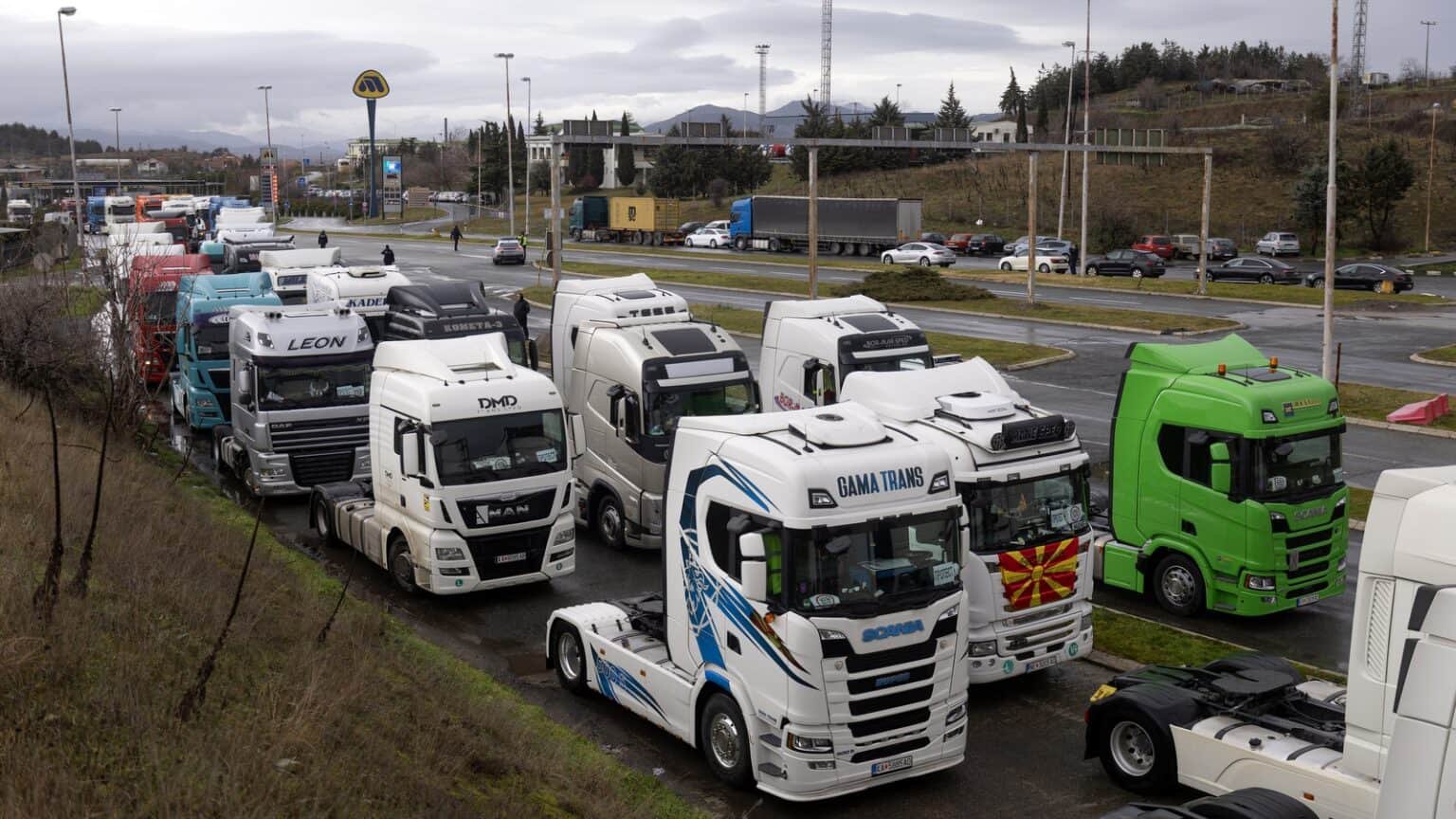
As reported by the Serbian business publication Parametar, the transport companies of Serbia, Bosnia and Herzegovina, Montenegro and North Macedonia require the European Union to propose a concrete solution to the problem of limiting the stay of professional drivers in the Schengen area by September 1, 2026. Otherwise, carriers are ready to hold coordinated protests again and block cargo terminals at the borders with the EU.
The decision was agreed upon by representatives of transport associations of the four countries at a regional meeting in Skopje. At the same time, September 1 is not automatically the start date of the blockade. The carriers intend to wait for the negotiations with the European Commission and the discussion of the new EU visa strategy, after which they will decide on further actions.
The main claim of the carriers is related to the 90/180 rule. Visa-free third-country nationals may stay in the Schengen area for a maximum of 90 days in any 180-day period. This restriction also applies to professional drivers from the countries of the Western Balkans.
Carriers consider this approach wrong, because drivers do not come to the EU as tourists, but regularly cross the border during international cargo delivery and return to their countries after flights.
“Our drivers leave every two, three or five days, depending on the route, and then return. They do not want to leave their countries, they want to work in our companies. But 90 days is not enough for professional work," said the president of the Serbian Association of International Carriers, Nejo Mandić.
According to regional transport organizations, the problem affects about 100,000 professional drivers in four countries. Tighter control over compliance with the limit became especially noticeable after the introduction of the European electronic Entry/Exit System (EES), which automatically registers the entry and exit of citizens of third countries.
The threat to carriers already has a precedent. At the end of January 2026, drivers from Serbia, Bosnia and Herzegovina, Montenegro and North Macedonia simultaneously blocked more than 20 cargo crossings in the direction of the Schengen zone. The borders of Serbia and Bosnia and Herzegovina with Croatia, North Macedonia with Greece and Bulgaria, as well as the port of Bar in Montenegro were blocked.
The economic effect was significant. The president of the Chamber of Commerce and Industry of Serbia, Marko Chadezh, estimated at the time that the blockade affected about 93% of the exports of the four countries, and the combined losses amounted to about 92 million euros per day.
Individual enterprises due to non-fulfillment of contractual obligations faced, according to his estimation, fines and losses in the amount of 10-50 thousand euros per day per company. Moreover, problems arose not only among Balkan producers - European companies with factories, suppliers and buyers in the region also suffered from the delays.
If a new regional blockade takes place on a similar scale, economic losses could again amount to tens of millions of euros every day.
For Serbia, the most vulnerable industry is oriented towards European production chains. Automotive components, electrical equipment, rubber engineering products, metal products, food products and other goods are often transported by road transport according to a schedule and must reach the customer at a strictly defined time.
Even a short stoppage of traffic means the accumulation of goods in warehouses, disruption of production cycles and the risk of fines from European buyers.
A long blockade is especially dangerous for manufacturers of perishable goods. During the January protests, carriers reported that Lidl alone planned to deliver around 120 truckloads of meat, dairy products, fruit and vegetables from Europe to Serbia in one week. The traffic jam directly threatened these deliveries.
The trucking companies themselves suffer a double loss: the idle truck continues to generate leasing costs, driver wages, insurance and other payments, but does not generate revenue. Associations also warn that the inability to fully use drivers on EU routes may lead to the loss of contracts in favor of carriers from EU countries.
Economic damage will not be limited to the Western Balkans. A significant part of the enterprises of Serbia, North Macedonia and Bosnia and Herzegovina are integrated directly into the production chains of EU companies.
The delay in the supply of components may affect factories in Germany, Italy, Austria, Slovenia, Hungary and other countries. The return flow of European goods to the Balkans is also coming to a halt.
In addition, an important land transport corridor between Central Europe, Turkey and further into the Middle East passes through Serbia and North Macedonia. During the January protests, Reuters noted that the blockade disrupted traffic along this strategic route.
Even after the January protests, the European Commission recognized that the established regime creates problems for highly mobile professions, including international drivers, artists and athletes. The new EU visa strategy, adopted in January, provides for the possibility of finding a more flexible mechanism for such categories of workers.
However, the automatic exclusion of professional drivers from the 90/180 rule has not yet been implemented.
Carriers are pushing for either a special status for international drivers or a mechanism for professional visas or other authorization that would allow them to stay in the Schengen area for more than 90 days without risk of detention, deportation or entry ban.
Thus, September 1 becomes a key date for the transport market of the Western Balkans. If Brussels offers a working mechanism for professional drivers, a new blockade can be avoided. If an agreement cannot be reached, the carriers of the four countries have already agreed on the possibility of a joint action.
The problem of limiting the stay of professional drivers in the Schengen area also affects Ukraine.
Ukrainian truck drivers who work for carriers registered in Ukraine, when entering Schengen visa-free, are also usually subject to the rule of 90 days within a 180-day period, unless they have a separate long-term status or residence permit. In its visa strategy of January 29, 2026, the European Commission directly recognized that the current system creates problems for mobile professions, separately mentioning truck drivers who serve EU business.
At the same time, the EU-Ukraine agreement on road transport, valid until March 31, 2027, simplifies the access of Ukrainian carriers to the EU market and eliminates the need for a number of permits for bilateral and transit transport, but in itself is not an exception to Schengen migration rules.
Therefore, Ukraine is objectively interested in the same decision demanded by the carriers of the Western Balkans: to separate the working time of a professional driver on an international flight from the usual tourist stay or to create a special regime for such drivers.