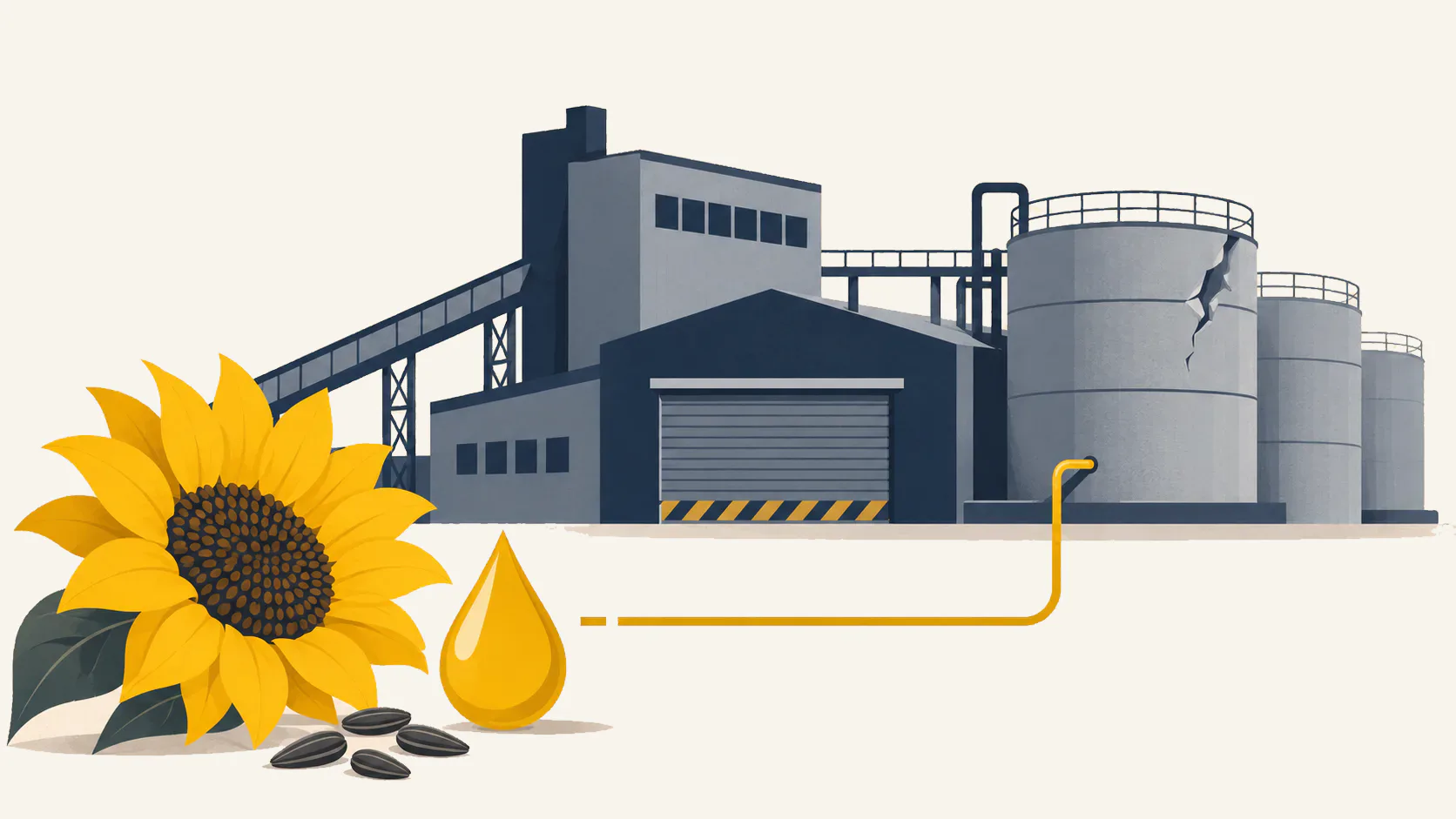
Massive Russian attacks on Ukrainian industry in November 2026 led to the shutdown of a number of major oilseed processing enterprises. The agricultural holding Kernel, Delta Wilmar Ukraine, Potoky, the Nizhyn Fat Plant, and food producer Korolivskyi Smak announced the suspension of production.
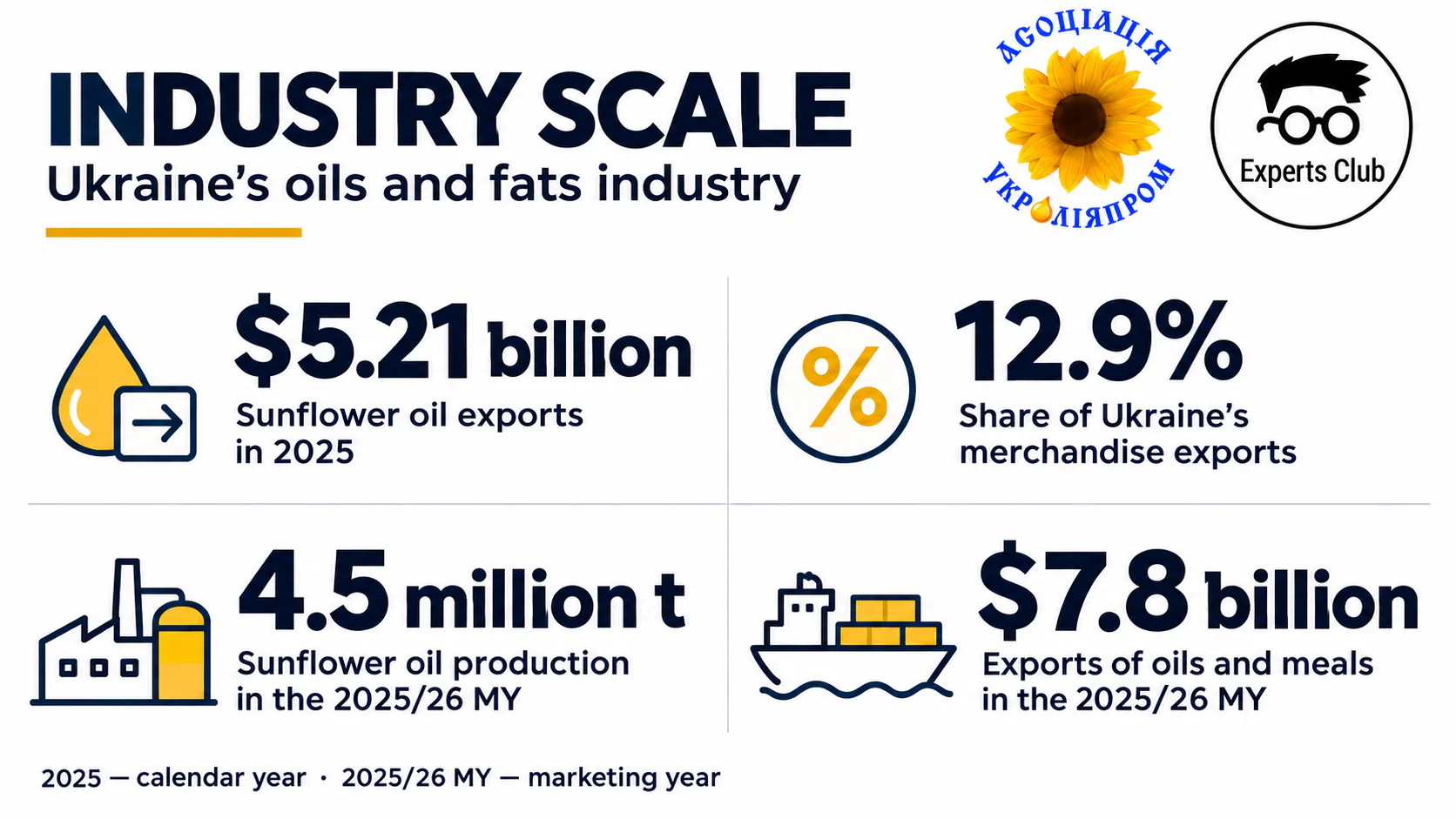
These developments create a risk of a reduction in one of Ukraine’s largest sources of foreign currency earnings. In 2025, sunflower oil exports brought the country $5.21 billion, or about 12.9% of total merchandise exports. Sunflower oil accounted for approximately 23% of the value of agricultural exports.
The corresponding figures are confirmed by State Customs Service data published on the government’s export support portal. According to the Ministry of Economy, Ukraine’s total agricultural exports in 2025 amounted to $22.6 billion, while total merchandise exports amounted to $40.37 billion. These statistics demonstrate the scale of the threat: even a partial prolonged shutdown of processing enterprises could affect not only sunflower oil production but also purchase prices for farmers, the operation of transport infrastructure, export contracts, and the foreign exchange balance.
At the same time, the shutdowns announced by the enterprises differ in their causes and the extent of damage. There are currently no grounds to claim that Ukraine’s entire vegetable oil industry has ceased operating or that the country has already lost the corresponding share of exports.
Which enterprises have stopped production
The most extensive decision was that of Kernel, announced on November 12. The company introduced a complete technological shutdown of its oil extraction enterprises and halted purchases of sunflower seeds.
The agricultural holding owns eight oil extraction plants with a combined annual processing capacity of 3.5 million tonnes of seeds. However, two enterprises in the Kharkiv region, in Vovchansk and Prykolotne, have not operated since 2022 because of the war. Therefore, the holding’s total installed capacity cannot be equated with the capacity of the plants that were actually operating on the eve of the November attacks.
According to the company, Russian strikes damaged production buildings, equipment, and storage tanks. Kernel explained that the shutdown was necessary to protect personnel from the risk of fires and continues to ship products from existing stocks.
The situation has also affected other major producers.
Delta Wilmar Ukraine, part of the international Wilmar group, suspended operations at all its production facilities in the Odesa region from November 12. The reasons were threats to personnel safety and constant emergency power outages. The industry publication Latifundist confirmed information about the decision by the company’s management.
Potoky LLC, whose oil extraction plant is located in Dnipro, stopped purchasing and processing sunflower seeds from November 13. The enterprise cited power supply disruptions, security threats, and the need for restoration work following previous shelling. The plant produces oil, meal, and other sunflower processing products.
The Nizhyn Fat Plant in the Chernihiv region stopped production following a series of Russian strikes on November 10. The enterprise, which has operated since 1896, specializes in processing sunflower seeds, soybeans, and rapeseed. Its sunflower seed processing capacity is up to 1,200 tonnes per day.
The Korolivskyi Smak corporation, a producer of sunflower oil, mayonnaise, sauces, and other food products, also announced the forced suspension of production processes and purchases of oilseed crops on November 13. The company stated that it needed to reduce staff because of power supply problems and war-related risks.
The soybean processing industry was affected separately. An enterprise belonging to the Astarta agricultural holding was damaged in a Russian attack on November 8, after which the company suspended its operations. This extends the scale of the problem beyond sunflower processing itself.
In addition, in September 2026, the Oleina plant, owned by the international Bunge group, temporarily suspended operations following a Russian strike on Dnipro. However, the September shutdown should not be regarded as a new November decision without separate confirmation of the plant’s current status.
Thus, over the course of one week, at least six major participants in Ukraine’s oilseed processing market announced a shutdown or suspension of operations, including Astarta’s soybean processing enterprise. This does not mean that all plants in the industry have ceased operating: some enterprises continue to work, while individual companies are shipping previously manufactured products.
Sunflower oil accounts for almost 13% of Ukraine’s merchandise exports
The economic importance of the vegetable oil industry is determined not only by the scale of production but also by its strong export orientation.
According to a statement by the Ukroliyaprom association dated October 9, 2026, Ukrainian enterprises processed 10.2 million tonnes of sunflower seeds and produced 4.5 million tonnes of sunflower oil in the 2025/26 marketing year.
More than 4 million tonnes of products worth $5.3 billion were supplied to foreign markets. This means that approximately 90% of the sunflower oil produced was exported.
Total foreign currency revenues from exports of oils and meals produced from sunflower seeds, soybeans, and rapeseed in the 2025/26 marketing year amounted to $7.8 billion. Of this amount, vegetable oils accounted for $6.5 billion and meals for $1.3 billion.
Compared with the previous marketing year, the corresponding export revenues increased by 8.3%, or by more than $600 million.
These figures confirm that the oils and fats industry is one of the key sectors of Ukrainian manufacturing oriented toward international markets. Ukraine does not simply sell the sunflower seeds it grows. The vast majority of seeds are processed domestically into oil, meal, and other products. This generates demand for industrial equipment, energy resources, transport and logistics services, and creates jobs and tax revenues.
If processing is suspended for a prolonged period, some of these economic links may be lost. Even if farmers find an opportunity to export seeds directly, Ukraine will lose out on part of the added value created during industrial processing.
What contribution does the vegetable oil industry make to Ukraine’s GDP?
According to the State Statistics Service, Ukraine’s nominal GDP in 2025 amounted to UAH 8.93 trillion. The World Bank estimates it at approximately $214.23 billion.
In this comparison, annual exports of sunflower oil alone, worth $5.21 billion, correspond to approximately 2.4% of Ukraine’s nominal GDP.
However, this indicator cannot be regarded as the vegetable oil industry’s direct share of GDP.
Gross domestic product measures the added value created, whereas export revenues also include the cost of seeds, electricity, fuel, intermediate materials, and other expenses.
Accurately determining the contribution of vegetable oil production to GDP requires data on the gross value added of the relevant economic activity. The sources used do not contain a separate confirmed figure for 2025 that would allow sunflower processing specifically to be isolated.
At the same time, the industry’s macroeconomic significance extends beyond the activities of the oil extraction plants themselves. Their operations support economic activity in agriculture, freight transport, port infrastructure, wholesale trade, and related industries.
Therefore, the overall impact of a prolonged processing shutdown on the economy may be greater than the direct loss of added value at the plants. At the same time, the precise scale of this impact requires a separate interindustry calculation.
How much foreign currency revenue does Ukraine risk losing?
To assess the possible consequences, Experts Club considered hypothetical scenarios for a reduction in sunflower oil exports.
The calculation uses actual export revenues in 2025 as its baseline: $5.21 billion, or an average of approximately $434 million per month.
Potential monthly revenue at risk
Reduction in exports by 10% | $43 million |
|---|
Reduction in exports by 25% | $109 million |
Reduction in exports by 50% | $217 million |
A hypothetical calculation by Experts Club based on average monthly export revenues in 2025. This is not a forecast of actual losses.
If exports decline by 25% over three months, the amount of foreign currency revenue whose receipt would be at risk could reach approximately $326 million.
However, these figures do not mean the irreversible loss of all the corresponding funds. Exports may be temporarily supported by warehouse stocks, other enterprises may be able to provide part of the production, and delayed deliveries may be completed after operations resume.
Actual economic losses will depend on the duration of downtime, the extent of damage, opportunities for alternative processing, logistics, global prices, and the terms of export contracts.
It is also important that a reduction in oil exports may be accompanied by a decrease in meal shipments. This is a separate source of foreign currency income, as well as an important product for livestock farming.
Five main risks to the Ukrainian economy
The first risk is a reduction in foreign currency revenues. Sunflower oil remains one of Ukraine’s largest export commodity categories. Prolonged restrictions on its production could increase the merchandise trade deficit and reduce foreign currency inflows from exporters.
The second risk is a deterioration in farmers’ financial position. Major processors are the main buyers of sunflower seeds. When they stop purchasing, agricultural producers lose the ability to sell their harvest quickly. This could cause purchase prices to decline, storage costs to increase, and a shortage of working capital ahead of the next sowing campaign.
The third risk is a reduction in employment and tax revenues. A production shutdown reduces the workload of employees, contractors, transport operators, and service companies. Enterprises whose main activity is oil production become the most vulnerable.
The fourth risk is the loss of some international markets. If Ukrainian suppliers are unable to fulfill contracts on time, foreign buyers will seek alternative producers. After plants resume operations, winning back some customers may require additional expenditure and price concessions.
The fifth risk is a deterioration in the investment attractiveness of processing. Rising costs for security, backup power supply, insurance, restoration of damaged equipment, and inventory financing may reduce enterprises’ profitability and restrain investment in new production capacity.
A particular threat is posed by the simultaneous impact of several factors: physical damage to plants, unstable electricity supply, difficulties transporting products, and reduced purchases of raw materials.
In this situation, even enterprises that have not been directly affected by strikes may face liquidity and logistics problems.
Environmental consequences of attacks on enterprises
Environmental damage has become a separate problem. According to information from Ukraine’s Ministry of Economy and Environment dated November 13, a Russian strike on the Kernel agricultural holding’s Bandurskyi Oil Extraction Plant in the Mykolaiv region caused a sunflower oil spill and contaminated more than 3,500 square metres of land.
The attack on November 12 damaged four oil storage tanks, one of which was completely destroyed. Damage to the protective containment berm caused some of the product to spill beyond the production site.
As of midday on November 13, no direct entry of oil into a body of water had been recorded. Work was being carried out at the enterprise to pump out the product and construct additional earthen barriers.
Thus, the economic consequences of Russian strikes on the vegetable oil industry include not only damage to equipment and lost production but also the costs of cleaning up environmental contamination.
Does Ukraine face a sunflower oil shortage?
Despite the scale of the announced shutdowns, there are currently no grounds to speak of an inevitable shortage of sunflower oil on the domestic market. According to an estimate by the Ukroliyaprom association cited by the industry publication Latifundist on November 13, the annual needs of Ukraine’s domestic market amount to approximately 400,000–500,000 tonnes of sunflower oil.
This is less than 12% of production in the 2025/26 marketing year.
This balance indicates a substantial reserve of export-oriented production capacity. Even under conditions of a forced reduction in processing, supplying domestic consumers may remain possible thanks to existing stocks and the operation of enterprises that have not shut down.
However, the price situation will depend not only on the physical availability of products. Prices will be affected by the costs of electricity, logistics, packaging, storage, and the restoration of production.
Therefore, short-term disruptions will not necessarily lead to a shortage, but they may increase producers’ costs and create conditions for higher prices for finished products.
What measures are needed to stabilize the industry?
In Experts Club’s view, the immediate priority is to create conditions for the safe resumption of processing and the preservation of financial links between plants and agricultural enterprises.
Protecting production facilities, providing access to backup electricity supplies and working capital financing, accelerating restoration work, and maintaining stable export logistics will be of key importance.
Special attention is needed to support agricultural producers who may lose a significant portion of their current income because of the suspension of sunflower seed purchases. Access to credit during the period of harvest storage and preparation for the next production cycle is critical for them.
In the long term, it is important to prevent the Ukrainian economy from losing its oilseed processing capacity.
In the 2025/26 marketing year, almost all sunflower seeds grown in Ukraine were processed domestically. This is the result of the development of industrial infrastructure that makes it possible to export finished products instead of predominantly raw materials.
A large-scale shift toward seed exports because of prolonged plant downtime would mean weakening precisely the part of the agricultural economy that creates additional jobs, tax revenues, and export earnings.
The November shutdowns of enterprises in the oils and fats industry have become one of the most serious challenges facing Ukrainian agricultural processing in 2026. This is an industry that generates more than $5 billion annually from sunflower oil exports alone and accounts for a significant share of the agricultural sector’s foreign currency earnings.
If enterprises are able to resume operations after the security situation stabilizes, some of the negative consequences will be temporary.
However, if the shutdowns last for months, the consequences could spread to agricultural production, employment, international trade contracts, the financial stability of enterprises, and the pace of Ukraine’s economic recovery.
For Ukraine’s economy, it is important to preserve not only the ability to grow sunflower seeds but also the capacity to process them domestically. This is precisely what determines how much of the value of agricultural products the Ukrainian economy will receive.